
Critical Thinking Test for Adolescents
How the Scales are Structured
Who Usually Takes This Test?
See How You Compare
Below is a preview of how scores are typically distributed across each scale.
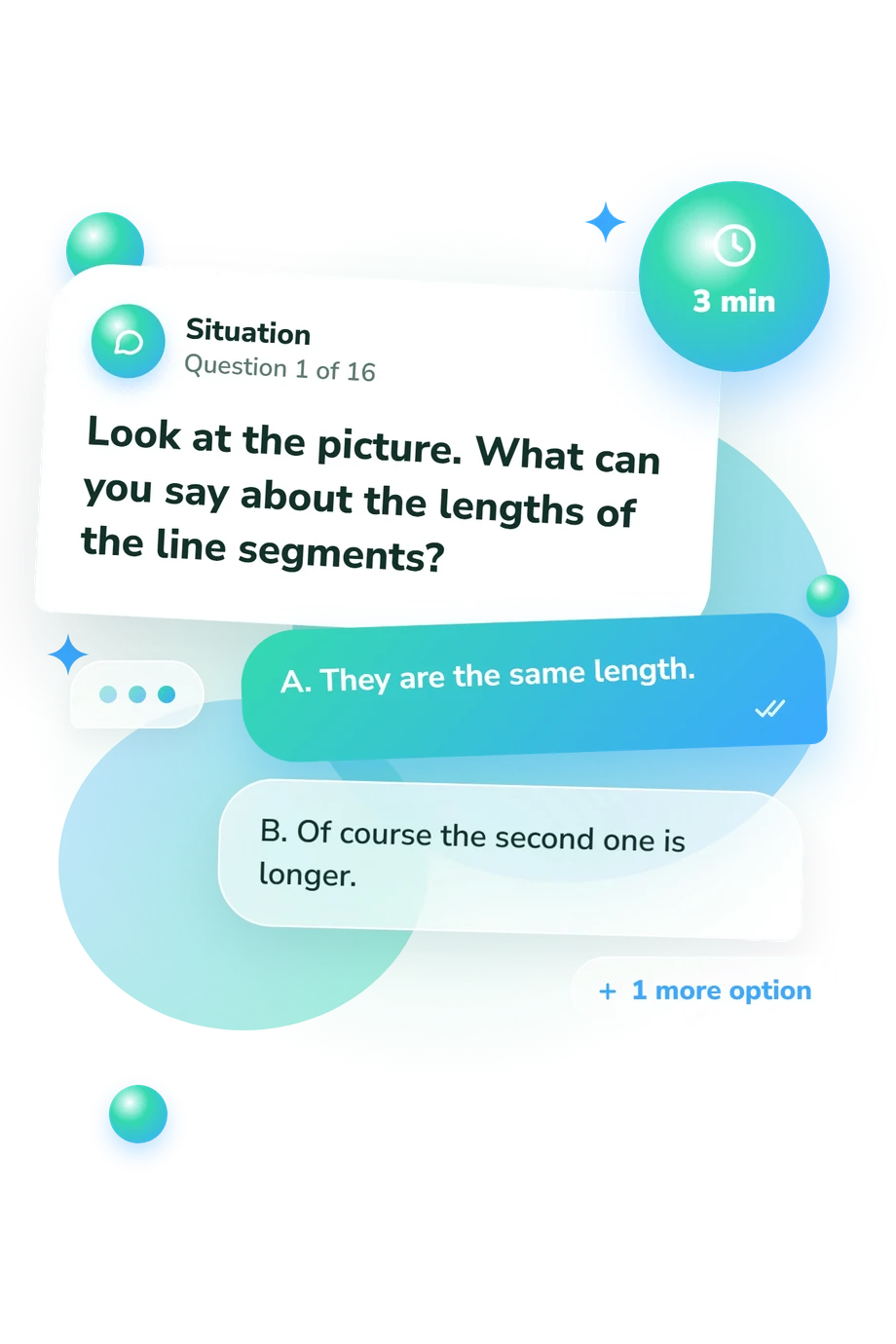
Example Questions From the Test
- A. They are the same length.
- B. Of course the second one is longer.
- B. The first one is still longer.
- To the right.
- To the left.
- How could you possibly tell?
- Heads and tails will alternate, starting with heads.
- Only heads will come up all 5 times.
- Only tails will come up all 5 times.
- All options could be equally likely.
Critical Thinking Test for Adolescents - Description and methodology of the test
People who want a clearer picture of how they reason through claims, uncertainty, and everyday decisions may find this critical thinking test useful. Intended for adolescents, the questionnaire asks respondents to compare alternatives, examine implications, and avoid confident guesses. By requiring those judgments across short tasks, it functions as a critical thinking assessment test of reasoning. The result can support self-reflection.
What This Assessment Explores
Visual and probability tasks, evidence checks, and deductions give this critical thinking quiz a varied reasoning focus. They ask adolescents to separate observation from assumption and choose conclusions supported by information.
These are the reasoning themes sampled by the questions:
- Visual judgment tests whether impressions are checked against evidence.
- Probability reasoning shows how uncertainty is handled.
- Argument evaluation identifies unsupported conclusions and generalizations.
- Logical reasoning examines categories, analogies, and deductions.
Together, these themes are summarized by one displayed Critical Thinking Level scale (0-16), which assesses critical-thinking development in adolescents; no separate scores are shown for individual themes. Higher scores indicate a greater capacity to analyze information, detect logical errors, and form well-founded conclusions, reflecting a tendency toward independent thinking and critical evaluation of incoming information. Results are Developing (0-8), Moderate (9-12), or Advanced (13-16).
Methodology and Evidence Base
The mixed-format forced-choice questionnaire combines visual and verbal reasoning tasks with hypothetical everyday scenarios. The visual tasks may require comparison, while verbal items use probability, analogy, and deduction. Each prompt offers several answer choices: some require a direct conclusion, while others ask what the respondent would do after checking evidence or recognizing insufficient information. This structure samples performance-style reasoning alongside judgment in ordinary situations.
Because its displayed score summarizes responses across the tasks, the questionnaire functions as a critical thinking skills assessment. That result indicates current reasoning performance; mood, self-presentation, and familiarity with puzzle-like tasks can influence answers.
The questionnaire is conceptually consistent with Nepryakhin and Paschenko (2020), whose work brings logical errors, evidence, assumptions, and ordinary decisions together; it is not an adaptation of their book. Facione (1990) reports a consensus framework covering interpretation, analysis, evaluation, inference, and explanation. Halpern (1998) supports viewing critical thinking as transferable skills involving dispositions and metacognitive monitoring.
Use the result as a snapshot of present reasoning and a prompt for reflection.
- Nepryakhin, Nikita, and Taras Paschenko. (2020). Critical Thinking: Iron Logic for Every Situation in Life. Moscow: Alpina Publisher, 192 pp. ISBN 978-5-9614-3001-1.
- Facione, Peter A. (1990). Critical Thinking: A Statement of Expert Consensus for Purposes of Educational Assessment and Instruction: Research Findings and Recommendations. American Philosophical Association, Committee on Pre-College Philosophy. ERIC Document ED315423.
- Halpern, Diane F. (1998). Teaching Critical Thinking for Transfer Across Domains: Dispositions, Skills, Structure Training, and Metacognitive Monitoring. American Psychologist, 53(4), 449-455. 10.1037/0003-066X.53.4.449
Updated: