
Emotional Intelligence Test
How the Scales are Structured
Who Usually Takes This Test?
See How You Compare
Below is a preview of how scores are typically distributed across each scale.
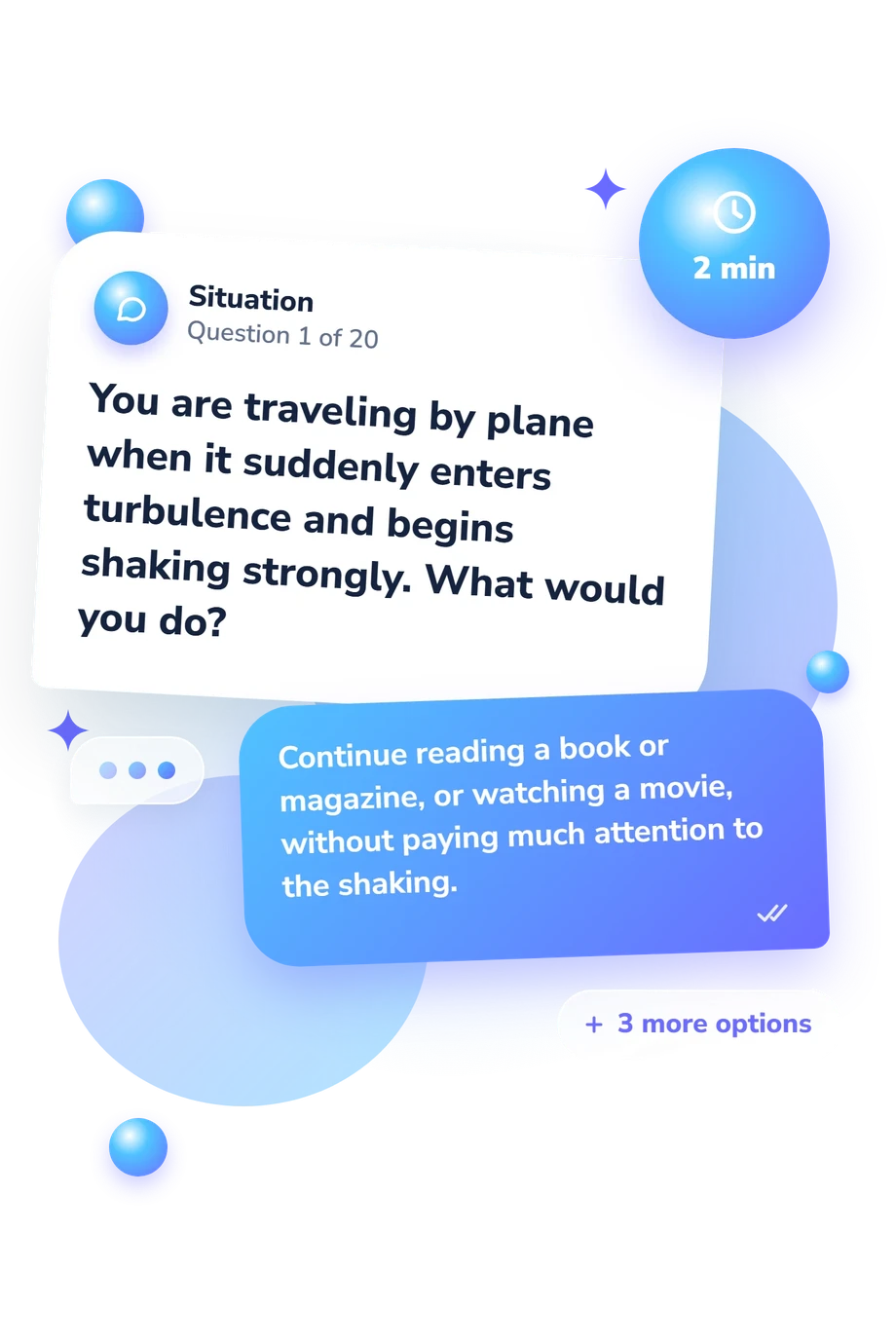
Example Questions From the Test
- Continue reading a book or magazine, or watching a movie, without paying much attention to the shaking.
- Focus, listen for flight attendant announcements, and read the safety instructions on what to do in an emergency.
- Some of both.
- Not sure; I have not paid attention.
- I would not intervene; I would let the children work it out themselves.
- I would talk with her and suggest how she could get the other children's attention.
- I would speak to her in a gentle voice and tell her to stop crying.
- I would try to distract her with other games.
- Develop a plan to improve your academic performance and follow it.
- Decide that in the future you should do better.
- Decide that what happened happened, and focus on other subjects to get higher grades.
- Go to the instructor and try to negotiate for a higher grade.
Emotional Intelligence Test - Description and methodology of the test
People who want a focused way to reflect on feelings, setbacks, conflict, and social demands may find the Emotional Intelligence Test useful. It is intended for anyone interested in practical self-reflection about reactions and relationships. The result offers an emotional intelligence assessment of recurring tendencies, including self-control, empathy, persistence, and social judgment, while leaving room for context and personal interpretation.
What This Assessment Explores
This questionnaire examines noticing feelings, managing impulses, responding to distress, and choosing actions under pressure. Its scenarios cover disappointment, rejection, anger, disagreement, teamwork, novelty, and practice, linking results to emotional habits.
Through emotionally charged situations, the emotional intelligence questionnaire samples regulation, empathy, and interaction during setbacks, social tension, or unfamiliar demands. It cannot explain a choice or predict behavior across settings.
The situations form three thematic groups:
- Emotional awareness and regulation show how the profile manages feelings before acting.
- Empathy and social responsiveness show how it reacts to distress, anger, or exclusion.
- Setbacks, teamwork, and novelty show persistence, cooperation, and flexibility.
One scale measures emotional understanding, regulation, and interaction with others. Emotional Intelligence Level (0-120) uses Developing (0-49), Functional (50-79), and Well-developed (80-120); higher scores indicate greater balance, sociability, responsiveness, and empathy.
Methodology and Scientific Basis
Each item is a short scenario with four response options, contrasting avoidance, impulsivity, support, reflection, persistence, or constructive intervention. The format samples judgment in context rather than vocabulary or direct trait ratings. Four-option scenarios let this emotional intelligence skills test sample practical judgment through self-report, so it works best when answers describe usual behavior rather than an idealized self-image.
The questionnaire reports a total on the displayed scale, but its item-level scoring key and normative basis are not specified. The resulting categories are descriptive levels within this questionnaire, not universal standards.
Its framework is conceptually consistent with Goleman’s emotional-intelligence framework, especially awareness, regulation, motivation, empathy, and social effectiveness. His later work extends these ideas to work, while the Mayer-Salovey-Caruso ability model distinguishes emotional-intelligence abilities from broader competencies. The choices also parallel Miller’s coping-under-impending-stress perspective; this questionnaire is not an adaptation of those published works.
Because it is brief and self-reported, results can shift with mood, experience, self-awareness, and the wish to appear favorable. Treat the profile as a reflection prompt alongside repeated behavior and context.
- Goleman, D. (1995). Emotional Intelligence: Why It Can Matter More Than IQ. New York: Bantam Books.
- Miller, S. M. (1979). Coping with Impending Stress: Psychophysiological and Cognitive Correlates of Choice. Psychophysiology, 16(6), 572-581. 10.1111/j.1469-8986.1979.tb01523.x.
- Goleman, D. (1998). Working with Emotional Intelligence. New York: Bantam Books.
- Mayer, J. D., Salovey, P., & Caruso, D. R. (2004). Emotional Intelligence: Theory, Findings, and Implications. Psychological Inquiry, 15(3), 197-215. 10.1207/S15327965PLI1503_02.
Updated: