
Freudly+971 508685814hello@freudly.ai
Freudly
self-regulation

Behavioral Self-Regulation Style Questionnaire Test
Take the online Behavioral Self-Regulation Style Questionnaire Test - AI psychologist FreudlyYou can take Behavioral Self-Regulation Style Questionnaire Testhere. Online version of a simple and accurate psychological test with interpretation.en
Understand how you set goals, plan, follow through, and review results in about 7 minutes. Get a clear, practical profile from 35 items to guide coaching, counseling, and growth.
Start Online Test
Questions: 357 minutes
08:30
October 2, 2025
October 2, 2025
Material has been updated
October 2, 2025
Material has been published
18,345 views
1,457 completions
1,205 likes
Verified by Daniel Hall
Psychologist with 25 years of experience
Share
Scale Explorer

How the Scales are Structured

example score
2/5
Reliability (R)
Measures the consistency and credibility of the respondent's answers, indicating how reliably the results can be interpreted.
Low reliability
Moderate reliability
High reliability
01: Low reliability | 23: Moderate reliability | 45: High reliability
A score of 2 indicates moderate response reliability, so the results are generally usable but may benefit from cautious interpretation.
example score
2/4
Autonomy (A)
Independence measures regulatory autonomy in planning, organizing, monitoring actions, and evaluating outcomes without reliance on external support.
Dependent
Partly autonomous
Autonomous
01: Dependent | 23: Partly autonomous | 4: Autonomous
A score of 2 indicates partial autonomy, with some capacity to self-regulate while still benefiting from guidance or external structure in more demanding situations.
example score
1/4
Flexibility (F)
Measures regulatory flexibility—the ability to adjust self-regulation quickly and effectively when conditions change.
Low flexibility
Moderate flexibility
High flexibility
01: Low flexibility | 23: Moderate flexibility | 4: High flexibility
A score of 1 suggests lower regulatory flexibility, with adaptation to changing conditions tending to be slower and more effortful.
example score
1/5
Evaluation of Outcomes (EoO)
Measures how stable and adequate a person’s self-evaluation is when judging their performance and outcomes.
Low
Moderate
High
01: Low | 23: Moderate | 45: High
A score of 1 falls in the Low range, suggesting less stable success criteria and a tendency toward insufficiently critical or inconsistent evaluation of results.
example score
2/5
Action Programming (AP)
Measures how consciously a person programs their actions by planning methods to reach goals and adjusting behavior as needed.
Low
Moderate
High
01: Low | 23: Moderate | 45: High
A score of 2 suggests a moderate level of action programming, with some ability to plan steps but occasional inconsistency or impulsivity in carrying out plans.
example score
2/4
Modeling (M) (M)
Measures how well a person identifies, understands, and realistically represents the key conditions needed to achieve goals.
Low
Moderate
High
01: Low | 2: Moderate | 34: High
A score of 2 indicates a moderate ability to model significant conditions for goal attainment, with generally adequate representations that may be inconsistently applied in planning.
example score
3/4
Planning (P)
Measures how consistently a person sets, maintains, and consciously plans goals and actions.
Low planning
Moderate planning
High planning
01: Low planning | 2: Moderate planning | 34: High planning
A score of 3 falls in the High planning range, suggesting a strong preference for realistic goal setting, structured planning, and stable goals.
example score
19/35
Overall Level of Self-Regulation (OLoSR)
Measures the overall development of conscious self-regulation for goal-directed activity, including planning, flexibility, and monitoring results.
Low
Moderate
High
012: Low | 1325: Moderate | 2635: High
A score of 19 falls in the Moderate range, suggesting a generally adequate but not consistently strong ability to consciously plan, adjust actions to changing conditions, and evaluate outcomes.
Start Online Test
just completed the test
DATA-BASED USER COHORTS

Who Usually Takes This Test?

Career and goal shifters
41%OF USERS
People reconsidering their direction take it to see whether they set clear goals, plan steps, and follow through under real-life constraints.
Coaching and therapy clients
34%OF USERS
Clients working on habits, motivation, or burnout use it to pinpoint which self-regulation processes (planning, action programming, monitoring) need support.
Managers and HR assessors
25%OF USERS
Leaders and HR specialists use it to quickly understand how someone organizes work, adapts to changing conditions, and evaluates results.
BASED ON AGGREGATED, ANONYMIZED DATA FROM TENS OF THOUSANDS OF FREUDLY USERS.
Benchmarking

See How You Compare

Once you complete the test, your results are compared with real-world data from people in your country.
Below is a preview of how scores are typically distributed across each scale.
Reliability (R)
Reliability (R)
Average
2.9
Normal range
2.33.6
min.
0
max.
5
This curve shows how scores are typically distributed.
Once you complete the test, your result will appear on the scale so you can see how you compare.
Independence (I) (I()
Average
1.9
Normal range
1.22.7
min.
0
max.
4
This curve shows how scores are typically distributed.
Once you complete the test, your result will appear on the scale so you can see how you compare.
Flexibility (F) (F()
Average
2.7
Normal range
2.23.2
min.
0
max.
4
This curve shows how scores are typically distributed.
Once you complete the test, your result will appear on the scale so you can see how you compare.
Evaluation of Results (ER) (EoR()
Average
2.9
Normal range
23.7
min.
0
max.
5
This curve shows how scores are typically distributed.
Once you complete the test, your result will appear on the scale so you can see how you compare.
Programming (Prog) (P()
Average
2.9
Normal range
23.7
min.
0
max.
5
This curve shows how scores are typically distributed.
Once you complete the test, your result will appear on the scale so you can see how you compare.
Modeling (M) (M()
Modeling (M) (M()
Average
1.2
Normal range
0.61.8
min.
0
max.
4
This curve shows how scores are typically distributed.
Once you complete the test, your result will appear on the scale so you can see how you compare.
Planning (Pl) (P()
Planning (Pl) (P()
Average
2.8
Normal range
2.13.5
min.
0
max.
4
This curve shows how scores are typically distributed.
Once you complete the test, your result will appear on the scale so you can see how you compare.
Overall Level of Self-Regulation (OL) (OLoS()
Average
9.2
Normal range
3.515
min.
0
max.
35
This curve shows how scores are typically distributed.
Once you complete the test, your result will appear on the scale so you can see how you compare.
Featured On
SAMPLE QUESTIONS

Example Questions From the Test

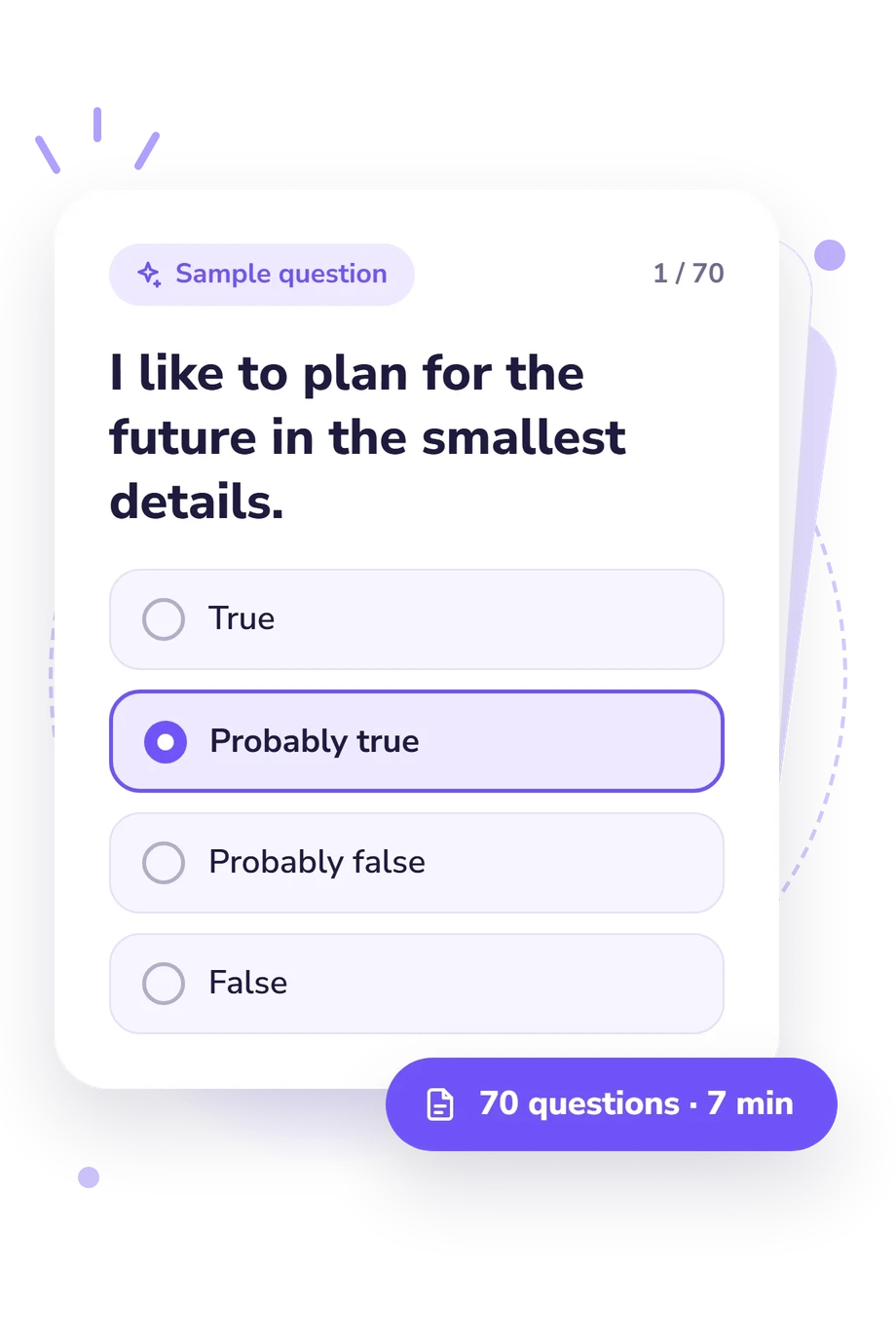
You will be presented with a series of statements about behavioral characteristics. After reading each statement in order, select one of four response options: “True,” “Probably true,” “Probably false,” or “False.” Please note that there are no right or wrong answers, as this is not a test of ability but an assessment of individual differences in behavior.
    • True
    • Probably true
    • Probably false
    • False
    • True
    • Probably true
    • Probably false
    • False
    • True
    • Probably true
    • Probably false
    • False
WHAT THE TEST MEASURES
About This Assessment
Behavioral Self-Regulation Style, SSPM-2013 Test

Behavioral Self-Regulation Style Questionnaire Test - Symptoms and Signs

self-regulation

This self-report questionnaire is designed to assess individual differences in behavioral self-regulation processes relevant to goal setting, planning, and monitoring progress. The Behavioral Self-Regulation Style Questionnaire provides a structured snapshot of how a respondent typically organizes and adjusts goal-directed behavior. It was authored by Roy F. Baumeister.

The measure consists of 35 items and typically requires about 7 minutes to complete. Responses are intended to support clinically informed interpretation of self-regulatory style, including strengths and relative vulnerabilities across common phases of self-regulation (e.g., planning, implementation, and evaluation). Results from the Behavioral Self-Regulation Style Questionnaire may be used as an adjunct to interview and other assessment data when considering interventions aimed at improving goal management, follow-through, and adaptive behavior change.

Author: Roy F. Baumeister
Literature: Baumeister, R. F., & Vohs, K. D. (Eds.). Handbook of self-regulation: Research, theory, and applications. Guilford Press. 2004.; Carver, C. S., & Scheier, M. F. On the self-regulation of behavior. Cambridge University Press. 1998.
Popular tests
Comments
Leave a Comment