
Сonflict management styles quiz
How the Scales are Structured
Who Usually Takes This Test?
See How You Compare
Below is a preview of how scores are typically distributed across each scale.
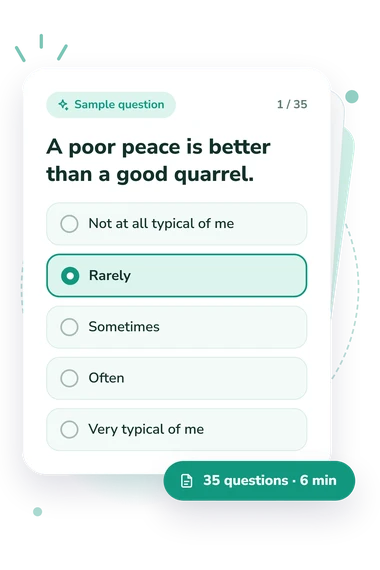
Example Questions From the Test
- Not at all typical of me
- Rarely
- Sometimes
- Often
- Very typical of me
- Not at all typical
- Rarely
- Sometimes
- Often
- Very typical
- Not at all typical
- Rarely
- Sometimes
- Often
- Very typical
Сonflict management styles quiz - Description and methodology of the test
People wanting to understand reactions during disagreement can use this assessment to examine recurring choices instead of judging themselves as simply “good” or “bad” at conflict. The conflict management styles quiz suits self-reflection about cooperation, firmness, withdrawal, and concession, helping readers notice which responses may support or hinder communication in relationships, teams, and negotiations. It can clarify which conflict management strategies feel most natural before someone practices alternatives.
What This Assessment Explores
This questionnaire examines how a person tends to respond when interests, opinions, or needs collide. Its proverbs and statements touch on agreement, firmness, concessions, withdrawal, and softening opposition. For readers comparing conflict responses, this conflict style quiz can reveal preferred interpersonal patterns without reducing every disagreement to one fixed trait.
The result groups responses into five approaches:
- Collaboration shows an effort to combine perspectives and address both sides.
- Compromise reflects exchanging concessions so each party gains something.
- Competition emphasizes asserting a position or securing an outcome.
- Avoidance limits engagement or postpones confrontation.
- Accommodation prioritizes harmony or another person’s wishes over one’s own.
None is automatically a strength or weakness; its usefulness depends on the relationship and situation.
Methodology and Scientific Basis
Each item is a short proverb or statement rated on a five-point scale from “Not at all typical of me” to “Very typical of me.” The format asks respondents to judge personal tendencies, while cooperative, forceful, conciliatory, and disengaging themes connect everyday reactions with broader conflict patterns.
Themes in this questionnaire are conceptually consistent with the five-mode framework associated with the Thomas-Kilmann Conflict Mode Instrument and the MODE measure described by Kilmann and Thomas (1977). This version presents a self-report preference profile for reflection and skill development; its result should be read as a current pattern of preferences rather than a fixed personal label.
The displayed scale is Conflict Behavior Strategies, scored from 0-100. Its bands are Low preference 0-33, Moderate preference 34-66, and High preference 67-100. Conflict-resolution styles can vary with the relationship, stakes, mood, and recent experience, so the result describes a current conflict resolution styles profile rather than a fixed personal label, while answers can reflect self-presentation or limited self-awareness.
- Shabalina, V. V. (2001). Virtual Workshop: Training Volunteer Mediators of an Adolescent Psychological Service. St. Petersburg: Medical Press.
- Thomas, K. W., & Kilmann, R. H. (1974). Thomas-Kilmann Conflict Mode Instrument. Tuxedo, NY: XICOM, Inc.
- Kilmann, R. H., & Thomas, K. W. (1977). Developing a Forced-Choice Measure of Conflict-Handling Behavior: The “MODE” Instrument. Educational and Psychological Measurement, 37(2), 309-325. 10.1177/001316447703700204