
Computer Addiction Test for Primary School Children
How the Scales are Structured
Who Usually Takes This Test?
See How You Compare
Below is a preview of how scores are typically distributed across each scale.
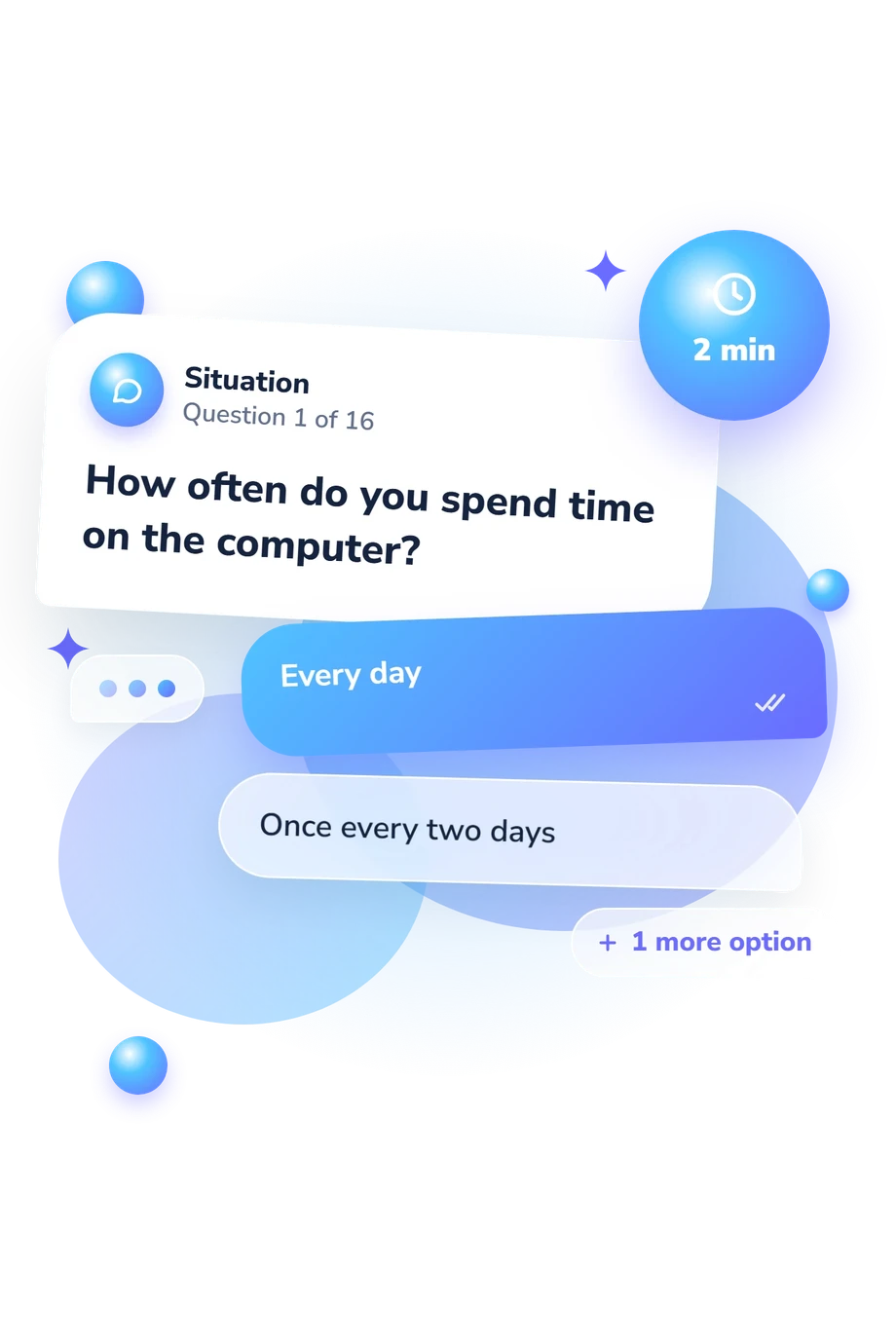
Example Questions From the Test
- Every day
- Once every two days
- Only when there is nothing else to do
- More than 2–3 hours
- 2 hours (I get absorbed in the game)
- No more than 1 hour
- Yes, that has happened
- A couple of times, maybe, but the activity was not that important
- No, that has never happened
Computer Addiction Test for Primary School Children - Description and methodology of the test
Primary school children are the respondents in this questionnaire; adults can help them understand the result and discuss their computer routines. The Computer Addiction Test for Primary School Children examines patterns of time, control, priority, and interference. Its result helps adults discuss possible computer addiction symptoms in children, indicating no addiction, risk of developing addiction with a need for preventive measures, or pronounced computer addiction requiring specialist intervention.
What This Assessment Explores
The questionnaire treats computer addiction in children as a pattern of intensity, loss of control, preoccupation, and disruption of other activities.
The Computer Addiction scale (8-24) shows No signs (8-12), At risk (13-18), and Pronounced (19-24). No signs indicates no addiction; At risk indicates risk of developing addiction and the need for preventive measures; Pronounced indicates pronounced computer addiction and requires specialist intervention.
Questions cover three areas:
- Frequency and duration show how often and how long computer activity lasts.
- Control and preoccupation show whether the child can stop and how often computer thoughts recur.
- Priority and interference show whether computer use displaces school, interests, or important activities.
Taken together, the result describes severity in covered situations, not a fixed personality trait. Adults should interpret a child's routines alongside context, changes over time, and the child's explanation.
Methodology and Scientific Basis
Each item in this computer addiction assessment offers three response choices describing different levels of frequency, control, priority, or consequence. The situations cover time, stopping, preoccupation, and interference with school or activities.
Scoring for this online version has not been standardised. Readers should interpret the displayed bands as provided rather than infer a point formula from the response choices.
Methodologically, the questionnaire is conceptually consistent with Kutueva's Computer Addiction Test, which addresses computer-related overuse in children, but it is not identified as a formally validated adaptation of that instrument. Young's 1998 work offers a broader framework for preoccupation, impaired control, and disruption; it supports comparison of themes, not authorship or validation of this online version.
The online form does not present a standardization sample, reliability estimates, or clinical validation for this version. Self-report can be shaped by current routines, recall, parental expectations, and a child's understanding, so the result is a structured reflection rather than a standalone clinical classification.
- Kutueva, O. L. (2014). Computer Addiction Test for Children and Parents..
- Muratkhanov, V. A. (Ed.). (2024). Risks in the Digital Environment: Diagnosis, Prevention, Correction. Moscow: ANO Center for Global IT Cooperation.
- Long, C., Liu, J., Wu, Y., and Liu, S. (2024). The relationship between parental smartphone dependence and elementary students’ internet addiction during the COVID-19 lockdown in China: the mediating role of parent-child conflict and the moderating role of parental roles. Frontiers in Psychology, 15, 1480151. 10.3389/fpsyg.2024.1480151
- Young, K. S. (1998). Internet Addiction: The Emergence of a New Clinical Disorder. CyberPsychology & Behavior, 1(3), 237-244. 10.1089/cpb.1998.1.237
Updated: