
Emotional Awareness Test
How the Scales are Structured
Who Usually Takes This Test?
See How You Compare
Below is a preview of how scores are typically distributed across each scale.
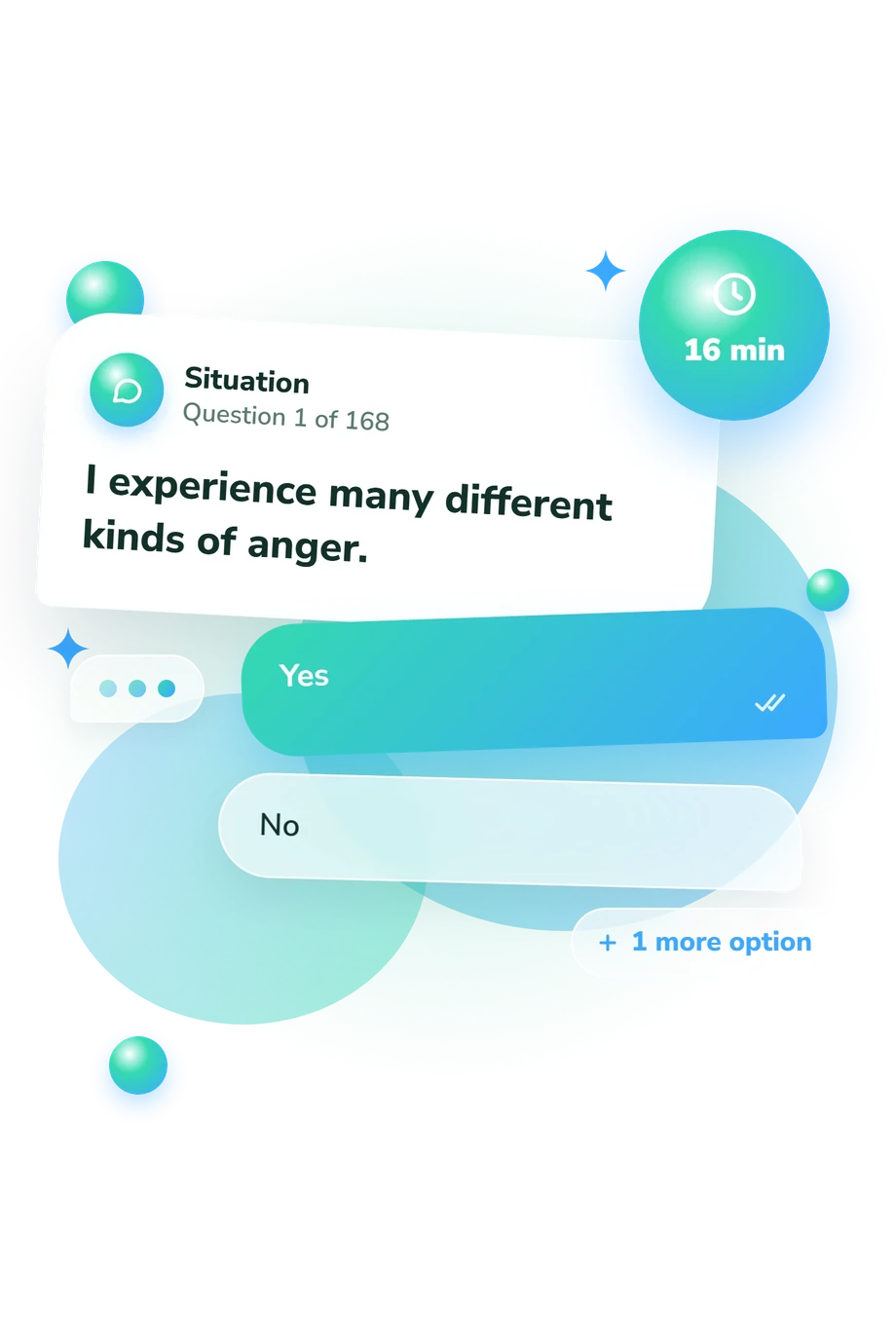
Example Questions From the Test
- Yes
- No
- Not sure
- Yes
- No
- Not sure
- Yes
- No
- I don't know
Emotional Awareness Test - Description and methodology of the test
For readers who want to understand how they notice and interpret difficult feelings, the Emotional Awareness Test offers a structured self-reflection exercise. As an emotional awareness questionnaire, this test can clarify whether sadness and anger are easy to identify, accept, and differentiate, or whether uncertainty appears when feelings are named and understood. It also suits people examining their emotional vocabulary, bodily signals, and habitual responses in everyday situations.
What This Assessment Explores
Sadness and anger are examined as emotions that can be noticed, understood, differentiated, and expressed. Items address bodily cues, intensity, links with other feelings, beliefs about expression, and responses such as withdrawal or waiting for a feeling to pass. As an emotional awareness assessment, it helps readers reflect on recognition in themselves and others. Higher scores on the two emotion-specific scales indicate greater awareness, while higher uncertainty counts indicate more difficulty recognizing the corresponding emotion.
Four displayed outputs describe the profile:
- “I Don’t Know” Responses - Sadness (0-10) measures recognition difficulty: Clear awareness 0-3; Some uncertainty 4-7; Marked uncertainty 8-10.
- “I Don't Know” Responses - Anger (0-10) measures recognition difficulty: Clear recognition 0-3; Some uncertainty 4-7; High uncertainty 8-10.
- Sadness (-26-14) measures awareness and understanding: Low awareness -26--1; Moderate awareness 0-6; High awareness 7-14.
- Anger (-24-20) measures recognition and responding: Low awareness -24-0; Higher awareness 1-20.
Methodology and Scientific Basis
Representative items use Yes, No, Not sure, or I don't know choices and ask about bodily cues, emotional meanings, social expression, and ways of handling feelings. Results report emotion-specific scores alongside separate uncertainty counts. Because the ranges do not reveal how each answer is weighted, point values should not be inferred from the endpoints.
The conceptual anchor is the Levels of Emotional Awareness model (Lane & Schwartz, 1987), which describes movement from limited differentiation toward more precise understanding. The published LEAS (Lane et al., 1990) is related evidence, while Mayer, Salovey, and Caruso (2004) place emotion recognition within emotional intelligence. This questionnaire is conceptually consistent with these works, not the published LEAS itself or a validated adaptation of it.
Used as an emotional awareness quiz, this questionnaire provides a structured reflection prompt. Its displayed categories are descriptive rather than population norms or diagnostic thresholds. Self-report can be shaped by current mood, memory, language, self-awareness, and willingness to disclose, so the profile is best used to examine patterns rather than as a standalone clinical conclusion.
- Lane, R. D., & Schwartz, G. E. (1987). Levels of emotional awareness: A cognitive-developmental theory and its application to psychopathology. American Journal of Psychiatry, 144(2), 133-143. 10.1176/ajp.144.2.133
- Lane, R. D., Quinlan, D. M., Schwartz, G. E., Walker, P. A., & Zeitlin, S. B. (1990). The Levels of Emotional Awareness Scale: A cognitive-developmental measure of emotion. Journal of Personality Assessment, 55(1-2), 124-134. 10.1080/00223891.1990.9674052
- Mayer, J. D., Salovey, P., & Caruso, D. R. (2004). Emotional intelligence: Theory, findings, and implications. Psychological Inquiry, 15(3), 197-215. 10.1207/S15327965PLI1503_02
Updated: