
Personality Paradoxicality Scale Test
How the Scales are Structured
Who Usually Takes This Test?
See How You Compare
Below is a preview of how scores are typically distributed across each scale.
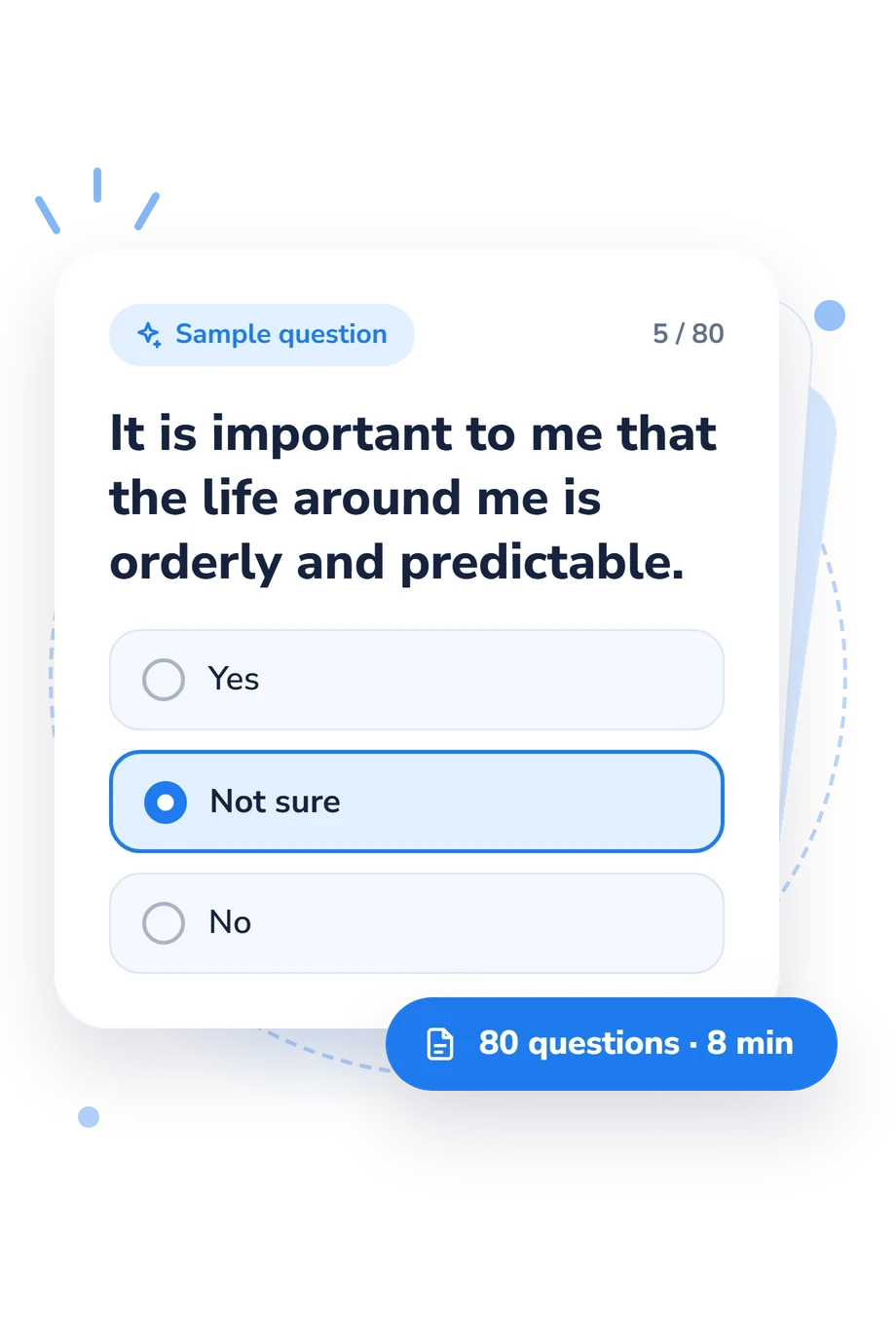
Example Questions From the Test
- Yes
- Not sure
- No
- Yes
- Not sure
- No
- Yes
- Not sure
- No
Personality Paradoxicality Scale Test - Description and methodology of the test
For readers deciding whether a structured personality measure suits their self-reflection, the Personality Paradoxicality Scale Test provides a single, clearly scored profile rather than a collection of separate trait results. People who value a defined interpretive framework may find this personality paradoxicality assessment useful for considering their own response pattern.
What This Assessment Explores
At its core, the questionnaire examines how a person considers multiple perspectives and analyzes contradictory information. Items cover new methods, traditions, multiple solutions, independent decisions, pressure, and finding a third option when viewpoints conflict. They also address predictability, rules, habits, and personal change. Higher scores indicate a stronger reported tendency toward unconventional thinking and a more objective perception of reality.
The displayed scale is Degree of Personality Paradoxicality (A), scored 0-10. Its bands are:
- Lower paradoxicality (0-3) marks the lower range of the reported tendency to consider multiple perspectives and analyze contradictory information.
- Moderate paradoxicality (4-7) marks the middle range of that reported tendency.
- High paradoxicality (8-10) indicates a stronger reported tendency toward unconventional thinking and a more objective perception of reality.
Scores from this personality paradoxicality test help readers examine responses to change, stress, and decisions without obvious answers.
Methodology and Scientific Basis
Responses use three choices-Yes, Not sure, or No-for each statement. These self-report items capture how a person sees current habits, preferences, and reactions rather than testing performance. The questionnaire produces one overall total, not separate scores for creativity, independence, or flexibility.
The methodology is conceptually consistent with the published Paradoxical Personality Scale, which examines paradoxical personality characteristics rather than treating traits as isolated qualities. This online questionnaire is not presented as an adaptation, validation, or equivalent version of that instrument. Research on that instrument cannot establish norms for this online version because its samples and procedures were different.
Costa and McCrae are the registered authors; their NEO manual supplies general personality-assessment background, while this questionnaire has its own displayed items and scoring.
Because this personality paradoxicality questionnaire is self-report, its result describes reported tendencies rather than fixed identity. Exact item-to-point weighting is not stated, so the numeric total should not be reverse-engineered from answers. Self-presentation, stress, and limited self-awareness can affect responses, so one score is best considered alongside behavior and circumstances.
- Freiberg Hoffmann, Agustín, Guadalupe de la Iglesia, Juliana Beatriz Stover, and Mercedes Fernández Liporace. "Paradoxical Personality Scale: Its Development and Construct Validity Analysis." International Journal of Psychological Research, 7(1), 49-72, 2014.
- Freiberg Hoffmann, Agustín, and María Mercedes Fernández Liporace. "Paradoxical Personality and Academic Achievement in College Students From Buenos Aires." Europe's Journal of Psychology, 11(4), 597-618, 2015. 10.5964/ejop.v11i4.898
- Csikszentmihalyi, Mihaly. Creativity: Flow and the Psychology of Discovery and Invention. HarperCollins Publishers, 1996.
- Costa, Paul T., Jr., and McCrae, Robert R. Revised NEO Personality Inventory (NEO-PI-R) and NEO Five-Factor Inventory (NEO-FFI): Professional Manual. Psychological Assessment Resources, 1992.
Updated: