
Humor Style Self-Assessment Test
How the Scales are Structured
Who Usually Takes This Test?
See How You Compare
Below is a preview of how scores are typically distributed across each scale.
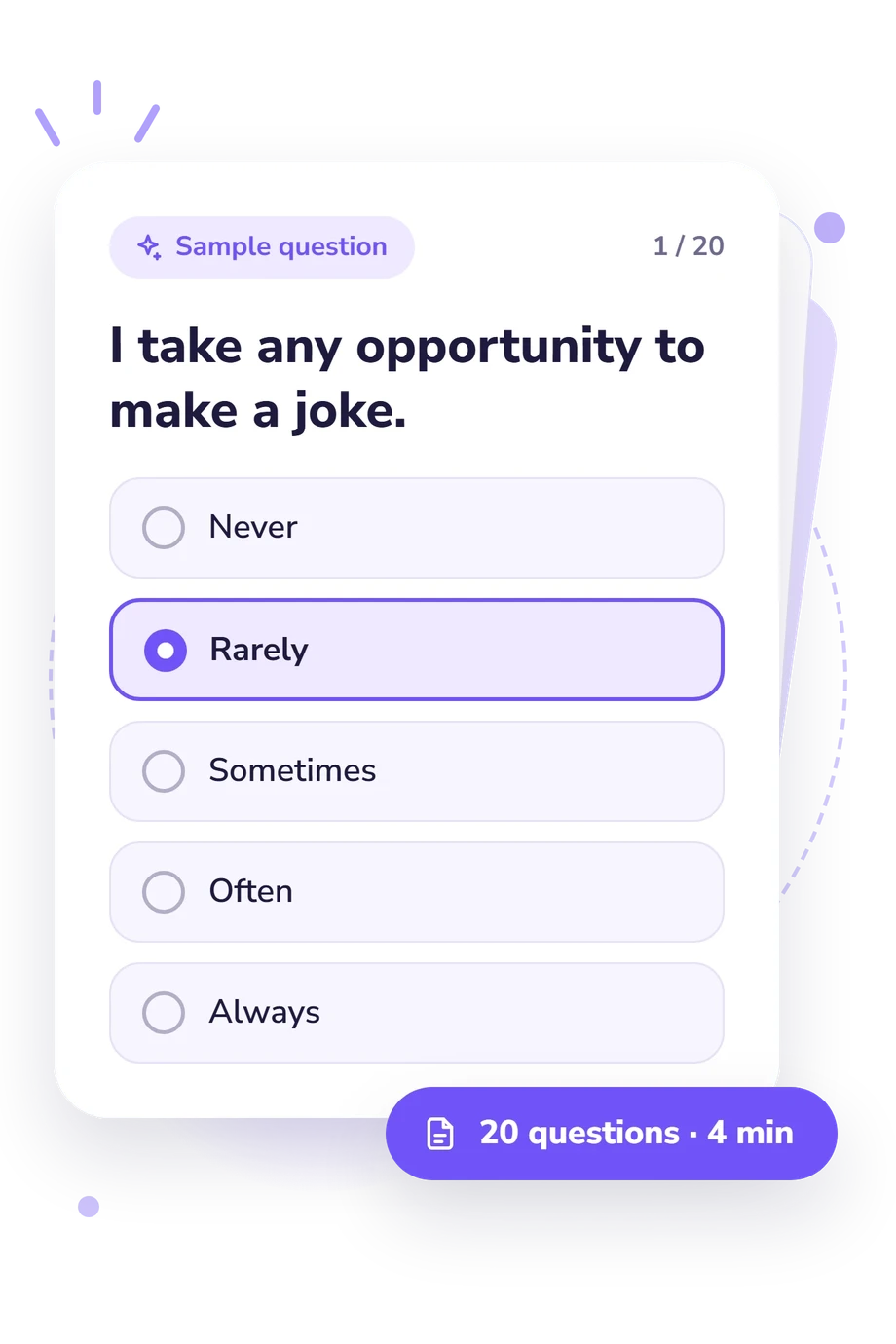
Example Questions From the Test
- Never
- Rarely
- Sometimes
- Often
- Always
- Never
- Rarely
- Sometimes
- Often
- Always
- Never
- Rarely
- Sometimes
- Often
- Always
Humor Style Self-Assessment Test - Description and methodology of the test
People who want to understand how they participate in funny interactions can use the Humor Style Self-Assessment Test as a self-report exercise. It is intended for anyone curious about how they understand humor produced by others and how they initiate jokes or humorous situations, rather than for judging whether their humor is good or bad. This humor style questionnaire offers a structured starting point for reflecting on everyday social responses.
What This Assessment Measures
The items treat humor as both receiving and creating funny material across social situations. They address joke-making, retelling, playful performance, pointing out amusing events, helping someone laugh, joining group laughter, finding humor in life, understanding subtle meaning, and noticing social boundaries.
The questionnaire covers both amusement or comprehension of others' humor and the tendency to generate jokes or humorous situations. Across these themes, a sense of humor questionnaire distinguishes responsiveness from initiation. The result describes a reported engagement style, not fixed wit or identity.
The result separates two complementary dimensions:
- Humor Reactivity (B), 0-40, measures how readily you perceive and understand others' humor: Low reactivity 0-13; Moderate reactivity 14-26; High reactivity 27-40 are the displayed bands.
- Humor Activity (A), 0-40, measures how readily you initiate humorous situations: Low initiator 0-13; Moderate initiator 14-27; High initiator 28-40 are the displayed bands.
Methodology and Scientific Basis
Each statement uses five choices-Never, Rarely, Sometimes, Often, or Always-so the respondent reports typicality rather than a correct answer. The items combine outward behavior, private amusement, social understanding, and sensitivity to context. Responses are combined into two scores; higher values indicate more of the tendency defined by the relevant dimension, while the displayed bands organize interpretation.
The questionnaire is conceptually consistent with Dombrovskaya's work on levels and types of sense of humor, not presented as an adaptation of it. Bressler, Martin, and Balshine (2006) offer a related comparison by treating humor production and appreciation as separable traits. Martin's integrative account and Ivanova and Enikolopov's review likewise support a multidimensional view, but do not establish that this online questionnaire is a validated copy of their instruments.
For self-reflection, the online self-report profile of humor-related tendencies offers an online humor assessment of reported patterns. No standardization or validation status is stated for this questionnaire. Its meaning depends on honest self-report, current mood, social context, and self-awareness, so the profile is best read as a snapshot for reflection, not as a diagnosis.
- Dombrovskaya, Yolanta S. (2014). Humor in the Context of Development. Montreal: Accent Graphics Communications.
- Ivanova, E. M., and Enikolopov, S. N. (2006). Psychological Studies of Sense of Humor. Voprosy Psikhologii, no. 4, pp. 122-133.
- Bressler, Eric R., Rod A. Martin, and Sigal Balshine. (2006). Production and appreciation of humor as sexually selected traits. Evolution and Human Behavior, 27(2), 121-130. DOI 10.1016/j.evolhumbehav.2005.09.001.
- Martin, Rod A. (2007). The Psychology of Humor: An Integrative Approach. Burlington, MA: Elsevier Academic Press.
Updated: