
Metacognitive Processes Intensity Scale Test
How the Scales are Structured
Who Usually Takes This Test?
See How You Compare
Below is a preview of how scores are typically distributed across each scale.
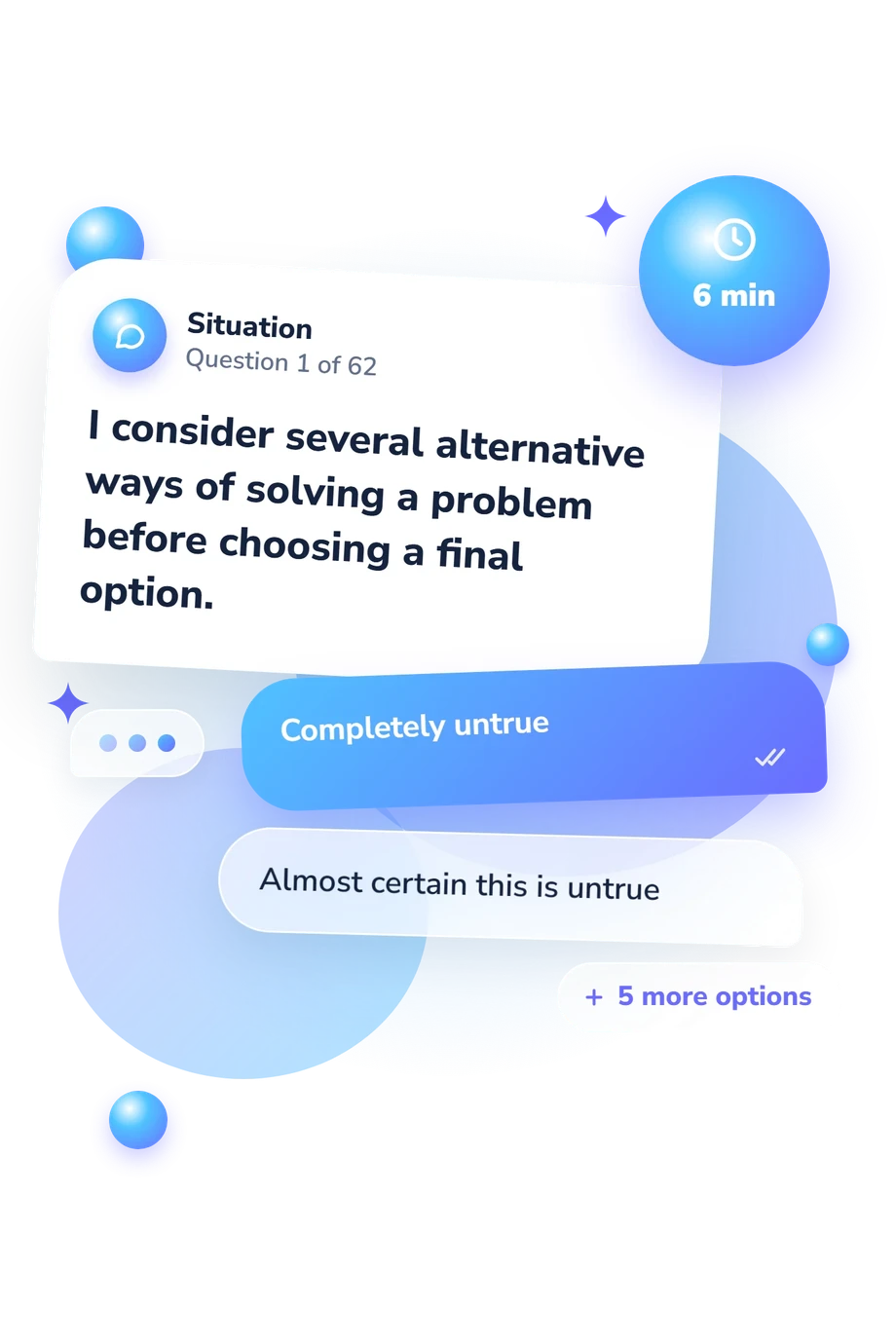
Example Questions From the Test
- Completely untrue
- Almost certain this is untrue
- Rather untrue than true
- Not sure
- Rather true than untrue
- Almost certain this is true
- Completely true
- Does not apply at all
- Almost sure it does not apply
- Applies more negatively than positively
- Not sure
- Applies more positively than negatively
- Almost sure it applies
- Applies completely
- Does not apply at all
- Almost certainly does not apply
- Somewhat does not apply rather than applies
- Not sure
- Somewhat applies rather than does not apply
- Almost certainly applies
- Completely applies
Metacognitive Processes Intensity Scale Test - Description and methodology of the test
People seeking a metacognitive assessment may benefit from this questionnaire when they want to examine how awareness shapes everyday mental work. The Metacognitive Processes Intensity Scale Test describes the degree to which you notice, organize, check, and adjust your own thinking. It is intended for self-reflection by readers interested in a clearer picture of their cognitive habits, rather than for labeling intelligence or ability.
What This Assessment Explores
Rather than measuring general intelligence, the questionnaire examines metacognitive regulation while you learn, solve problems, and make decisions. The items address planning, strategy choice, linking new material with prior knowledge, monitoring progress, checking understanding, and changing an approach when needed.
The assessment reports one scale, Metacognitive Process Intensity, with a range of 31-217. Its bands are Low 31-93, Moderate 94-155, and High 156-217. The scale measures the intensity of recognizing and regulating one’s own thinking; higher results indicate more developed planning, analysis, and cognitive self-regulation, while lower results may suggest difficulty managing thought processes.
The main themes are:
- Planning and goals show how deliberately you define outcomes and prepare for a task.
- Strategy use shows how you choose, adapt, and evaluate methods.
- Monitoring and self-knowledge show how you track progress and recognize strengths or limits.
Methodology and Scientific Basis
Each statement uses a seven-point response scale ranging from complete non-endorsement or non-application to complete endorsement or application, with an uncertain midpoint. This captures degree rather than forcing a yes-or-no choice. The result is reported on the single displayed scale, and the bands organize interpretation of the respondent's reported level of metacognitive activity.
The approach is conceptually consistent with the Metacognitive Awareness Inventory (Schraw & Dennison, 1994), which separates knowledge about cognition from regulation of cognition. Flavell (1979) supplies the framework of awareness and monitoring, and Nelson and Narens (1990) explain the relationship between monitoring and control. These sources clarify the construct, but this questionnaire is not presented as a direct adaptation, validation, or standardized version of their work.
The questionnaire is a structured metacognitive self-report profile of perceived cognitive regulation. Current demands, confidence, memory, self-awareness, and socially favorable responding can influence answers. The result can support reflection on learning and problem-solving habits, but it is not a diagnosis or substitute for assessment. Its value is in describing a pattern of perceived cognitive regulation, not predicting performance in every situation.
- Schraw, G., & Dennison, R. S. (1994). Assessing metacognitive awareness. Contemporary Educational Psychology, 19(4), 460-475. 10.1006/ceps.1994.1033
- Flavell, J. H. (1979). Metacognition and cognitive monitoring: A new area of cognitive-developmental inquiry. American Psychologist, 34(10), 906-911. 10.1037/0003-066X.34.10.906
- Nelson, T. O., & Narens, L. (1990). Metamemory: A theoretical framework and new findings. In G. H. Bower (Ed.), The Psychology of Learning and Motivation (Vol. 26, pp. 125-173). Academic Press. 10.1016/S0079-7421(08)60053-5
Updated: