
Self-Assessment of Mental States Test
How the Scales are Structured
Who Usually Takes This Test?
See How You Compare
Below is a preview of how scores are typically distributed across each scale.
Example Questions From the Test
- Yes, I often feel this way.
- Sometimes I feel this way.
- No, this does not describe me at all.
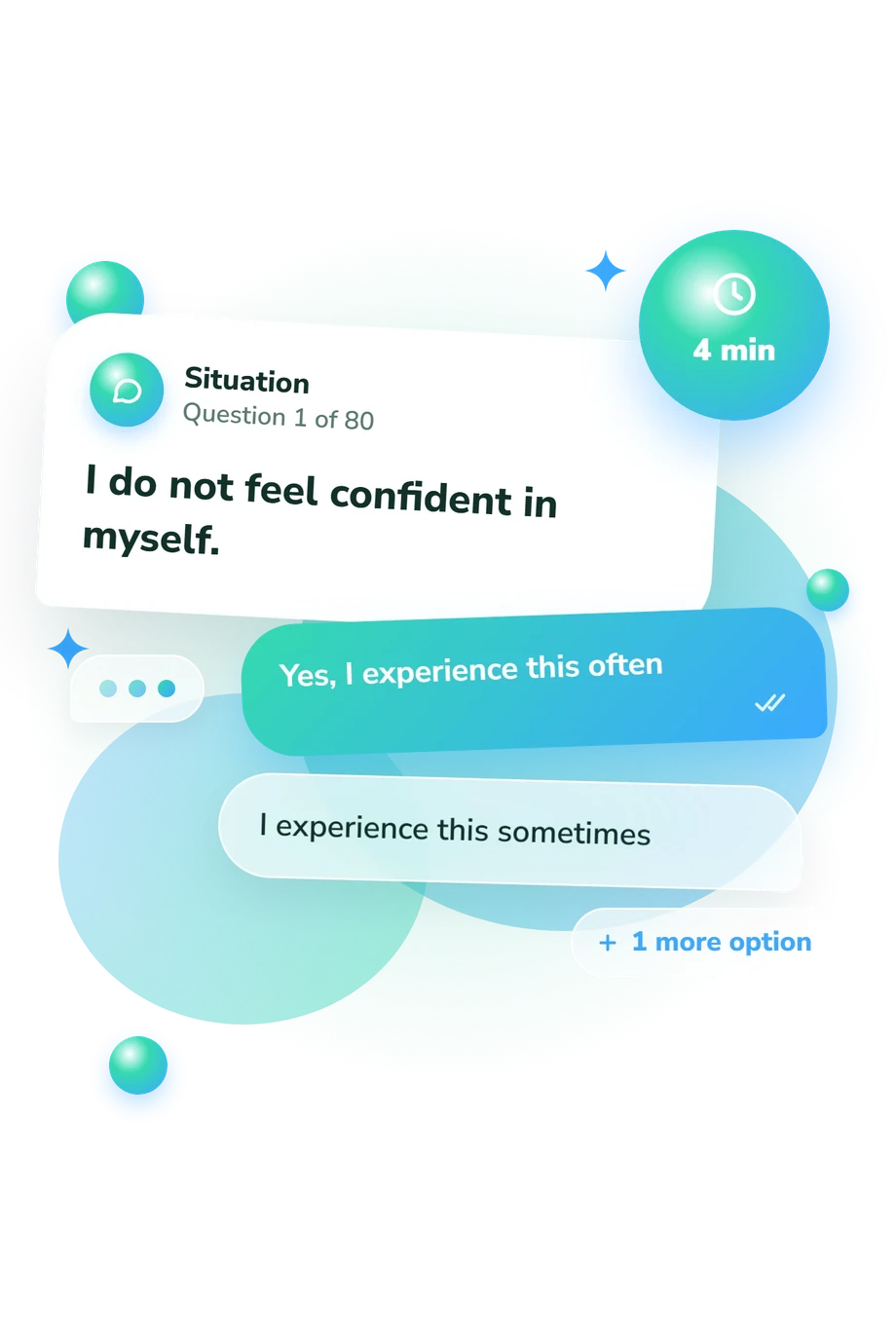
- Yes, I experience this often
- I experience this sometimes
- No, this does not describe me at all
- Yes, I experience this often
- I experience this sometimes
- No, this does not describe me at all
Self-Assessment of Mental States Test - Description and methodology of the test
People who want to understand how they respond to change, setbacks, interpersonal tension, and perceived danger may use the Self-Assessment of Mental States Test as a structured starting point. This mental states assessment is intended for personal reflection and is most useful when considered alongside specific situations and recurring reactions. It organizes recurring reactions into four dimensions and gives the reader a clearer profile to consider alongside everyday context.
What This Assessment Explores
Items cover blocked goals, disrupted routines, novelty, interpersonal friction, anger, self-blame, and anticipated danger. The result separates four dimensions:
- Rigidity (0-20) measures difficulty changing actions, habits, beliefs, or attitudes when circumstances require restructuring; Low rigidity 0-7, Moderate rigidity 8-14, High rigidity 15-20.
- Aggressiveness (0-20) measures unprovoked hostility, attack, harm, or superiority toward others or the surrounding world; Low 0-7, Moderate 8-14, High 15-20.
- Frustration (0-20) measures distress when attempts to satisfy a need or desire fail, including disappointment, irritability, anxiety, or despair; Low 0-7, Moderate 8-14, High 15-20.
- Anxiety (0-20) measures frequent, intense anxiety and anticipation of danger, with a low threshold for onset; Low 0-7, Moderate 8-14, High 15-20.
A psychological self-assessment of this kind can help a reader decide which reactions deserve closer observation.
Methodology and Scientific Basis
Each statement uses a three-choice self-report format: the experience occurs often, occurs sometimes, or does not describe the respondent. Responses are combined into separate scale totals and classified by the displayed bands. Current mood and the wording of a person's self-report can influence those totals.
The questionnaire is conceptually consistent with the Self-Assessment of Mental States method (Eysenck), included in Raigorodsky’s 2006 collection, and groups reported reactions into four recurring mental-state dimensions.
Research by Serebryakova and colleagues (2016) and Dvoinikova and colleagues (2021) applied related dimensions to socio-psychological adjustment and student adaptation. Those studies are not validation studies for this questionnaire and do not provide its population norms.
As a mental health questionnaire, it supports structured self-observation. Results can be affected by current mood, self-awareness, response bias, recent setbacks, or pressure to answer favorably. They cannot by themselves explain causes or establish a diagnosis; interpretation is stronger when connected with personal circumstances and repeated observations.
- Raigorodsky, D. Ya. (ed.-comp.). Practical Psychodiagnostics: Methods and Tests. Samara: Bakhrakh-M, 2006, pp. 141-145. ISBN 5-89570-005-5.
- Serebryakova, T. A., Morozova, L. B., Kochneva, E. M., Zharova, D. V., Skitnevskaya, L. V., and Kostina, O. A. (2016). The Problem of Socio-Psychological Adjustment of Personality in the Scientists’ Studies. International Journal of Environmental & Science Education, 11(11), 4706-4715.
- Dvoinikova, E. Yu., Beilina, N. S., and Telnova, O. V. (2021). Psychological Features of Social Adaptation of Students in the Distance Learning. European Proceedings of Social and Behavioural Sciences, 737-743. 10.15405/epsbs.2021.12.02.91
- Eysenck, H. J. (1954). The Psychology of Politics. London: Routledge & Kegan Paul.
Updated: