
Emotional Intelligence (EQ) Test
How the Scales are Structured
Who Usually Takes This Test?
See How You Compare
Below is a preview of how scores are typically distributed across each scale.
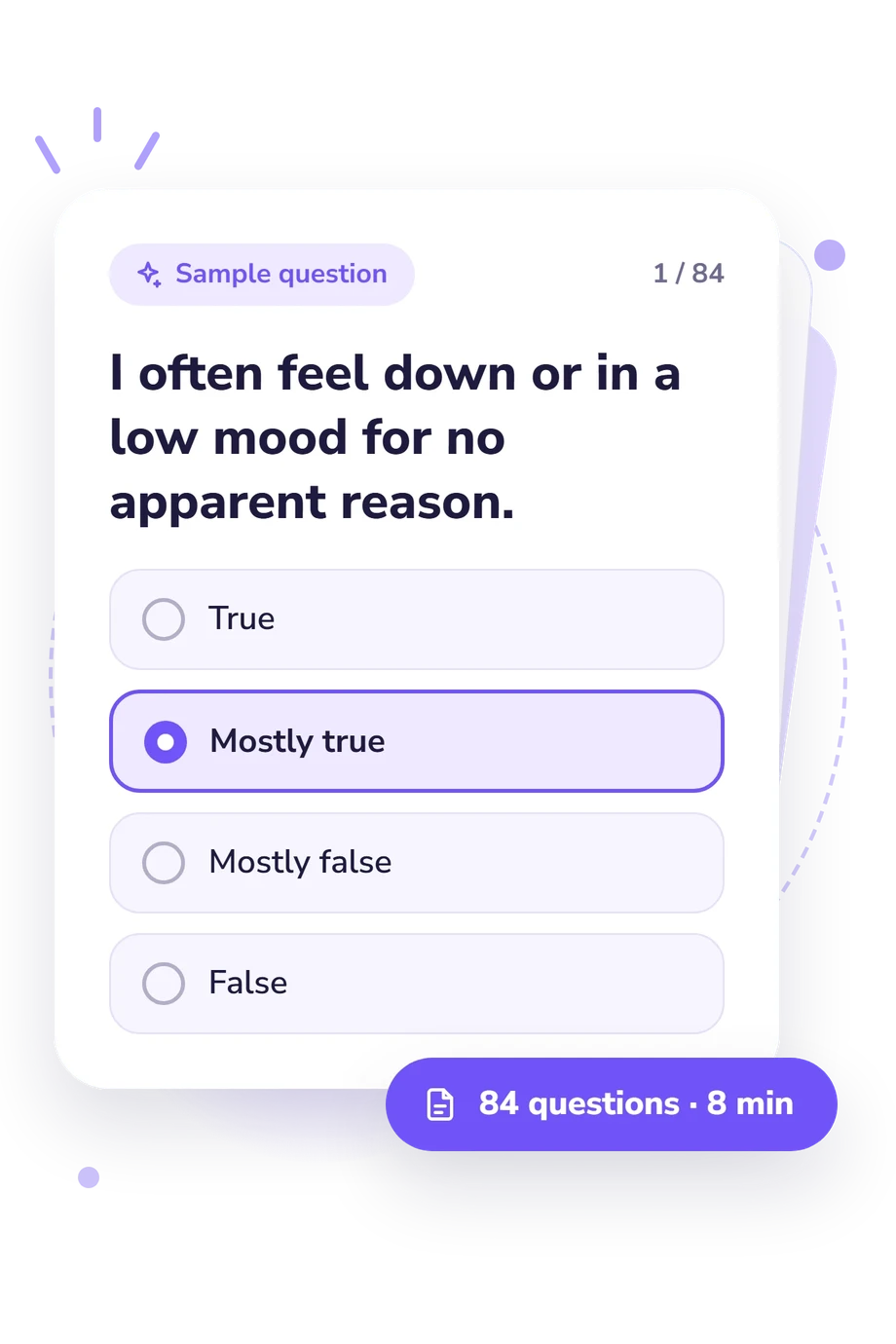
Example Questions From the Test
- True
- Mostly true
- Mostly false
- False
- True
- Mostly true
- Mostly false
- False
- True
- Mostly true
- Mostly false
- False
Emotional Intelligence (EQ) Test - Description and methodology of the test
People seeking a clearer view of how feelings influence choices, communication, and coping can use the Emotional Intelligence (EQ) Test as a structured self-reflection tool. An emotional intelligence assessment may help readers recognize patterns in self-regulation, empathy, emotional expression, and life priorities. The result offers a differentiated profile rather than a single judgment about personality.
What This Assessment Explores
The items sample mood, anger, impulse control, self-understanding, empathy, conflict, intuition, and quality of life. Taken together, these items form an emotional intelligence questionnaire that covers inner regulation, relationships, and life orientation; the stated definitions specify what each result reads from those situations.
The four displayed readings describe the result:
- Attitude Toward Life (14-56) assesses emotions in priorities and life satisfaction: Limited alignment (14-35); Strong alignment (36-56).
- Attitudes Toward Others (14-56) measures empathy, listening, and communication: Developing (14-35); Strong (36-56).
- Self-Attitude (14-56) reflects recognizing and regulating emotions: Needs development (14-35); Strong (36-56).
- Overall Emotional Quotient (42-168) summarizes emotional use across life: Lower EQ (42-80); Average EQ (81-120); Higher EQ (121-168).
Together, the readings show how the four reported areas are rated, including where one appears stronger or less developed than another.
Methodology and Scientific Basis
The displayed statements use four choices: True, Mostly true, Mostly false, and False. The items cover capacities and difficulties such as calming oneself, discussing conflict, reading people, handling criticism, prolonged anger, nervousness, and uncertainty about emotional reactions. The questionnaire combines responses into four displayed results, each with a stated score range and descriptive result bands that organize the profile.
The questionnaire is conceptually consistent with the EQ test described by Bear et al. (2007), particularly in its emotional-functioning themes and response format, but it is not presented as a verified adaptation of that instrument. Its framework aligns with Salovey and Mayer’s ability model, later developed with Caruso, where emotion is perceived, understood, regulated, and used in thought and action.
For an emotional intelligence profile, interpret the bands as descriptive readings rather than universal norms. The displayed bands are descriptive categories for this questionnaire and should not be treated as universal or clinical cutoffs. Self-report can be influenced by current mood, memory, self-awareness, and favorable responding, so the pattern is best considered alongside personal circumstances and the other dimensions.
- Bear, Jean-Michel, Natalia Evsikova, Christophe Andre, and Ksenia Kiseleva. "Two Tests: Discover Your IQ and EQ." Psychologies, 2007, no. 18 (supplement), pp. 24-33.
- Mayer, John D., Peter Salovey, and David R. Caruso. "Emotional Intelligence: Theory, Findings, and Implications." Psychological Inquiry, vol. 15, no. 3, 2004, pp. 197-215. 10.1207/S15327965PLI1503_02
- Salovey, Peter, and John D. Mayer. "Emotional Intelligence." Imagination, Cognition and Personality, vol. 9, no. 3, 1990, pp. 185-211. 10.2190/DUGG-P24E-52WK-6CDG
Updated: