
Personal Safety State Assessment Test
How the Scales are Structured
Who Usually Takes This Test?
See How You Compare
Below is a preview of how scores are typically distributed across each scale.
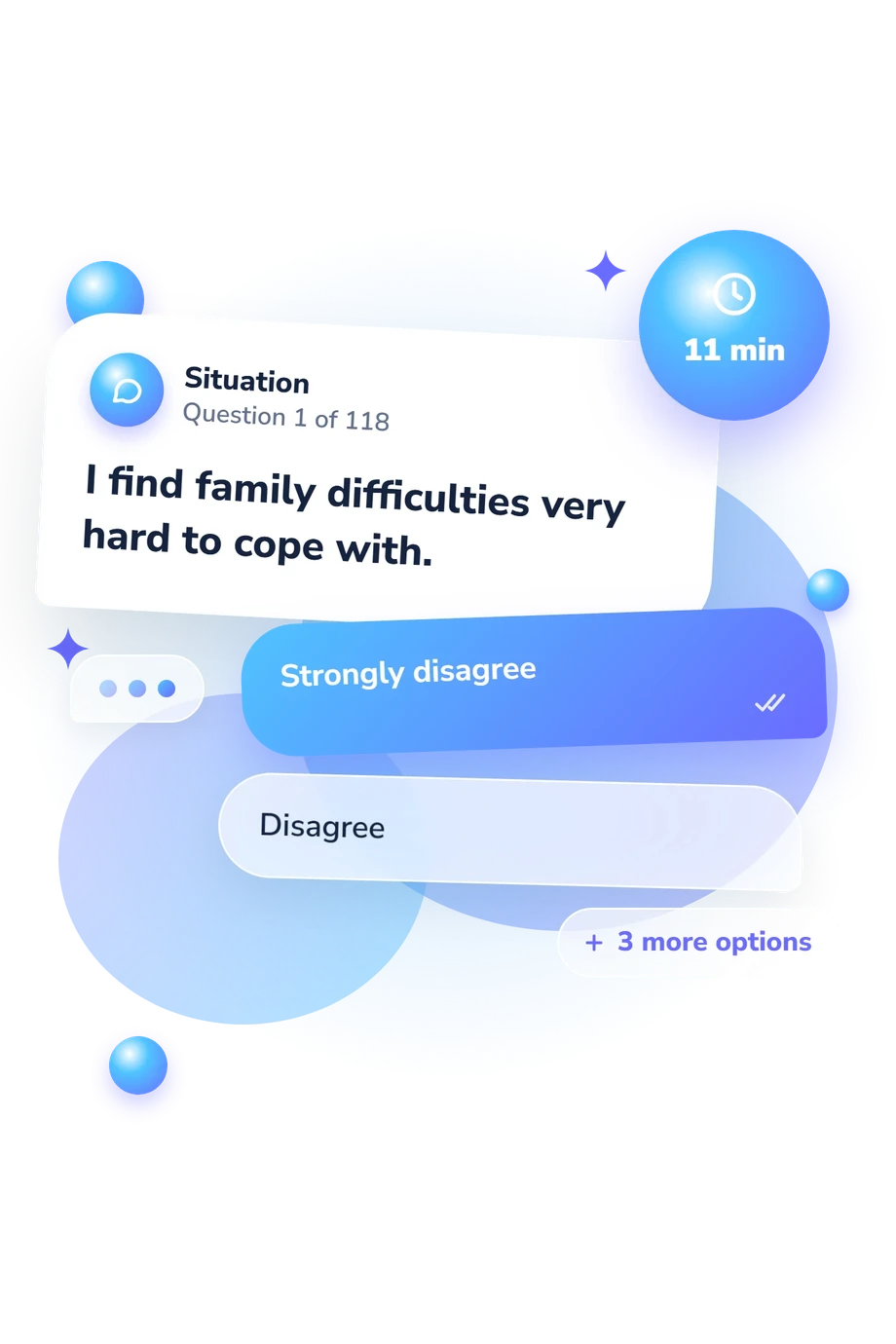
Example Questions From the Test
- Completely disagree
- Disagree
- Somewhere in between
- Agree
- Completely agree
- Completely disagree
- Disagree
- Neither agree nor disagree
- Agree
- Completely agree
- Strongly disagree
- Disagree
- Neither agree nor disagree
- Agree
- Completely agree
Personal Safety State Assessment Test - Description and methodology of the test
People who want to understand why some situations feel manageable while others trigger caution or worry may find the Personal Safety State Assessment Test useful. It is designed for self-reflection about how you assess personal safety across everyday, social, health, financial, work, and environmental concerns. The result is one broad indicator of perceived security across these situations, showing a general tendency to feel safe rather than explaining its causes.
What This Assessment Explores
Rather than measuring danger objectively, the questionnaire examines how secure a person tends to feel when facing uncertainty, change, conflict, health concerns, money, work demands, public evaluation, or disturbing news. It suits readers who want to identify recurring reactions across life.
The displayed result is Propensity to Experience a Sense of Safety (0-10): Low safety (0-4), Moderate safety (5-7), or High safety (8-10). This perceived safety scale summarizes reported security and confidence across those contexts.
The questions cover three recurring contexts in which this safety tendency appears:
- Coping with change shows how the safety tendency appears when routines or circumstances are altered.
- Anticipatory worry shows how the safety tendency appears around uncertainty, possible danger, and worst-case preparation.
- Everyday pressures show how the tendency appears amid health, relationships, finances, work, and social evaluation.
Methodology and Scientific Basis
Each item uses a five-point agreement format, from strong disagreement to strong agreement, with neutral or intermediate wording where appropriate. Statements address personal events, other people's difficulties, environmental threats, and performance situations. The questionnaire produces the displayed tendency score. Its answer-to-score mapping is not specified; the choices are response options, not probabilities of harm.
Its focus is conceptually consistent with the Personal Safety Perception Scale, which treats perceived safety as multidimensional. This questionnaire is not an adaptation of that published scale. Maslow's theory places safety among basic human needs, offering a broad theoretical context rather than validation of this score.
For interpretation, the result is best treated as a snapshot of subjective safety experience. Its standardization status is not specified, so the displayed bands should be read as the labels and ranges provided for this result. Answers can shift with current stress, context, self-awareness, and willingness to report openly. The result is most useful alongside the situations that shaped it.
- Dabbous, M., Sakr, F., Safwan, J., Rahal, M., Fahs, I., Akel, M., & Salameh, P. (2025). Psychometric validation and correlates of the personal safety perception scale (PSPS-26) as a multidimensional measure of perceived safety. Scientific Reports, 15(1), 28376. 10.1038/s41598-025-13050-y
- Maslow, A. H. (1943). A theory of human motivation. Psychological Review, 50(4), 370-396. 10.1037/h0054346
- Edmondson, A. C. (1999). Psychological safety and learning behavior in work teams. Administrative Science Quarterly, 44(2), 350-383. 10.2307/2666999
Updated: