
Conflict Engagement and Disengagement Tendency Test
How the Scales are Structured
Who Usually Takes This Test?
See How You Compare
Below is a preview of how scores are typically distributed across each scale.
Example Questions From the Test
- Yes
- No
- Yes
- No
- Yes
- No
Conflict Engagement and Disengagement Tendency Test - Description and methodology of the test
People who want to understand their habitual reactions to disagreement may use the Conflict Engagement and Disengagement Tendency Test as a structured starting point. It is suited to self-reflection after recurring arguments, tense discussions, or difficulty stating a position. As a conflict management questionnaire, it focuses on response patterns rather than judging whether a person handled a particular dispute correctly.
What This Assessment Explores
These questions examine reactions when disagreement feels emotional, threatening, or hard to control. They touch on losing, giving in, apologizing, suppressing emotion, discussing the conflict with others, using pressure, attacking a person, and insisting on winning. The pattern contrasts active defense with reluctance to enter or continue confrontation.
The two result dimensions are:
- Forceful Action (0-10) shows readiness for direct, assertive defense; lower results reflect restraint. Reserved (0-4), Balanced (5-7), and Bull-headed (8-10) are the displayed bands.
- Conflict Avoidance (0-10) shows preference for staying out of confrontation or preserving harmony; lower results suggest openness to engagement. Low avoidance (0-4), Moderate avoidance (5-7), and High avoidance (8-10) are the displayed bands.
Viewed as a conflict engagement test, this result is most useful as a tendency profile. A strong result in one area may coexist with a strong result in the other, so neither result alone defines communication style, maturity, or relationship quality.
Methodology and Evidence Base
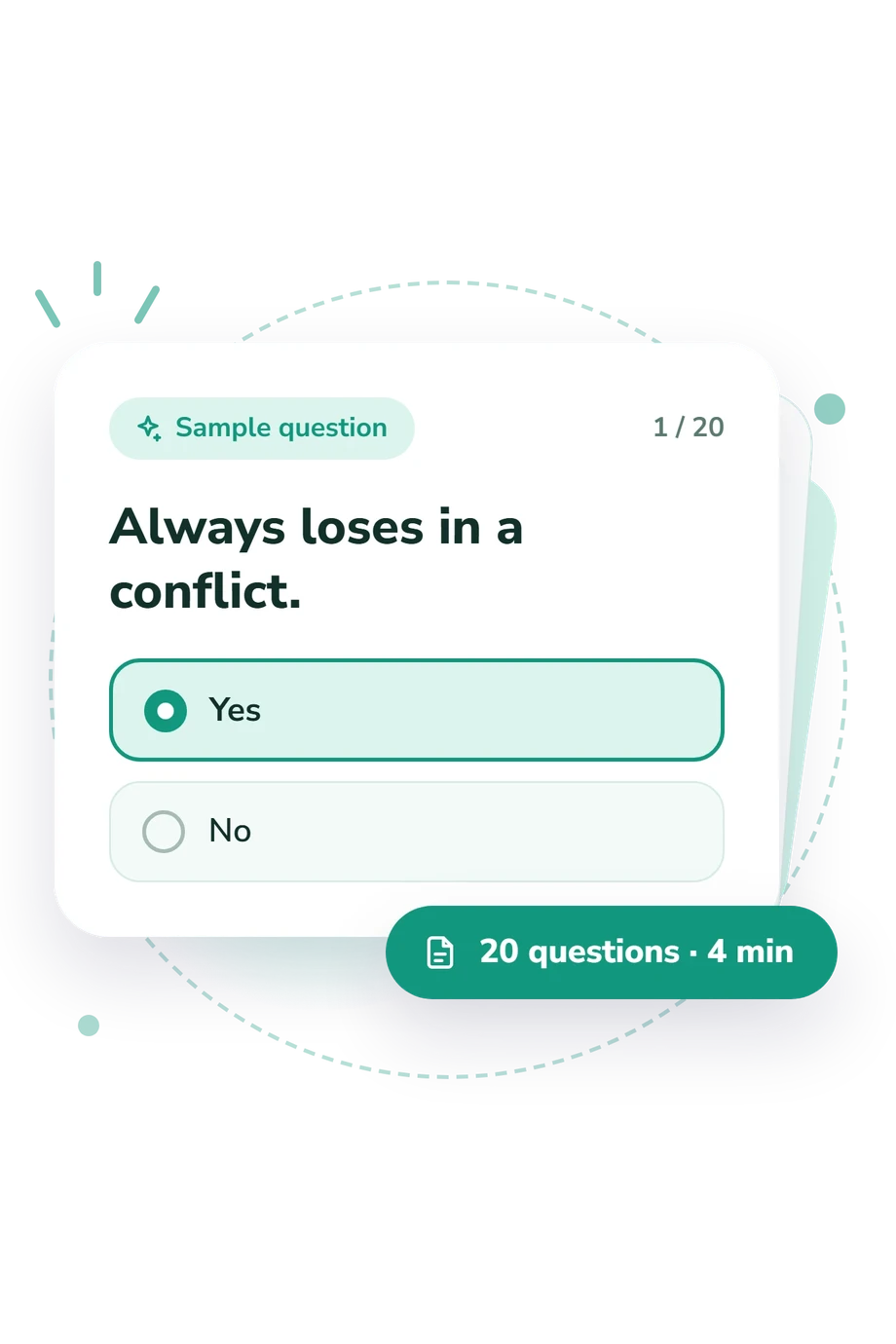
The questionnaire uses 20 statements with Yes/No responses. The items address beliefs, emotions, and tactics during disagreement, such as expecting to lose, suppressing emotion, discussing the issue, seeking weaknesses, applying pressure, or refusing to continue. The scoring produces separate numeric results, but the item weights and reverse-coding rules are not specified, so no point-by-point rule should be inferred.
Its conceptual reference is the Thomas-Kilmann Conflict Mode Instrument (Thomas & Kilmann, 1974), a published forced-choice measure of conflict-handling behavior. Kilmann and Thomas (1977) describe the development of the published Thomas-Kilmann measure, while Ruble and Thomas (1976) support a two-dimensional view of conflict behavior. The online questionnaire is conceptually consistent with these sources, not the original instrument, and does not establish the original instrument’s norms.
For interpretation, compare the results with personal examples rather than treating one profile as universally preferable. As a conflict behavior assessment, this questionnaire can reveal a recurring preference, while stress, context, self-awareness, and impression management can influence Yes/No answers. Without population norms or clinical cutoffs, the results describe this questionnaire’s profile rather than a diagnosis or complete account of behavior.
- Thomas, K. W., & Kilmann, R. H. (1974). Thomas-Kilmann Conflict Mode Instrument. XICOM, Tuxedo, New York.
- Kilmann, R. H., & Thomas, K. W. (1977). Developing a Forced-Choice Measure of Conflict-Handling Behavior: The "Mode" Instrument. Educational and Psychological Measurement, 37(2), 309-325. 10.1177/001316447703700204
- Ruble, T. L., & Thomas, K. W. (1976). Support for a Two-Dimensional Model of Conflict Behavior. Organizational Behavior and Human Performance, 16(1), 143-155. 10.1016/0030-5073(76)90010-6
Updated: