
Strathclyde Inventory (SI-22) Test
How the Scales are Structured
Who Usually Takes This Test?
See How You Compare
Below is a preview of how scores are typically distributed across each scale.
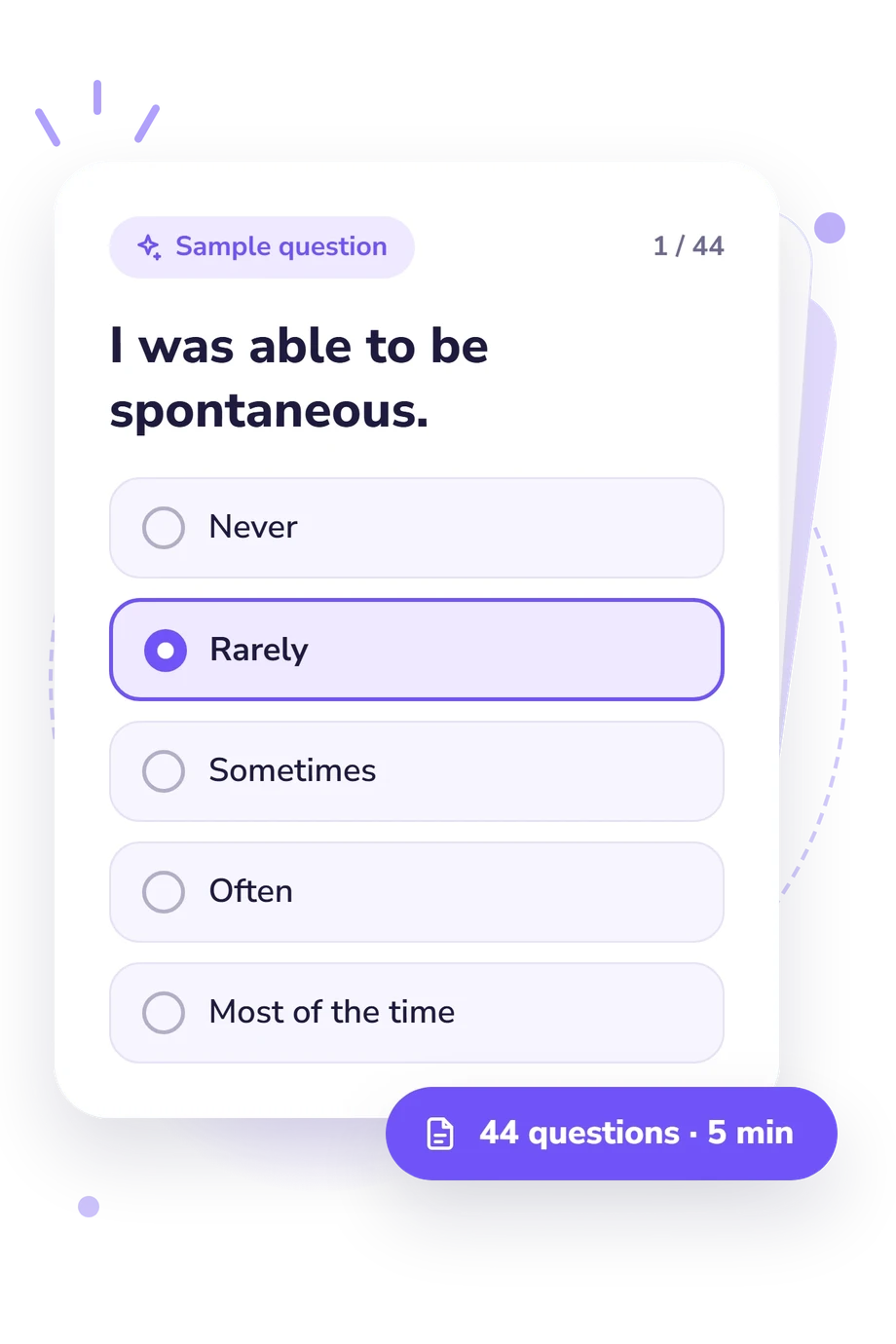
Example Questions From the Test
- Never
- Rarely
- Sometimes
- Often
- Most of the time
- Never
- Rarely
- Sometimes
- Often
- Most of the time
- Never
- Rarely
- Sometimes
- Often
- Most of the time
Strathclyde Inventory (SI-22) Test - Description and methodology of the test
People who want to examine how their everyday experience reflects Rogers’s idea of psychological growth may find the Strathclyde Inventory (SI-22) Test useful. An SI-22 questionnaire can help a respondent notice patterns in self-acceptance, emotional awareness, authenticity, autonomy, relationships, and adaptation. The result offers a focused starting point for personal reflection, especially when someone wants to understand how freely and consistently they are living from their own experience.
What This Assessment Explores
The questions examine spontaneity, self-judgment, emotional reactions, approval-seeking, closeness, responsibility, inner guidance, and feeling true to oneself. They also ask whether a person accepts feelings, understands others, and acts consistently with inner guidance rather than feeling out of character.
The Strathclyde Inventory scale presents one dimension: Fully Functioning Person Level, scored 0-80. It measures potential realization, harmony with self and others, self-regulation, adaptation, openness to experience, inner freedom, and organismic trust. The bands are Developing 0-49, Moderate 50-64, and High 65-80.
The main themes represented in the questions are:
- Self-awareness shows how clearly you notice inner experience.
- Authenticity indicates whether choices feel true to you.
- Autonomy reflects inner judgment and responsibility.
- Emotional flexibility describes acceptance and adaptation.
- Relational openness concerns trust, empathy, and comfort with others.
Methodology and Scientific Basis
Each statement uses five response options-Never, Rarely, Sometimes, Often, or Most of the time-so you rate how frequently an experience fits. The wording includes constructive and difficult experiences, such as spontaneity and self-judgment or self-acceptance and conformity. The displayed result gives a range and bands, but no item-by-item weighting rule is stated; a more detailed scoring formula should not be inferred.
The published Strathclyde Inventory-22 is the closest named source (Freire, 2009). This online questionnaire is a structured self-report conceptually consistent with Rogers’s person-centered theory, emphasizing openness to experience, trust in organismic responses, authenticity, and development; its relationship to published versions, including wording, norms, and standardization, is not established. Stephen and Elliott (2022) discuss a brief Strathclyde instrument for counseling outcomes, and Zech and colleagues (2018) report validation of a French version. These studies concern the instrument family, not this questionnaire.
Use the fully functioning person assessment as a descriptive reflection on current tendencies, not a fixed label. Mood, recent events, self-awareness, and socially desirable responding can affect self-report, so interpret the result alongside concrete experiences and broader reflection.
- Freire, E. S. (2009). The Strathclyde Inventory-22 item version. Unpublished data analyses, University of Strathclyde, Glasgow, UK.
- Zech, E., Brison, C., Elliott, R., Rodgers, B., & Cornelius-White, J. H. D. (2018). Measuring Rogers’ conception of personality development: Validation of the Strathclyde Inventory-French version. Person-Centered & Experiential Psychotherapies, 17(2), 160-184. 10.1080/14779757.2018.1473788
- Stephen, S., & Elliott, R. (2022). The Strathclyde inventory: Development of a brief instrument for assessing outcome in counseling according to Rogers’ concept of the fully functioning person. Measurement and Evaluation in Counseling and Development, 55(3), 187-206. 10.1080/07481756.2021.1955213
- Rogers, C. R. (1961). On Becoming a Person: A Therapist’s View of Psychotherapy. Boston, MA: Houghton Mifflin.
Updated: