
Freudly+971 508685814hello@freudly.ai
Freudly
attitude towards illness

Attitudes Toward Illness Questionnaire Test
Take the online Attitudes Toward Illness Questionnaire Test - AI psychologist FreudlyYou can take Attitudes Toward Illness Questionnaire Testhere. Online version of a simple and accurate psychological test with interpretation.en
Understand how someone thinks and feels about their illness in about 27 minutes. Get clear, actionable insight to improve communication and support during treatment.
Start Online Test
Questions: 1227 minutes
08:30
October 2, 2025
October 2, 2025
Material has been updated
October 2, 2025
Material has been published
18,508 views
1,774 completions
1,528 likes
Verified by Daniel Hall
Psychologist with 25 years of experience
Share
Scale Explorer

How the Scales are Structured

example score
23/27
Hypochondriacal (H)
Measures the degree of preoccupation with bodily sensations and fear of having a serious illness, including symptom exaggeration and persistent reassurance-seeking.
Low
Elevated
High
015: Low | 1622: Elevated | 2327: High
A score of 23 falls in the High range, indicating a pronounced focus on symptoms and strong health-related worry that may be difficult to relieve with reassurance.
example score
21/27
Paranoid (P)
Measures the degree of suspiciousness and tendency to attribute illness-related problems to others’ mistakes or malicious intent.
Low
Moderate
High
015: Low | 1622: Moderate | 2327: High
A score of 21 falls in the Moderate range, indicating a noticeable tendency to mistrust others’ intentions and to blame medical staff or close ones for illness-related difficulties.
example score
20/27
Egocentric (E)
Measures the extent to which a person seeks attention or special treatment by emphasizing suffering and the uniqueness of their illness.
Low
Moderate
High
015: Low | 1622: Moderate | 2327: High
A score of 20 falls in the Moderate range, suggesting a noticeable tendency to highlight illness-related experiences to gain attention or preferential consideration, though not at the most pronounced level.
example score
20/27
Sensitive (S) (S)
Measures how strongly a person is emotionally sensitive and concerned about others’ opinions regarding their illness.
Low
Moderate
High
015: Low | 1622: Moderate | 2327: High
A score of 20 falls in the Moderate range, suggesting noticeable sensitivity and concern about how the illness is perceived by others, though not at the most pronounced level.
example score
23/27
Dysphoric (D) (D)
Measures the tendency to respond to illness with irritability, aggression, and suspicious or blaming attitudes toward treatment and others.
Low
Elevated
High
014: Low | 1522: Elevated | 2327: High
A score of 23 falls in the High range, suggesting pronounced dysphoric reactions such as irritability, bitterness, and suspicion that may color interactions around illness and care.
example score
22/27
Apathetic (A) (A)
Measures the degree of indifferent, detached attitude toward illness, with passive compliance and reduced engagement in treatment and life events.
Low
Moderate
High
014: Low | 1522: Moderate | 2327: High
A score of 22 falls in the Moderate range, suggesting notable apathy with limited interest in the illness and a tendency toward passive participation in care.
example score
12/27
Melancholic (M) (M)
Measures the degree of depressive, pessimistic feelings and hopelessness in a person’s attitude toward their illness and future.
Low
Moderate
High
014: Low | 1522: Moderate | 2327: High
A score of 12 falls in the Low range, indicating relatively few melancholic features such as pessimism or hopelessness in the current attitude toward illness.
example score
4/27
Neurasthenic (N) (N)
Assesses the degree of irritability, impatience, and mood instability related to experiencing illness and treatment interactions.
Low
Moderate
High
014: Low | 1522: Moderate | 2327: High
A score of 4 falls in the Low range, suggesting minimal neurasthenic features such as illness-related irritability or impatience.
example score
17/27
Anxious (T) (A)
Measures the degree of worry, fear of consequences, and heightened attention to information and treatment related to one’s illness.
Low anxiety
Moderate anxiety
High anxiety
014: Low anxiety | 1522: Moderate anxiety | 2327: High anxiety
A score of 17 falls in the Moderate anxiety range, suggesting noticeable worry about the illness and its outcomes with a tendency to seek reassurance or additional information.
example score
17/27
Anosognosic Type (Z) (AT)
Measures the tendency to deny, minimize, or ignore an illness and its potential consequences.
Low denial
Moderate denial
High denial
014: Low denial | 1522: Moderate denial | 2327: High denial
A score of 17 falls in the Moderate denial range, suggesting a noticeable tendency to downplay or disregard aspects of the illness in thoughts and emotions.
example score
24/27
Ergopathic (E)
Measures the tendency to cope with illness by prioritizing work and maintaining professional/social roles, sometimes minimizing symptoms and treatment constraints.
Low
Moderate
High
015: Low | 1622: Moderate | 2327: High
A score of 24 falls in the High range, suggesting a strong focus on staying productive and preserving status, with possible downplaying of illness-related limitations.
example score
2/27
Harmonious (H) (H)
Assesses how realistically and constructively a person relates to their illness and engages with treatment while maintaining everyday functioning.
Low harmonious attitude
Moderate harmonious attitude
High harmonious attitude
014: Low harmonious attitude | 1522: Moderate harmonious attitude | 2327: High harmonious attitude
A score of 2 indicates a low harmonious attitude, suggesting limited presence of a calm, realistic, and actively cooperative approach to the illness in this profile.
Start Online Test
just completed the test
DATA-BASED USER COHORTS

Who Usually Takes This Test?

Chronic condition patients
41%OF USERS
People living with long-term illnesses who want to understand whether they cope calmly, anxiously, or through avoidance and how that may affect treatment.
Recently diagnosed patients
34%OF USERS
People processing a new diagnosis who want to clarify their emotional reaction and readiness to follow medical recommendations.
Clinicians screening attitudes
25%OF USERS
Doctors and nurses using a quick tool to identify a patient’s typical response to illness and tailor communication and support.
BASED ON AGGREGATED, ANONYMIZED DATA FROM TENS OF THOUSANDS OF FREUDLY USERS.
Benchmarking

See How You Compare

Once you complete the test, your results are compared with real-world data from people in your country.
Below is a preview of how scores are typically distributed across each scale.
Hypochondriac (H) (H()
Average
14.9
Normal range
10.519.2
min.
0
max.
27
This curve shows how scores are typically distributed.
Once you complete the test, your result will appear on the scale so you can see how you compare.
Paranoid (P) (P()
Paranoid (P) (P()
Average
9
Normal range
5.112.9
min.
0
max.
27
This curve shows how scores are typically distributed.
Once you complete the test, your result will appear on the scale so you can see how you compare.
Egocentric (E) (E()
Egocentric (E) (E()
Average
10.4
Normal range
6.214.5
min.
0
max.
27
This curve shows how scores are typically distributed.
Once you complete the test, your result will appear on the scale so you can see how you compare.
Sensitive (S) (S()
Sensitive (S) (S()
Average
9.9
Normal range
5.714
min.
0
max.
27
This curve shows how scores are typically distributed.
Once you complete the test, your result will appear on the scale so you can see how you compare.
Dysphoric (D) (D()
Dysphoric (D) (D()
Average
15.9
Normal range
12.219.6
min.
0
max.
27
This curve shows how scores are typically distributed.
Once you complete the test, your result will appear on the scale so you can see how you compare.
Apathetic (A) (A()
Apathetic (A) (A()
Average
8.3
Normal range
4.412.2
min.
0
max.
27
This curve shows how scores are typically distributed.
Once you complete the test, your result will appear on the scale so you can see how you compare.
Melancholic (M) (M()
Average
15.9
Normal range
12.419.5
min.
0
max.
27
This curve shows how scores are typically distributed.
Once you complete the test, your result will appear on the scale so you can see how you compare.
Neurasthenic (N) (N()
Average
17.2
Normal range
12.621.7
min.
0
max.
27
This curve shows how scores are typically distributed.
Once you complete the test, your result will appear on the scale so you can see how you compare.
Anxious (A) (A()
Anxious (A) (A()
Average
9.5
Normal range
5.213.8
min.
0
max.
27
This curve shows how scores are typically distributed.
Once you complete the test, your result will appear on the scale so you can see how you compare.
Anosognosic (A) (A()
Average
12
Normal range
7.416.7
min.
0
max.
27
This curve shows how scores are typically distributed.
Once you complete the test, your result will appear on the scale so you can see how you compare.
Ergopathic (R) (E()
Ergopathic (R) (E()
Average
19.2
Normal range
15.123.3
min.
0
max.
27
This curve shows how scores are typically distributed.
Once you complete the test, your result will appear on the scale so you can see how you compare.
Harmonious (H) (H()
Harmonious (H) (H()
Average
18
Normal range
13.622.5
min.
0
max.
27
This curve shows how scores are typically distributed.
Once you complete the test, your result will appear on the scale so you can see how you compare.
Featured On
SAMPLE QUESTIONS

Example Questions From the Test

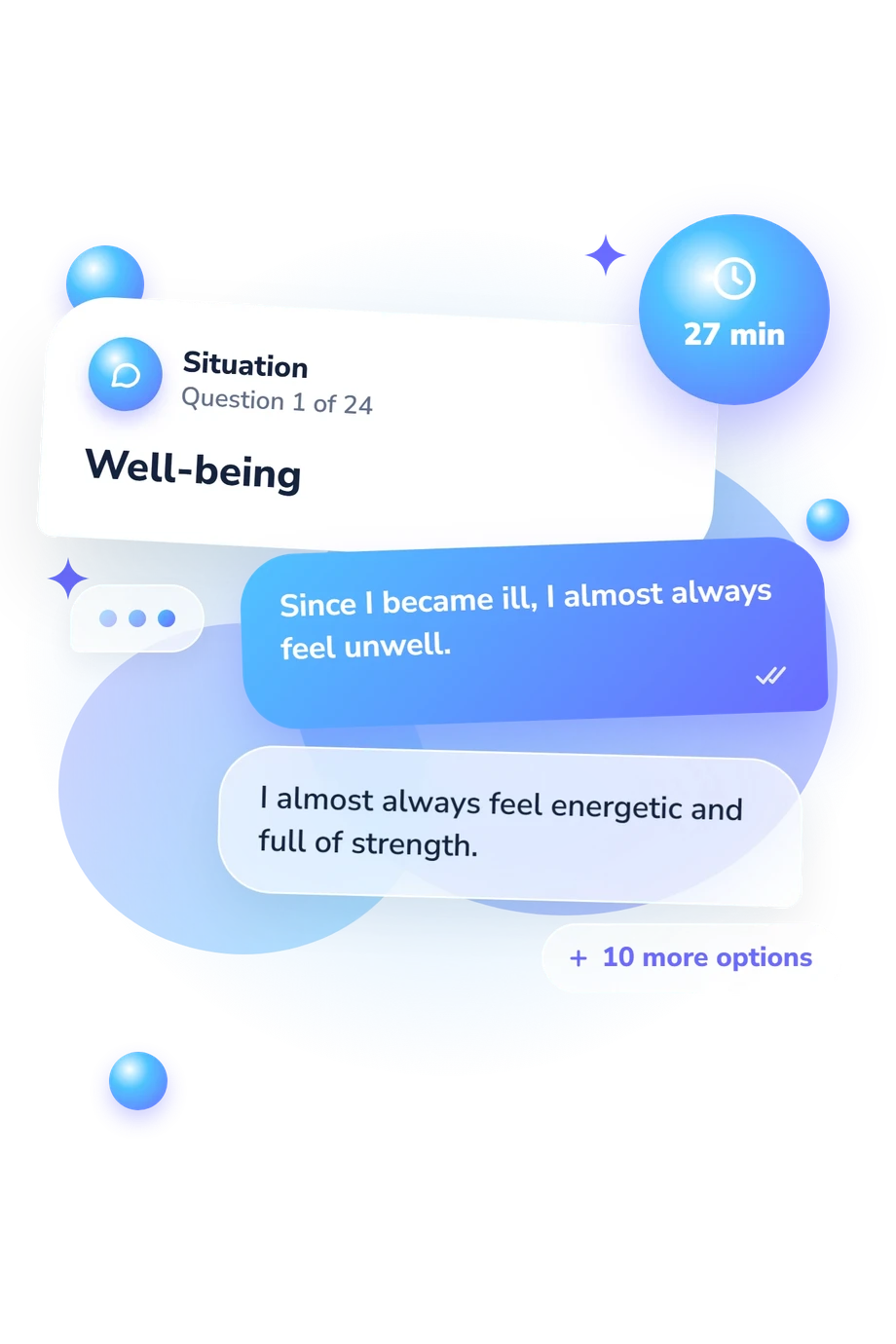
Below is a series of statements concerning your illness, your well-being, and certain aspects of life in general. Please indicate the statements you consider true for you. In each section, you may select no more than two statements.
    • Since I became ill, I have felt unwell almost all the time.
    • I feel energetic and full of strength almost all the time.
    • I try to overcome feeling unwell.
    • I try not to show others when I feel unwell.
    • I almost always have some kind of pain.
    • I feel unwell after upsetting events.
    • I start to feel unwell when I am expecting trouble.
    • I try to endure pain and physical suffering patiently.
    • My well-being is quite satisfactory.
    • Since I became ill, I have had periods of feeling unwell with irritability and a feeling of sadness.
    • My well-being depends greatly on how other people treat me.
    • None of these statements applies to me.
    • As a rule, my mood is very good.
    • Because of my illness, I am often impatient and irritable.
    • My mood worsens because I anticipate possible troubles, worry about loved ones, and feel uncertain about the future.
    • Because of my illness, I do not allow myself to give in to despondency or sadness.
    • Because of my illness, I almost always feel in a bad mood.
    • My low mood depends on how unwell I feel.
    • My mood has become completely indifferent.
    • I have bouts of dark irritability during which people around me get the brunt of it.
    • I do not feel despondent or sad, but I may feel hardened and angry.
    • Even minor troubles upset me a great deal.
    • Because of my illness, I feel anxious all the time.
    • None of these statements applies to me.
    • When I wake up, I immediately make myself get up.
    • Morning is the hardest time of day for me.
    • If something upsets me, I cannot fall asleep for a long time.
    • I sleep poorly at night and feel sleepy during the day.
    • I sleep little but wake up feeling refreshed. I rarely have dreams.
    • In the morning I am more active, and it is easier for me to work than in the evening.
    • I sleep poorly and restlessly, and I often have distressing, gloomy dreams.
    • In the morning I get up feeling alert and energetic.
    • I wake up thinking about what I will need to do today.
    • At night I have episodes of fear.
    • In the morning I feel completely indifferent to everything.
    • At night, I am especially troubled by thoughts about my illness.
    • In my dreams I see all kinds of illnesses.
    • None of the statements applies to me.
WHAT THE TEST MEASURES
About This Assessment
Type of Attitude Towards Illness, TOBOL Test

Attitudes Toward Illness Questionnaire Test - Symptoms and Signs

attitude towards illness
uneasiness

This questionnaire is designed to help clinicians characterize how an individual perceives and emotionally responds to having a health condition. The Attitudes Toward Illness Questionnaire provides a brief, structured self-report format to support case formulation and clinical communication; it is attributed to Howard Leventhal and Kenneth A. Wallston.

The instrument contains 12 items and typically requires about 27 minutes to complete. The Attitudes Toward Illness Questionnaire may be used to identify broad patterns of illness-related beliefs and coping responses that can inform patient education, engagement, and supportive interventions alongside medical care.

Author: Howard Leventhal, Kenneth A. Wallston
Literature: Leventhal, H., Meyer, D., & Nerenz, D. The common sense representation of illness danger. In S. Rachman (Ed.), Medical psychology (Vol. 2). Pergamon Press. 1980.
Popular tests
Comments
Leave a Comment