
Freudly+971 508685814hello@freudly.ai
Freudly
autonomy

Psychological Space Sovereignty Questionnaire (PSS) Test
Take the online Psychological Space Sovereignty Questionnaire (PSS) Test - AI psychologist FreudlyYou can take Psychological Space Sovereignty Questionnaire (PSS) Testhere. Online version of a simple and accurate psychological test with interpretation.en
Understand how confidently someone sets and protects personal boundaries in about 13 minutes. Get clear, actionable insights across key areas of personal space for adults, teens, and family work.
Start Online Test
Questions: 6713 minutes
08:30
October 2, 2025
October 2, 2025
Material has been updated
October 2, 2025
Material has been published
17,589 views
2,023 completions
1,670 likes
Verified by Daniel Hall
Psychologist with 25 years of experience
Share
Scale Explorer

How the Scales are Structured

example score
-10/14
Sovereignty of Values (SoV)
Measures how freely a person can adhere to their own views, tastes, and worldview without adopting others’ beliefs under pressure.
Low autonomy
High autonomy
-14-1: Low autonomy | 014: High autonomy
A score of -10 falls in the Low autonomy range, suggesting notable pressure or influence from others that can make it harder to maintain and act on personal values.
example score
-3/7
Sovereignty of Social Connections (SoSC)
Measures how freely a person can choose their social circle and maintain relationships without external control or restrictions.
Restricted
Balanced
-7-1: Restricted | 07: Balanced
A score of -3 suggests reduced autonomy in choosing and maintaining social connections, with some perceived external influence or limitations.
example score
-6/12
Sovereignty of Habits (SoH)
Measures how confidently a person accepts and protects their daily routine and stable habits from external pressure.
Low confidence
Balanced
High confidence
-12-1: Low confidence | 0: Balanced | 112: High confidence
A score of -6 falls in the Low confidence range, suggesting the person may experience frequent outside influence on their usual routines and habits.
example score
4/13
Sovereignty of the World of Things (SotWoT)
Measures how strongly a person recognizes and protects their right to control and be respected in relation to personal belongings.
Low
Moderate
-13-1: Low | 013: Moderate
A score of 4 falls in the Moderate range, suggesting generally adequate respect for personal property and the ability to assert control over belongings, with occasional boundary challenges possible.
example score
2/10
Territorial Sovereignty (TS)
Territorial Confidence measures how safe and in control a person feels over their personal physical space and its boundaries.
Blurred boundaries
Clear boundaries
-100: Blurred boundaries | 010: Clear boundaries
A score of 2 suggests generally clear territorial boundaries with some room to strengthen consistency in maintaining control over personal space.
example score
1/11
Physical Body Sovereignty (PBS)
Measures how protected and respected a person feels regarding their bodily boundaries against unwanted physical intrusions.
Low confidence
High confidence
-110: Low confidence | 111: High confidence
A score of 1 falls in the High confidence range, suggesting generally adequate comfort with bodily boundaries and basic readiness to uphold them when needed.
example score
-33/67
Psychological Space Sovereignty (PSS)
This scale measures how confidently a person maintains and protects their personal boundaries while meeting their needs.
Low confidence
High confidence
-67-1: Low confidence | 067: High confidence
A score of -33 falls in the Low confidence range, suggesting reduced consistency in recognizing and defending personal boundaries when needs or pressures arise.
Start Online Test
just completed the test
DATA-BASED USER COHORTS

Who Usually Takes This Test?

Workplace boundary builders
41%OF USERS
Employees and managers take it to understand how confidently they protect personal space, habits, and values at work.
Parents of teenagers
34%OF USERS
Parents use it to see where a teen’s boundaries are strong or fragile and how this affects family closeness and conflict.
Therapy and coaching clients
25%OF USERS
People in counseling or personal development take it to pinpoint which areas of their personal boundaries need strengthening.
BASED ON AGGREGATED, ANONYMIZED DATA FROM TENS OF THOUSANDS OF FREUDLY USERS.
Benchmarking

See How You Compare

Once you complete the test, your results are compared with real-world data from people in your country.
Below is a preview of how scores are typically distributed across each scale.
Confidence in values (Civ)
Average
-5.2
Normal range
-9.7-0.6
min.
-14
max.
14
This curve shows how scores are typically distributed.
Once you complete the test, your result will appear on the scale so you can see how you compare.
Confidence in Social Connections (CiSC)
Average
-2.5
Normal range
-4.9-0.2
min.
-7
max.
7
This curve shows how scores are typically distributed.
Once you complete the test, your result will appear on the scale so you can see how you compare.
Confidence in Habits (CiH)
Average
-1.9
Normal range
-6.22.4
min.
-12
max.
12
This curve shows how scores are typically distributed.
Once you complete the test, your result will appear on the scale so you can see how you compare.
Confidence in the World of Things (CitWoT)
Average
-6.3
Normal range
-10.8-1.8
min.
-13
max.
13
This curve shows how scores are typically distributed.
Once you complete the test, your result will appear on the scale so you can see how you compare.
Territorial Confidence (TC)
Average
-0.8
Normal range
-3.82.3
min.
-10
max.
10
This curve shows how scores are typically distributed.
Once you complete the test, your result will appear on the scale so you can see how you compare.
Physical Body Confidence (PBC)
Average
-2.4
Normal range
-5.40.6
min.
-11
max.
11
This curve shows how scores are typically distributed.
Once you complete the test, your result will appear on the scale so you can see how you compare.
Confidence in the Psychological Space (CitPS)
Average
2.8
Normal range
-21.727.3
min.
-67
max.
67
This curve shows how scores are typically distributed.
Once you complete the test, your result will appear on the scale so you can see how you compare.
Featured On
SAMPLE QUESTIONS

Example Questions From the Test

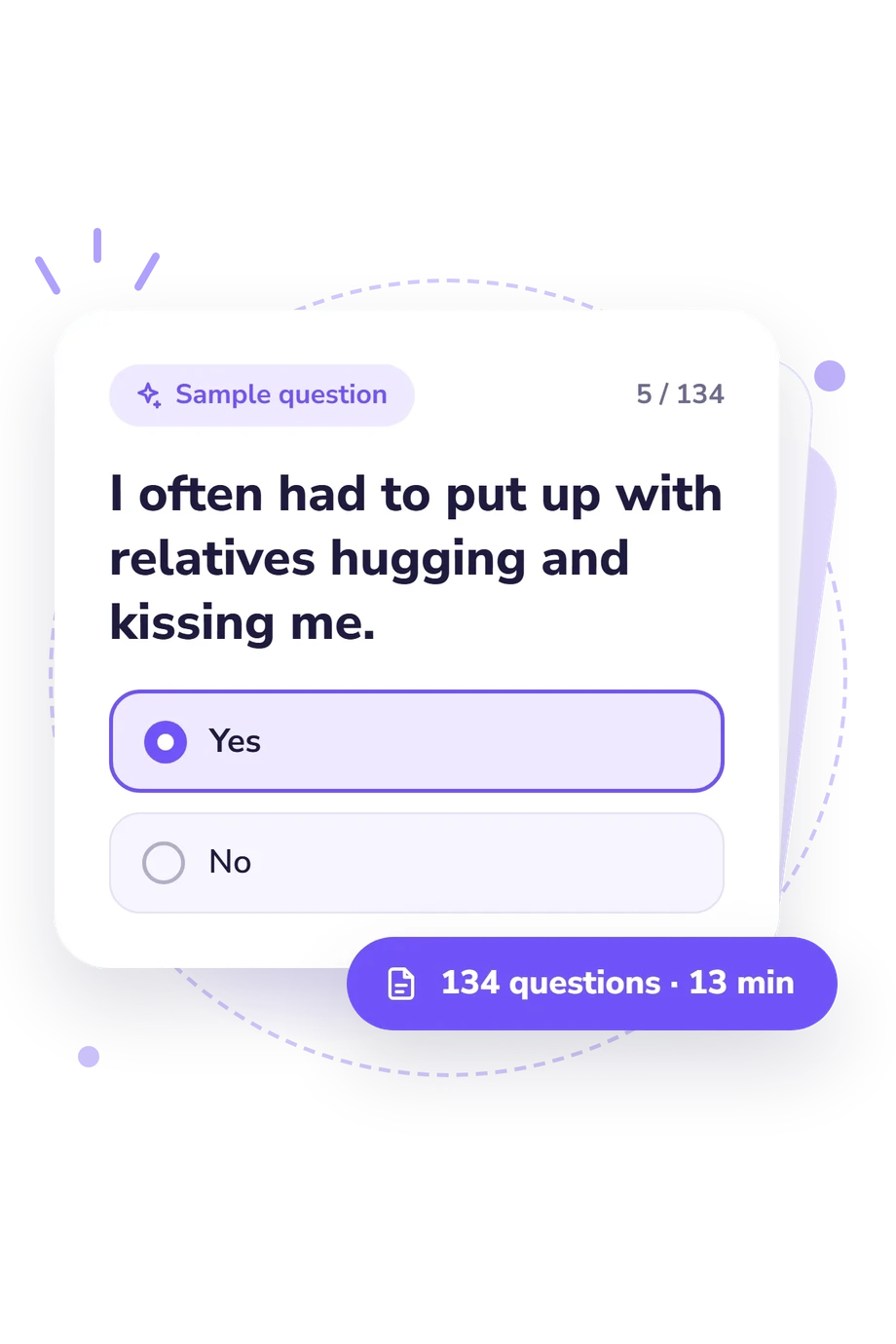
You are asked to evaluate statements in a questionnaire that describes a person’s childhood. If the content of a statement applies to you, respond “Yes.” If you have not encountered similar situations in your life, respond “No.” If it is difficult to recall what actually occurred, indicate what you consider the most likely situation. This questionnaire does not assess intellectual ability; therefore, there are no right or wrong answers, and each response option occurs in real life. Please try not to spend too much time thinking about each item.
    • Yes
    • No
    • Yes
    • No
    • Yes
    • No
WHAT THE TEST MEASURES
About This Assessment
Psychological Space Sovereignty, PSS-2010 Test

Psychological Space Sovereignty Questionnaire (PSS) Test - Symptoms and Signs

autonomy
boundaries
family

This questionnaire is used to assess perceived personal boundary regulation across everyday domains. The Psychological Space Sovereignty Questionnaire (PSS) is intended to support clinical and counseling formulations related to autonomy, privacy, and boundary-setting in adolescents and adults.

The measure includes 67 items and typically takes about 13 minutes to complete. Content is organized around multiple domains of psychological space (e.g., bodily autonomy, personal territory, possessions, routines, social ties, and personal values), helping to characterize how consistently an individual experiences and protects these boundaries across contexts.

The Psychological Space Sovereignty Questionnaire (PSS) is attributed to Irwin Altman and may be used alongside interview and collateral information to inform case conceptualization; interpretation should consider developmental stage, cultural norms, and situational demands.

Author: Irwin Altman
Literature: Altman, I. The environment and social behavior: Privacy, personal space, territory, and crowding. Brooks/Cole. 1975.; Westin, A. F. Privacy and freedom. Atheneum. 1967.; Brown, G., Lawrence, T. B., & Robinson, S. L. Territoriality in organizations. Academy of Management Review. 2005.
Popular tests
Comments
Leave a Comment