
Optimism/Pessimism Test (QPOP)
How the Scales are Structured
Who Usually Takes This Test?
See How You Compare
Below is a preview of how scores are typically distributed across each scale.
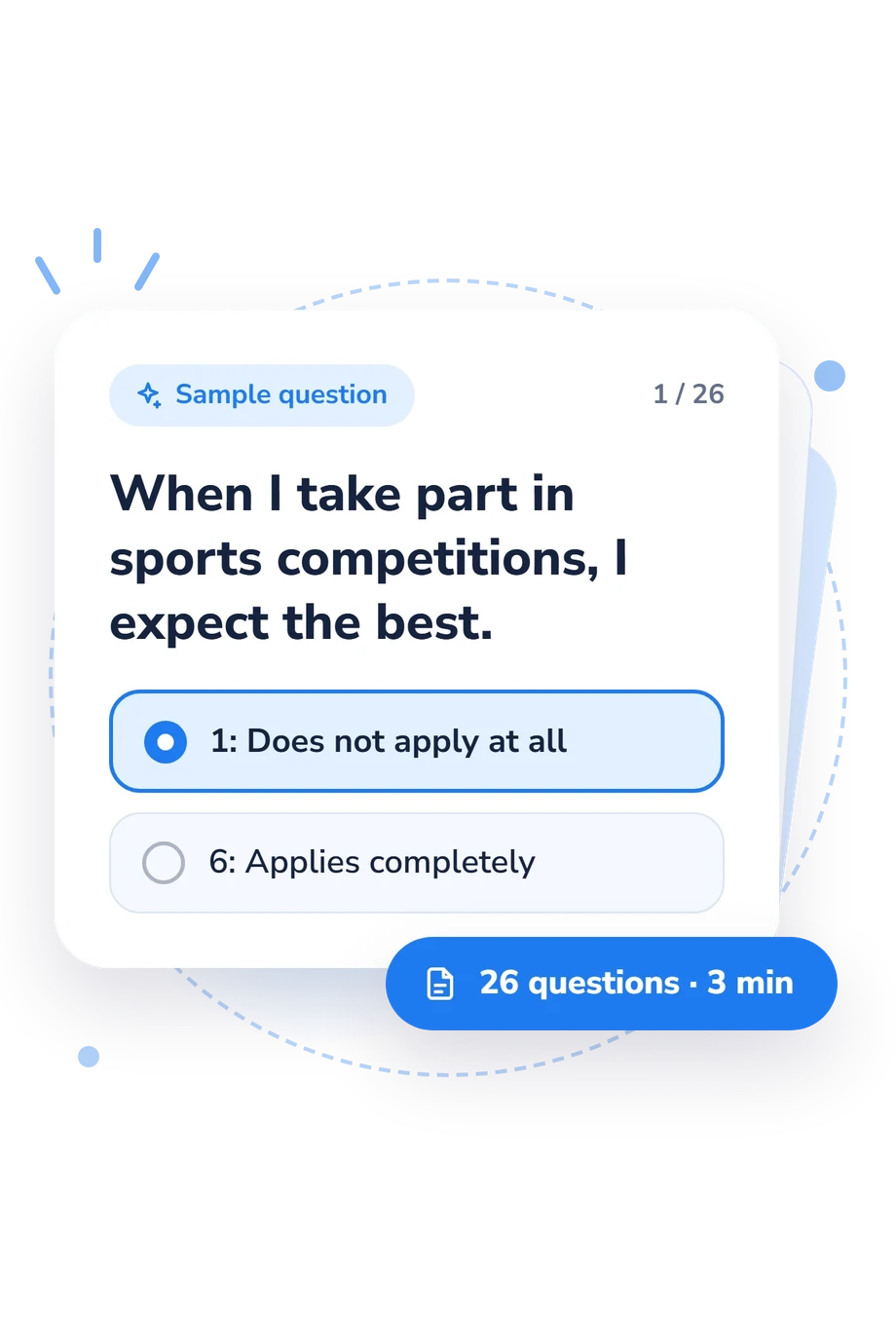
Example Questions From the Test
- 1: Does not apply to me at all
- 6: Applies to me completely
- 1: Does not apply at all
- 6: Completely applies
- 1: Does not apply at all
- 6: Applies completely
Optimism/Pessimism Test (QPOP) - Description and methodology of the test
People who want to understand how they approach performance pressure can use the Optimism/Pessimism Test (QPOP) to examine expectations about future outcomes. This optimism and pessimism assessment is intended for readers reflecting on competitions, achievement, and situations in which confidence and worry coexist. Its result places reported expectations on a continuum, helping clarify whether anticipation tends toward favorable outcomes or possible difficulties.
What This Test Measures
This questionnaire assesses a person's overall optimism versus pessimism about the future, using competition and performance situations as the contexts for its items. Its themes include success, poor results, anxiety, preparation, failure, effective performance, and perceived previous achievement.
The item themes fall into three overlapping content areas, not separate result dimensions:
- Positive anticipation describes expectations that success or effective performance will occur.
- Threat anticipation covers attention to poor results and possible failure.
- Performance concern covers anxiety, preparation worries, and imagined consequences.
The result is shown on one continuum, Pessimism to Optimism: -30-30. The catalogue defines it as overall optimism versus pessimism: negative scores indicate a pessimistic view of the future, 0 is neutral, and positive scores indicate an optimistic orientation. The displayed bands are Pessimistic -30-0 and Optimistic 1-30.
This optimism test therefore describes the direction of expectations rather than their cause or the outcome achieved.
Methodology and Scientific Basis
Each prompt uses a six-point self-report format, from “does not apply to me at all” to “applies completely.” Respondents rate expectations and reactions in performance contexts. Responses are combined into one displayed continuum with the stated bands; the questionnaire offers no additional item-level interpretation, so individual answers should not be read as separate results.
The closest published reference is QPOP, a sport-focused work addressing optimism, pessimism, anxiety, and performance-related thinking. This questionnaire is conceptually consistent with it, not presented as a direct adaptation. Norem and Cantor offer a complementary framework: defensive pessimism describes how anticipating difficulties can channel anxiety into preparation, so negative expectations do not automatically signify poor coping.
Although the result is a single optimism-pessimism scale rather than a separate pessimism test, its pessimistic end draws on items about failure concern, preparation, and past performance; the score reflects overall optimism versus pessimism, and an optimistic result does not guarantee success. Current context, self-awareness, memory, anxiety, and self-presentation can influence responses, so the score is a context-dependent snapshot of reported expectations rather than a standalone clinical conclusion.
- Pérès, C., Cury, F., Famose, J.-P., & Sarrazin, P. (2002). When Anxiety Is Not Always a Handicap in Physical Education and Sport: Some Implications of the Defensive Pessimism Strategy. European Journal of Sport Science, 2(1), 1-9. 10.1080/17461390200072101
- Norem, J. K., & Cantor, N. (1986). Defensive Pessimism: Harnessing Anxiety as Motivation. Journal of Personality and Social Psychology, 51(6), 1208-1217. 10.1037/0022-3514.51.6.1208
Updated: