
Burnout Assessment Tool (BAT) Test
How the Scales are Structured
Who Usually Takes This Test?
See How You Compare
Below is a preview of how scores are typically distributed across each scale.
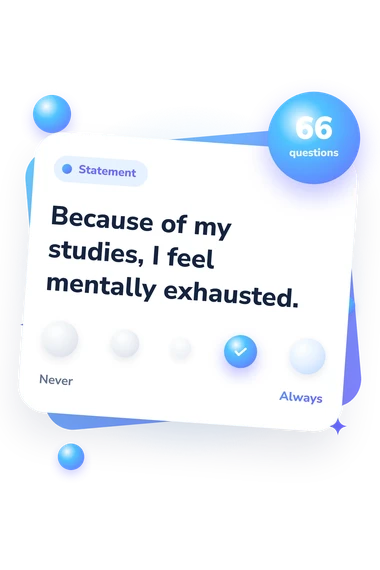
Example Questions From the Test
- Never
- Rarely
- Sometimes
- Often
- Always
- Never
- Rarely
- Sometimes
- Often
- Always
- Never
- Rarely
- Sometimes
- Often
- Always
Burnout Assessment Tool (BAT) Test - Description and methodology of the test
People who feel persistently drained, detached, or mentally overloaded by studying or working can use the Burnout Assessment Tool (BAT) Test to organize those experiences into a clearer profile. This burnout test places study-focused experiences within occupational-burnout dimensions, helping readers notice whether fatigue, disengagement, emotional strain, cognitive slips, or stress-related complaints are most prominent.
What This Assessment Explores
Burnout is an occupational pattern, not one feeling; the burnout symptom assessment highlights prominent study-related experiences.
The dimensions are:
- Mental Distance (1-5) measures detachment and reduced engagement: Low distancing 1-2.5; Moderate distancing 2.6-3.1; High distancing 3.2-5.
- Secondary Symptoms (1-5) measures psychosomatic complaints and reduced well-being: Low 1-2.84; Moderate 2.85-3.35; High 3.36-5.
- Emotional Difficulties (1-5) measures irritability, anxiety, and emotional regulation: Low 1-2.7; Moderate 2.7-3.1; High 3.1-5.
- Cognitive Impairment (1-5) measures concentration, memory, and thinking difficulties: Low 1-2.1; Moderate 2.1-2.9; High 2.9-5.
- Exhaustion (1-5) measures physical and emotional exhaustion: Low 1-3.3; High 3.31-5.
- Burnout Level (1-5) measures overall occupational burnout across these dimensions: Low 1-2.59; Moderate 2.6-3.02; High 3.03-5.
Methodology and Scientific Basis
The shown response options use five frequency choices, Never to Always, for study- or work-related experiences. Results display dimension scores and bands; the definitions link higher values with more frequent or pronounced difficulties where stated.
This online questionnaire is conceptually consistent with BAT-S (Schaufeli et al., 2020), but it is not a direct adaptation. The BAT framework distinguishes core strain, detachment, thinking, emotional, and secondary symptoms. Schaufeli, Desart, and De Witte (2020) support this model, while Popescu, Maricuțoiu, and De Witte (2024) provide psychometric evidence for the student version in a Romanian sample. Together, these BAT and BAT-S studies support the conceptual model but do not establish norms or validation for this online questionnaire.
Scores are a snapshot of perceived functioning in the context considered. A higher pattern can prompt review of workload, recovery, sleep, stress, or support, while self-report is sensitive to current circumstances, self-awareness, physical health, and response style. The occupational burnout assessment supports early identification of occupational exhaustion; this tool is a reflection tool, not a diagnosis.
- Schaufeli, W. B., De Witte, H., & Desart, S. (2020). Burnout Assessment Tool - Student Version (BAT-S). KU Leuven, Belgium.
- Schaufeli, W. B., Desart, S., & De Witte, H. (2020). Burnout Assessment Tool (BAT)-Development, Validity, and Reliability. International Journal of Environmental Research and Public Health, 17(24), 9495. 10.3390/ijerph17249495
- Popescu, B., Maricuțoiu, L. P., & De Witte, H. (2024). The student version of the Burnout Assessment Tool (BAT): Psychometric properties and evidence regarding measurement validity on a Romanian sample. Current Psychology, 43(3), 2037-2051. 10.1007/s12144-023-04232-w