
Interests and Aptitudes Test
How the Scales are Structured
Who Usually Takes This Test?
See How You Compare
Below is a preview of how scores are typically distributed across each scale.
Example Questions From the Test
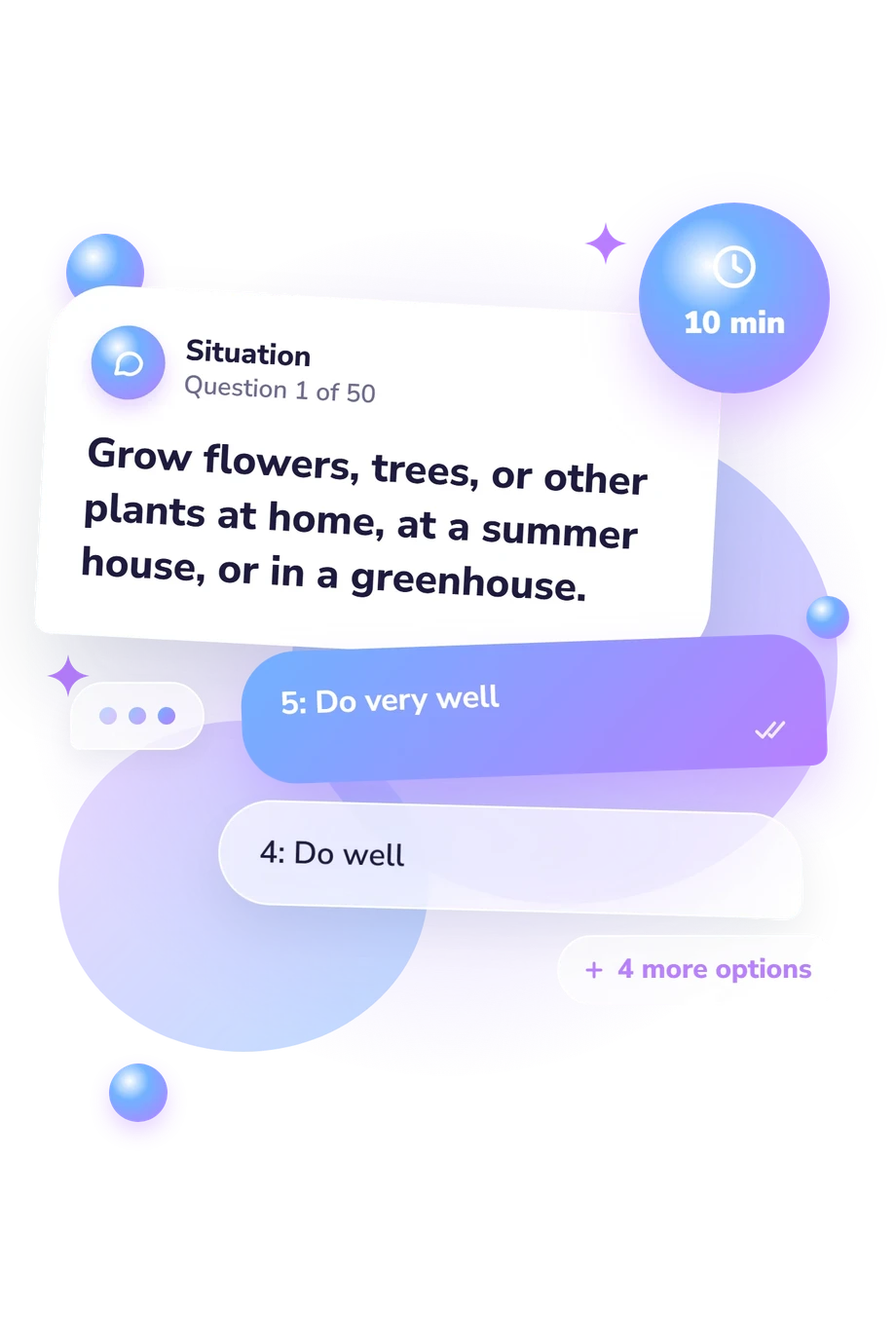
- 5: Do very well
- 4: Do well
- 3: Average
- 2: Do poorly
- 1: Do very poorly
- 0: Have not done this
- 5: Like very much
- 4: Like
- 3: Neutral
- 2: Dislike
- 1: Dislike very much
- 0: Have not done this
- 5: Do very well
- 4: Do well
- 3: Do moderately well
- 2: Do poorly
- 1: Do very poorly
- 0: Have not done this
Interests and Aptitudes Test - Description and methodology of the test
When you are weighing different fields of study or work, this assessment helps compare the relative prominence of five broad activity domains. As a career interest test, it can clarify whether artistic, symbolic, people-focused, technological, or nature-related work stands out more strongly in your profile. The Interests and Aptitudes Test presents relative prominence, not one required path.
What This Assessment Explores
Items ask about liking and perceived ability across five areas, while the scales report interest in related activities and occupational inclination. They cover creative work, information and symbols, communication and care, technical problem-solving, and living systems, allowing comparison of occupational interests.
The displayed dimensions are:
- Artistic Expression (X), 0-10, measures interest in art, music, literature, design, and creativity; Low 0-3, Moderate 4-7, High 8-10.
- Symbol Systems (Z), 0-10, measures interest in information, languages, codes, and computations; Low 0-3, Moderate 4-7, High 8-10.
- People, 0-10, measures interest in communication, teaching, and helping; Lower people-focus 0-4, Moderate people-focus 5-7, High people-focus 8-10.
- Technology (T), 0-10, measures interest in technical sciences, mechanisms, devices, and engineering; Low 0-4, Moderate 5-7, High 8-10.
- Nature, 0-10, measures interest in animals, plants, and the environment; Low 0-3, Moderate 4-7, High 8-10.
Methodology and Scientific Basis
Responses use six choices labelled 0 through 5. Depending on wording, a person rates ability, liking, or enjoyment; the zero choice records that the person has not done the activity, rather than measuring experience on the same scale. Answers are grouped by dimension into a profile. The questionnaire does not specify how responses are combined into displayed scale scores.
The structure is conceptually consistent with Test of Interests and Inclinations (Vershinin, 2010), while Klimov’s (1974) framework explains broad orientations between a person and the object of work. These sources provide context for the five domains but do not establish that this questionnaire is an adaptation of that instrument or specify how its scores should be interpreted.
For a vocational interest profile, read a high area as stronger attraction to tasks, not proof of ability or a guaranteed fit. Interest and confidence may diverge: someone can enjoy an activity without feeling skilled, or perform it well without wanting it as work. Circumstances, opportunity, familiarity, and response style can also shape self-report, so interpret the profile alongside experience, values, and practical constraints.
- Vershinin, S. I. (2010). Comparison of Students' Professional Interests with the Requirements of the Profession. School and Production, No. 3, pp. 90-92.
- Klimov, E. A. (1974). Path to a Profession: An Experimental Textbook for Senior Classes of Comprehensive Schools. Leningrad: Lenizdat, 190 pp.
- Khanina, I. B. (2014). The Professional World and Professional Activity of a Medical University Lecturer. Psychology in Russia: State of the Art, 7(4), 111-121. 10.11621/pir.2014.0410
Updated: