
Schutte Self-Report Emotional Intelligence Test (SSEIT)
How the Scales are Structured
Who Usually Takes This Test?
See How You Compare
Below is a preview of how scores are typically distributed across each scale.
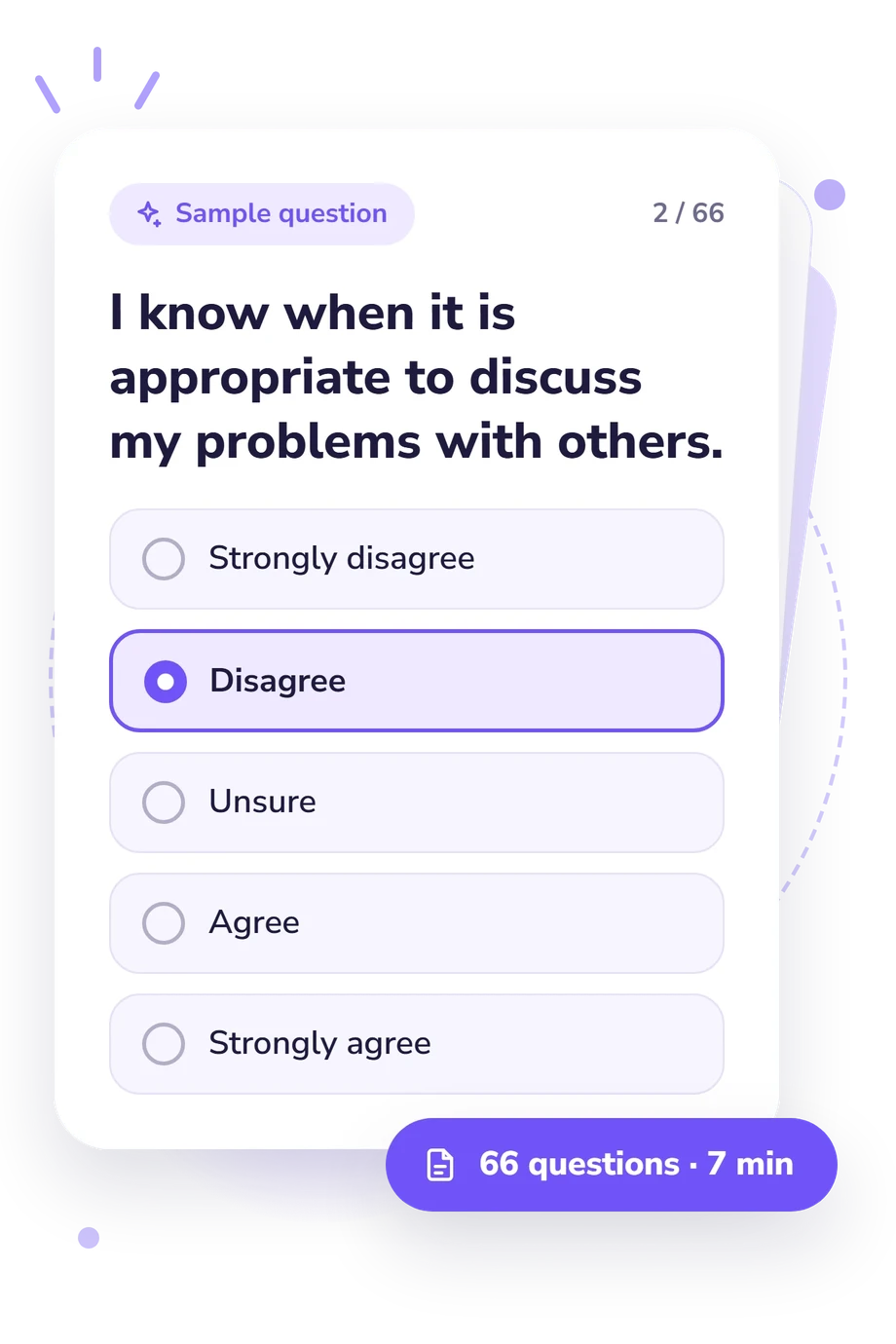
Example Questions From the Test
- Strongly disagree
- Disagree
- Unsure
- Agree
- Strongly agree
- Strongly disagree
- Disagree
- Not sure
- Agree
- Strongly agree
- Strongly disagree
- Disagree
- Hard to say
- Agree
- Strongly agree
Schutte Self-Report Emotional Intelligence Test (SSEIT) - Description and methodology of the test
People who want a clearer picture of how they notice and handle emotions can use this questionnaire for guided self-reflection. The Schutte Self-Report Emotional Intelligence Test (SSEIT) organizes that reflection around everyday experiences involving self-awareness, empathy, expression, and regulation. As an emotional intelligence assessment, it helps a respondent consider patterns in confidence, sensitivity, and emotional control without requiring specialist knowledge.
What This Assessment Explores
Rather than measuring a single mood, the questionnaire samples self-awareness, social perception, expression, motivation, and emotion regulation. The recurring themes are:
- Recognizing personal emotions shows how readily you notice and name inner experience.
- Reading other people’s cues reflects attention to facial expression, tone, and nonverbal communication.
- Using emotions for thinking shows whether moods support ideas, motivation, or coping.
- Regulating and sharing emotions describes managing feelings and responding supportively to others.
As an emotional awareness test, it helps readers reflect on responses to ordinary interpersonal and personal demands. The catalogue reports one overall Emotional Intelligence scale (33-165), defined as a self-report estimate of recognizing, understanding, and managing emotions in oneself and others. Higher results indicate more developed perceived skills in emotional perception and regulation. The displayed bands are Low (33-108), Moderate (109-140), and High (141-165).
Methodology and Scientific Basis
Each item uses five ordered response positions from strong disagreement to strong agreement, with an uncertainty option in the middle. Responses are combined into one overall result, so the output summarizes perceived emotional skills rather than separate item-by-item judgments.
The Schutte Emotional Intelligence Scale (Schutte et al., 1998) is the closest published reference for the content. Gong and Paulson (2018) add validation evidence from American college students, but those findings do not establish norms for every online administration.
Salovey and Mayer (1990) provide the ability-oriented theoretical background, while Petrides and Furnham (2000) examine emotional intelligence as a multidimensional construct. This questionnaire is conceptually consistent with those works, not presented as a direct adaptation of either study.
Because answers depend on self-awareness, honesty, and current context, the result is best read as an estimate of typical tendencies, not a clinical diagnosis or a direct performance test. Results may also shift as circumstances and self-perception change.
- Schutte, N. S., Malouff, J. M., Hall, L. E., Haggerty, D. J., Cooper, J. T., Golden, C. J., & Dornheim, L. (1998). Development and validation of a measure of emotional intelligence. Personality and Individual Differences, 25(2), 167-177. 10.1016/S0191-8869(98)00001-4
- Gong, X., & Paulson, S. E. (2018). Validation of the Schutte Self-Report Emotional Intelligence Scale With American College Students. Journal of Psychoeducational Assessment, 36(2), 175-181. 10.1177/0734282916669245
- Petrides, K. V., & Furnham, A. (2000). On the dimensional structure of emotional intelligence. Personality and Individual Differences, 29(2), 313-320. 10.1016/S0191-8869(99)00195-6
- Salovey, P., & Mayer, J. D. (1990). Emotional intelligence. Imagination, Cognition and Personality, 9(3), 185-211. 10.2190/DUGG-P24E-52WK-6CDG
Updated: