
Stress Tolerance Scale Test
How the Scales are Structured
Who Usually Takes This Test?
See How You Compare
Below is a preview of how scores are typically distributed across each scale.
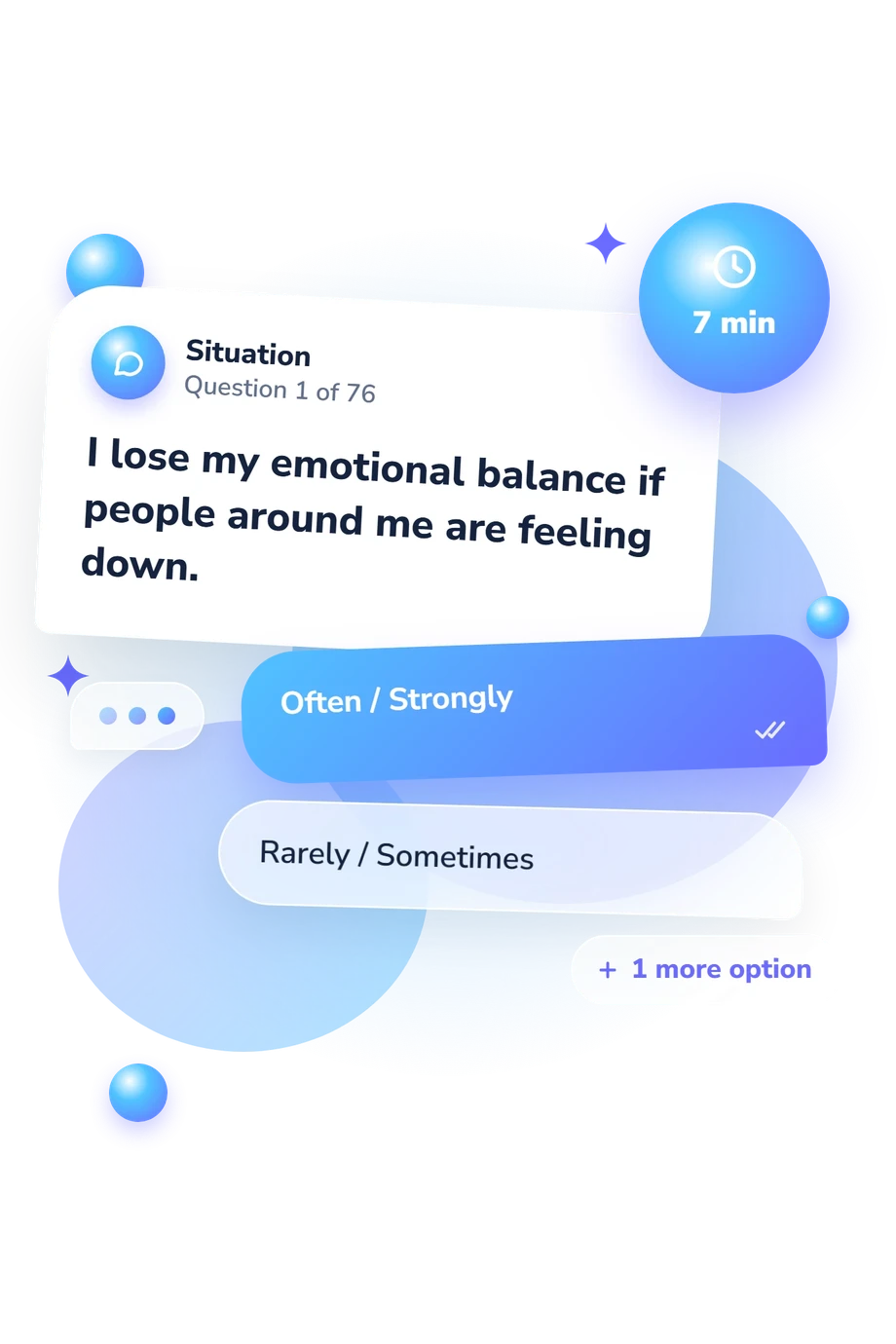
Example Questions From the Test
- Often / Strongly
- Rarely / Sometimes
- No / Never
- Often / Strongly
- Rarely / Sometimes
- No / Never
- Often / Strongly
- Rarely / Sometimes
- No / Never
Stress Tolerance Scale Test - Description and methodology of the test
People deciding whether to examine their reactions to demanding circumstances can use this assessment as a structured point of reflection. The Stress Tolerance Scale Test is relevant to anyone seeking a clearer picture of how daily demands interact with habits, attention, and relationships. As a stress tolerance assessment, it offers a practical basis for noticing which areas may merit deliberate attention.
What This Assessment Explores
Stressful situations are central to this stress tolerance questionnaire, which measures stress tolerance as a personality characteristic: the ability to withstand them. It suits readers exploring sleep, criticism, conflict, activity, optimism, and change; resilience labels the bands.
Lie Scale (0-5) indicates response validity: lower scores suggest more credible responding, higher scores suggest possible response distortion; bands: Low distortion 0-2, Possible distortion 3-3, and High distortion 4-5. Stress Tolerance Level (0-73) measures ability to withstand stress; bands: Low resilience 0-23, Average resilience 24-44, and High resilience 45-73.
Psychophysiological, emotional, motivational, volitional, informational, and intellectual components influence tolerance; more stress may reduce it, while moderate levels suit active lives with moderate strain.
Three areas follow:
- Emotional reactivity covers criticism, fear, irritation, and others’ moods.
- Physical-cognitive strain reflects sleep, weakness, headaches, or concentration.
- Coping and outlook indicate activity, relationships, habits, optimism, setbacks, and change.
Methodology and Scientific Basis
Each item offers three choices, usually pairing often or strongly, rarely or sometimes, and no or never; wording shifts for symptoms, activities, and intensity. Answers capture perceived frequency or strength, not objective stress physiology.
The questionnaire presents responses as displayed scores but does not specify how each response maps to points. The displayed bands are interpretive labels rather than standardized population norms; current pressure, memory, self-awareness, or the wish to present oneself favorably can affect responses, so read a higher resilience label as indicating stronger stress tolerance within this questionnaire and the validity label as a prompt to review response consistency.
Conceptually, the themes are compatible with Lazarus and Folkman (1984), whose appraisal-and-coping framework describes stress through appraisal and coping in context. Folkman et al. (1986) connect appraisal and coping with health status and symptoms, while Lazarus (1993) relates stress to changing emotional processes. These sources provide theoretical context, not the provenance or scoring method of this online questionnaire.
For readers considering this stress tolerance level test, the questionnaire offers a context-sensitive self-report profile.
- Lazarus, R. S., & Folkman, S. (1984). Stress, appraisal, and coping. Springer Publishing Company.
- Folkman, S., Lazarus, R. S., Gruen, R. J., & DeLongis, A. (1986). Appraisal, coping, health status, and psychological symptoms. Journal of Personality and Social Psychology, 50(3), 571-579. 10.1037/0022-3514.50.3.571
- Lazarus, R. S. (1993). From psychological stress to the emotions: A history of changing outlooks. Annual Review of Psychology, 44, 1-22. 10.1146/annurev.ps.44.020193.000245
Updated: