
Social Intelligence Scale Test
How the Scales are Structured
Who Usually Takes This Test?
See How You Compare
Below is a preview of how scores are typically distributed across each scale.
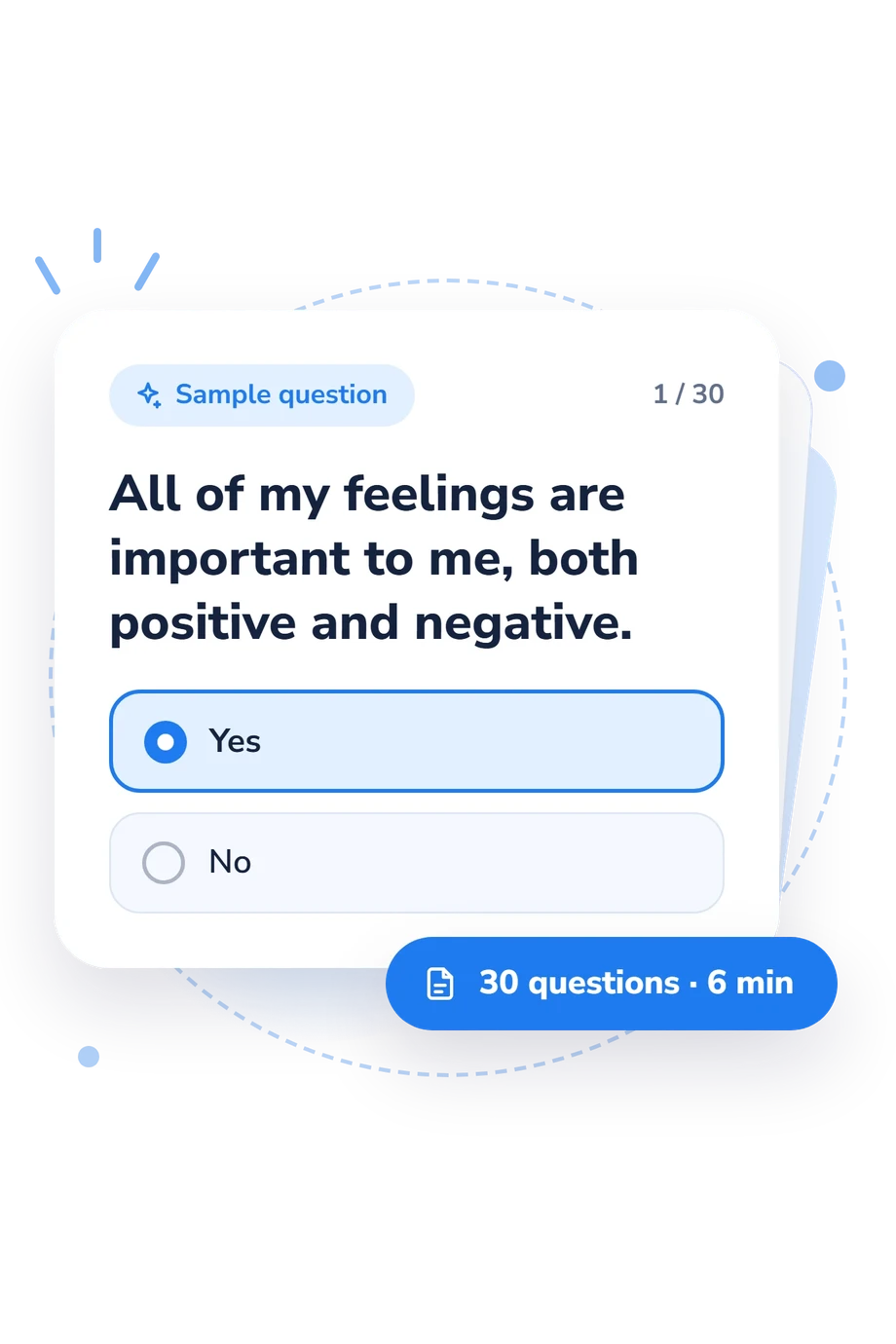
Example Questions From the Test
- Yes
- No
- Yes
- No
- Yes
- No
Social Intelligence Scale Test - Description and methodology of the test
People who want to understand their conduct at work, in relationships, and around unfamiliar people can use this assessment as structured self-reflection. The Social Intelligence Scale Test is intended for readers considering how their interpersonal style may support or complicate cooperation, communication, and personal development. As a social intelligence assessment, it produces a profile that can highlight personal resources and areas worth developing in everyday or professional interactions.
What This Assessment Explores
The questions connect emotional processes with everyday social situations. They cover noticing feelings, recovering from disappointment, sustaining effort, reading facial expressions, approaching unfamiliar people, listening patiently, and helping others. These themes relate to cooperation, communication, leadership, service, and personal development.
This social intelligence profile brings emotional insight and interpersonal engagement together across five dimensions. The result shows a pattern rather than one label:
- Self-Motivation: 0-6 shows goal-setting and sustained effort; Low 0-2, Moderate 3-4, High 5-6.
- Sociability: 0-6 shows interest in people and cooperation; Low 0-2, Moderate 3-4, High 5-6.
- Empathy: 0-6 shows perspective-taking and consideration of feelings; Low 0-2, Moderate 3-4, High 5-6.
- Self-Regulation: 0-6 shows management of emotional states and recovery after upset; Low 0-2, Moderate 3-4, High 5-6.
- Self-Awareness: 0-6 shows recognition of emotions, motives, and needs; Low 0-2, Moderate 3-4, High 5-6.
Methodology and Evidence Base
Every statement has a Yes/No response and concerns emotional reactions, social perception, motivation, or interaction. The questionnaire displays a separate result for each dimension. The displayed range shows the possible result for each dimension, but the questionnaire does not explain how individual answers contribute to those results, so a single answer should be interpreted within the full profile.
The questionnaire is conceptually consistent with Hall's 1999 emotional-intelligence self-evaluation, but it is not presented as an adaptation of that instrument. Goleman's 1995 synthesis and Salovey and Mayer's 1990 model provide related theoretical context, while O'Sullivan and Guilford's 1976 work represents a separate social-intelligence framework. The online social intelligence questionnaire shares related themes with these sources, but it is not presented as a reproduction of any one instrument or manual.
This is a self-report measure, so mood, recent experiences, social desirability, and self-awareness can influence answers. Interpretation should therefore consider the full pattern across dimensions and the situations in which the respondent usually works, relates to others, or meets unfamiliar people, rather than treating one result as a fixed judgment.
- Hall, N. (1999). Emotional Intelligence Self-Evaluation.
- Goleman, D. (1995). Emotional Intelligence: Why It Can Matter More Than IQ. New York: Bantam Books.
- Salovey, P., & Mayer, J. D. (1990). Emotional intelligence. Imagination, Cognition and Personality, 9(3), 185-211. 10.2190/DUGG-P24E-52WK-6CDG
- O'Sullivan, M., & Guilford, J. P. (1976). Four Factor Tests of Social Intelligence (Behavioral Cognition): Manual of Instructions and Interpretations. Orange, CA: Sheridan Psychological Services.
Updated: