
Freudly+971 508685814hello@freudly.ai
Freudly
business

Management Typology Assessment Test
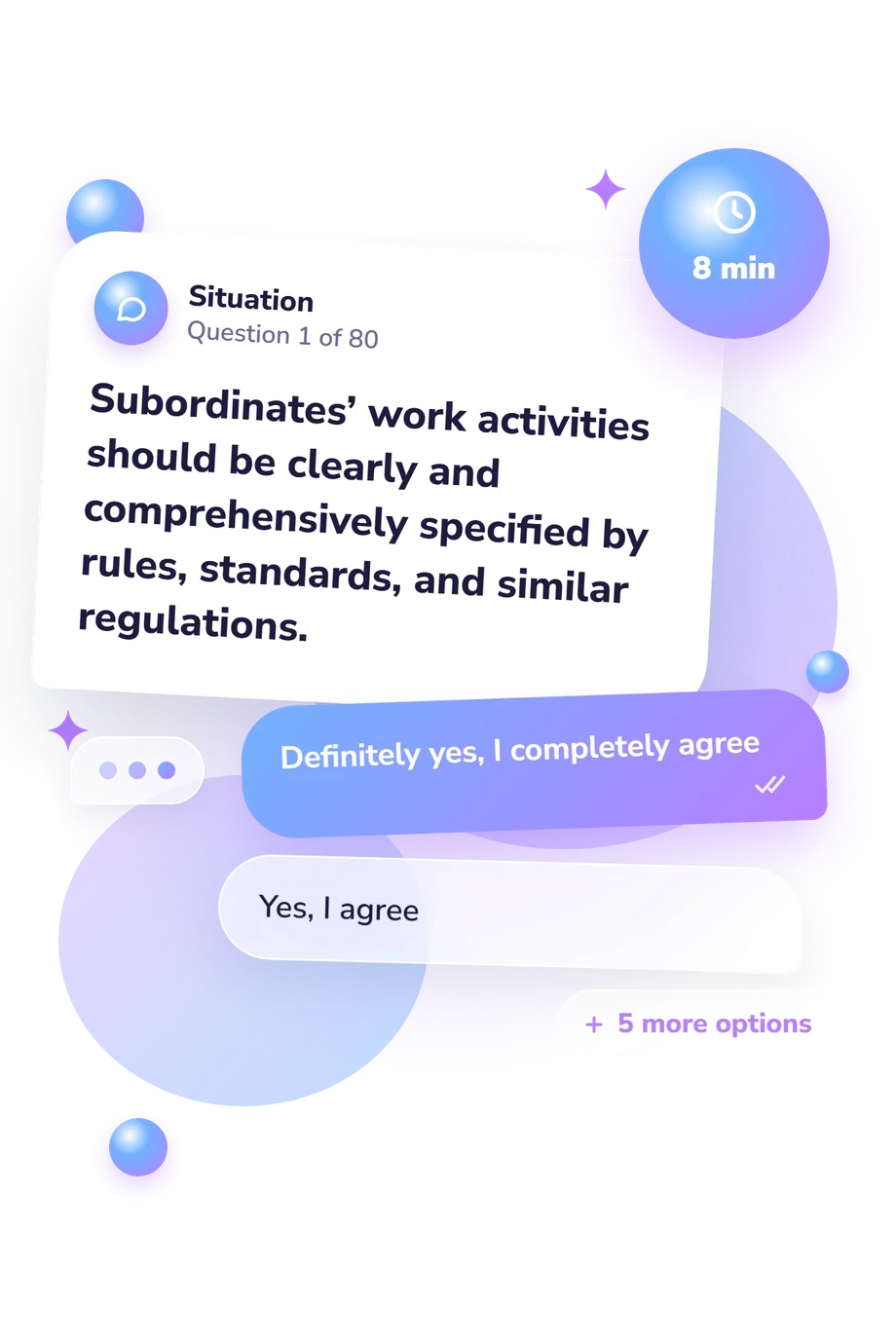
Take the online Management Typology Assessment Test - AI psychologist FreudlyYou can take Management Typology Assessment Testhere. Online version of a simple and accurate psychological test with interpretation.en
Understand your leadership style and team approach in about 8 minutes. Get clear, actionable insights to match roles, boost communication, and improve motivation fast.
Start Online Test
Questions: 408 minutes
08:30
October 2, 2025
October 2, 2025
Material has been updated
October 2, 2025
Material has been published
21,639 views
1,903 completions
1,600 likes
Verified by Daniel Hall
Psychologist with 25 years of experience
Share
Scale Explorer

How the Scales are Structured

example score
13/35
Objectivist (O)
Measures how strongly a person relies on objective factors and expects subordinates to foresee situations and outcomes without emphasizing subjective context.
Low
Moderate
High
514: Low | 1524: Moderate | 2535: High
A score of 13 falls in the Low range, indicating a relatively limited tendency to manage by disregarding subjective factors and expecting others to predict outcomes.
example score
16/35
Organizer (O)
Measures the extent to which a person leads by organizing processes, handling difficulties and conflict, and tolerating criticism, sometimes at the expense of hands-on follow-through.
Low
Moderate
High
514: Low | 1524: Moderate | 2535: High
A score of 16 falls in the Moderate range, suggesting a noticeable organizer style—comfortable with challenges and conflict, while occasionally leaving routine execution to others.
example score
33/35
Busybody (B)
Measures the tendency toward highly disciplined, detail-focused management with a risk of over-involvement in subordinates' tasks.
Low
Moderate
High
514: Low | 1524: Moderate | 2535: High
A score of 33 falls in the High range, indicating very strong punctuality and attention to detail with a tendency to duplicate others’ functions and overextend effort.
example score
22/35
Maximalist (M)
Measures the tendency to pursue the most complete and ambitious task outcomes rather than settling for simple solutions or material incentives.
Pragmatic
Balanced maximalism
Strong maximalism
514: Pragmatic | 1524: Balanced maximalism | 2535: Strong maximalism
A score of 22 indicates a balanced maximalist style, with a clear preference for thorough, high-standard completion while generally staying within practical limits.
example score
13/35
Procrastinator (P)
Measures the tendency to manage by delaying decisions and avoiding direct intervention in emerging issues.
Low
Moderate
High
514: Low | 1524: Moderate | 2535: High
A score of 13 falls in the Low range, suggesting you generally address issues without relying heavily on postponement or non-intervention.
example score
14/35
Sprinter (S)
Measures preference for rapid, flexible problem-solving in leadership situations versus sustained long-term planning.
Low
Moderate
High
514: Low | 1524: Moderate | 2535: High
A score of 14 indicates a low Sprinter tendency, suggesting you may favor steadier, less rapid-shift approaches over quick, change-driven management.
example score
20/35
Collegial (C)
Measures the extent to which a person prefers a democratic, consensus-based approach to managing others and making decisions.
Low collegiality
Moderate collegiality
High collegiality
514: Low collegiality | 1524: Moderate collegiality | 2535: High collegiality
A score of 20 indicates a moderate preference for collegial leadership, balancing participation and shared decision-making with the need for managerial direction.
example score
14/35
Regulator (R)
Measures the extent to which a manager’s style tends toward regulation and control that can hinder interpersonal contact and team climate.
Low
Moderate
High
514: Low | 1524: Moderate | 2535: High
A score of 14 falls in the Low range, suggesting minimal signs of a regulator-style pattern and fewer barriers to building contact and a positive team climate.
Start Online Test
just completed the test
DATA-BASED USER COHORTS

Who Usually Takes This Test?

New and aspiring managers
41%OF USERS
They take it to understand their natural leadership style and where they may need to adapt when leading people and projects.
HR and talent specialists
34%OF USERS
They use it to support hiring, promotion, and development decisions by quickly mapping candidates’ and managers’ management approaches.
Team leads and coaches
25%OF USERS
They take it to improve communication, role allocation, and motivation within teams during coaching or team-building work.
BASED ON AGGREGATED, ANONYMIZED DATA FROM TENS OF THOUSANDS OF FREUDLY USERS.
Benchmarking

See How You Compare

Once you complete the test, your results are compared with real-world data from people in your country.
Below is a preview of how scores are typically distributed across each scale.
Objectivist (O)
Objectivist (O)
Average
17.4
Normal range
12.122.6
min.
5
max.
35
This curve shows how scores are typically distributed.
Once you complete the test, your result will appear on the scale so you can see how you compare.
Organizer (O)
Organizer (O)
Average
23.6
Normal range
19.627.5
min.
5
max.
35
This curve shows how scores are typically distributed.
Once you complete the test, your result will appear on the scale so you can see how you compare.
Busybody (B)
Busybody (B)
Average
16.9
Normal range
11.622.2
min.
5
max.
35
This curve shows how scores are typically distributed.
Once you complete the test, your result will appear on the scale so you can see how you compare.
Maximalist (M)
Maximalist (M)
Average
23.3
Normal range
17.928.8
min.
5
max.
35
This curve shows how scores are typically distributed.
Once you complete the test, your result will appear on the scale so you can see how you compare.
Bureaucrat (B)
Bureaucrat (B)
Average
19.7
Normal range
15.523.8
min.
5
max.
35
This curve shows how scores are typically distributed.
Once you complete the test, your result will appear on the scale so you can see how you compare.
Sprinter (S)
Sprinter (S)
Average
24.8
Normal range
20.728.8
min.
5
max.
35
This curve shows how scores are typically distributed.
Once you complete the test, your result will appear on the scale so you can see how you compare.
Collegial (C)
Collegial (C)
Average
20.9
Normal range
17.224.6
min.
5
max.
35
This curve shows how scores are typically distributed.
Once you complete the test, your result will appear on the scale so you can see how you compare.
Regulator (R)
Regulator (R)
Average
14.7
Normal range
10.518.9
min.
5
max.
35
This curve shows how scores are typically distributed.
Once you complete the test, your result will appear on the scale so you can see how you compare.
Featured On
SAMPLE QUESTIONS

Example Questions From the Test

    • Strongly agree
    • Agree
    • Somewhat agree
    • Neither agree nor disagree
    • Somewhat disagree
    • Disagree
    • Strongly disagree
    • Definitely yes, completely agree
    • Yes, agree
    • Probably yes, partly agree
    • Neither agree nor disagree
    • Probably no, partly disagree
    • No, disagree
    • Definitely no, completely disagree
    • Definitely yes; I completely agree
    • Yes, I agree
    • Probably yes; I partly agree
    • Neither agree nor disagree
    • Probably not; I partly disagree
    • No, I disagree
    • Definitely not; I completely disagree
WHAT THE TEST MEASURES
About This Assessment
Management Typology Test

Management Typology Assessment Test - Symptoms and Signs

business
management
arrange
leadership style

When working with teams and projects, it can be useful to clarify how a person tends to approach leadership and coordination. The Management Typology Assessment is a brief self-report measure intended to characterize preferred management style patterns.

The measure includes 40 items and typically takes about 8 minutes to complete. Respondents rate statements about their typical behavior in managerial or supervisory situations; results are summarized as a descriptive profile that can support discussion of interpersonal approach, task focus, and collaboration tendencies. Interpretation should be integrated with other information (e.g., role demands, performance data, and behavioral observations) and used cautiously in high-stakes decisions.

The Management Typology Assessment is attributed to R. R. Blake and J. S. Mouton and is commonly used in applied settings such as leadership development, coaching, and team consultation to facilitate structured feedback and goal setting.

Author: J. S. Mouton, R. R. Blake
Literature: Hogan, R., & Kaiser, R. B. Why leaders fail. People and Strategy. 2005.
Popular tests
Comments
Leave a Comment