
Cross-Cultural Adaptability and Responsiveness Test
How the Scales are Structured
Who Usually Takes This Test?
See How You Compare
Below is a preview of how scores are typically distributed across each scale.
Example Questions From the Test
- You say nothing and serve the meal after removing the burned parts and garnishing the dishes.
- You feel irritated and explain to your guests why the food burned: you were expecting them at 7:00 p.m., not 9:00 p.m.
- You serve light snacks and drinks. You say you “burned” the meat and that you are very sorry, and you suggest going out to dinner at your favorite restaurant.
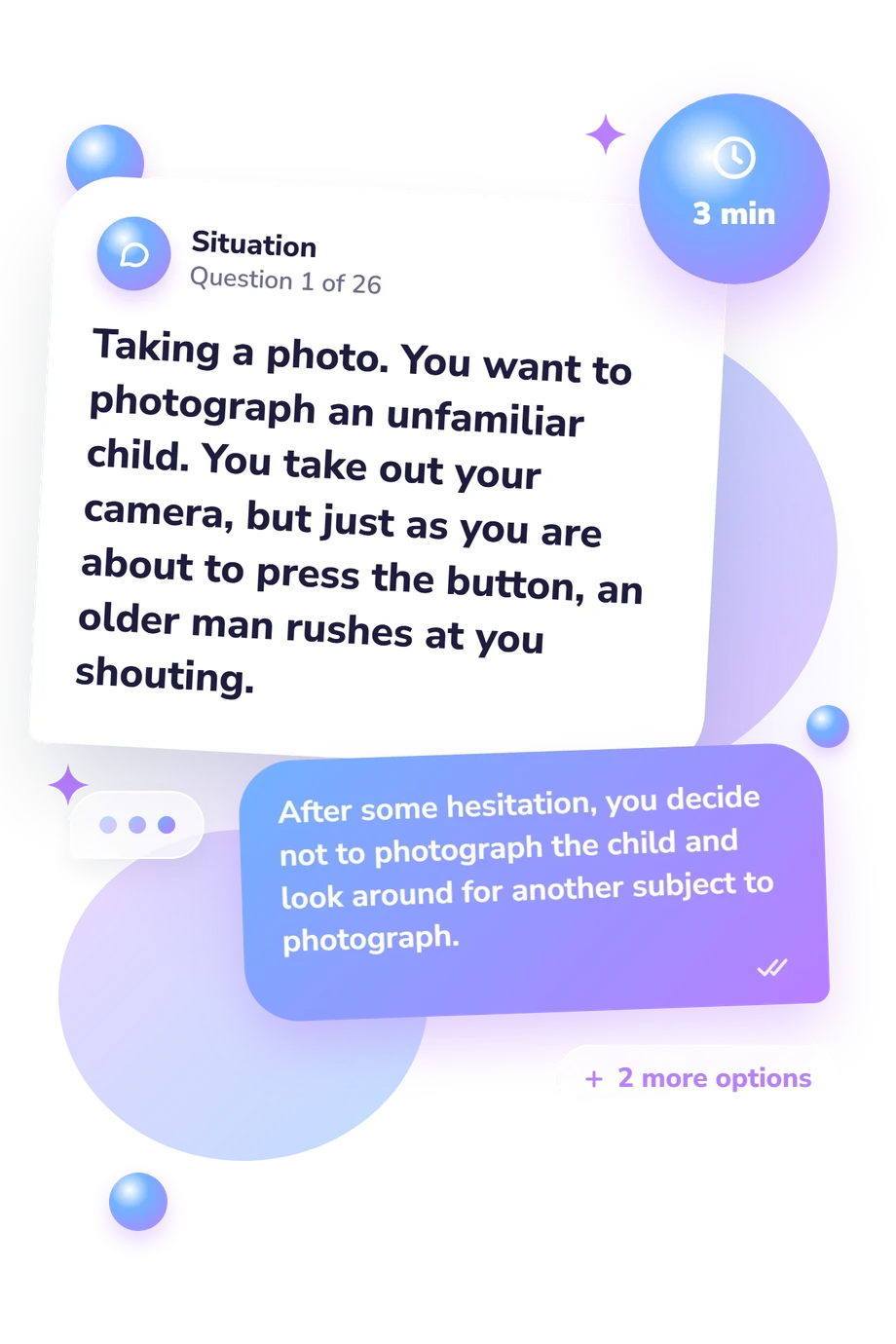
- After some hesitation, you decide not to photograph the child and look around for another subject to photograph.
- You realize the man does not want you to take the photo. You do not understand why, but you apologize and put the camera away.
- You wait for a moment when the man is not watching you and take the photo.
- You assume she is unfriendly and prejudiced against Russians (or against Europeans).
- You realize that kissing on a first date may be against the local custom, but you plan to call her the next day to apologize and ask for another date.
- You assume you misjudged the situation and that she simply did not enjoy the evening as much as you did.
Cross-Cultural Adaptability and Responsiveness Test - Description and methodology of the test
For readers preparing for travel, study, relocation, or international work, the Cross-Cultural Adaptability and Responsiveness Test offers a structured way to reflect on reactions to unfamiliar social rules and values. As a cross-cultural adaptability test, this questionnaire indicates an overall level of cross-cultural adaptability and responsiveness when familiar expectations no longer apply.
What This Assessment Explores
The scenarios examine how a person interprets unfamiliar norms, notices boundaries, tolerates ambiguity, and responds when local practices conflict with personal expectations. As a cultural responsiveness assessment, it links concrete choices with a broader tendency toward adjustment, respectful curiosity, or resistance.
The situations cover four areas:
- Social timing and etiquette show how you handle unfamiliar expectations about punctuality and hospitality.
- Boundaries and communication show how you read privacy, consent, embarrassment, and indirect cues.
- Participation and reciprocity show how readily you engage with hosts, strangers, and local customs.
- Values and disagreement show how you respond when practices challenge your principles.
Total Score ranges from 5-38. Limited adaptability covers 5-21, Developing adaptability 22-29, and Strong adaptability 30-38. Higher scores indicate greater adjustment and cross-cultural effectiveness; average results suggest useful skills alongside possible difficulty in unfamiliar settings.
Methodology and Evidence Base
Each item presents a brief cross-cultural scenario followed by three possible responses. The choices contrast ways of handling self-protection, empathy, social expectations, curiosity, and adaptation. Respondents choose the response that best reflects what they would do, making the cross-cultural sensitivity questionnaire a situational self-report rather than a knowledge quiz.
The questionnaire reports one displayed Total Score; its thematic areas do not produce separate displayed scores. The result bands provide the interpretive labels attached to that overall score.
The scenarios are conceptually consistent with Myasoedov’s discussion of confidence when working in a different culture (2003), particularly its focus on practical adjustment. Hofstede (2001) and Triandis (1994) provide complementary context through their work on cultural dimensions and social behavior. The questionnaire is not a reproduction, adaptation, or validation of those published works.
Its scenarios ask readers to weigh social expectations, personal boundaries, empathy, and practical adaptation in unfamiliar settings. Self-report answers can reflect current mood, cultural familiarity, prior travel, and self-awareness, so read the result as a snapshot for reflection rather than a stable trait.
- Myasoedov, Sergey Pavlovich. (2003). Fundamentals of Cross-Cultural Management: How to Do Business with Representatives of Other Countries and Cultures: Training Manual. Moscow: Delo. 256 pages.
- Hofstede, Geert. (2001). Culture's Consequences: Comparing Values, Behaviors, Institutions and Organizations Across Nations (2nd ed.). Thousand Oaks, CA: Sage Publications.
- Triandis, Harry C. (1994). Culture and Social Behavior. New York: McGraw-Hill. ISBN 0-07-065110-8.
- Hofstede, Geert. (2001). Culture's Recent Consequences: Using Dimension Scores in Theory and Research. International Journal of Cross Cultural Management, 1(1), 11-17. 10.1177/147059580111002
Updated: