
Suicidal Ideation Test
How the Scales are Structured
Who Usually Takes This Test?
See How You Compare
Below is a preview of how scores are typically distributed across each scale.
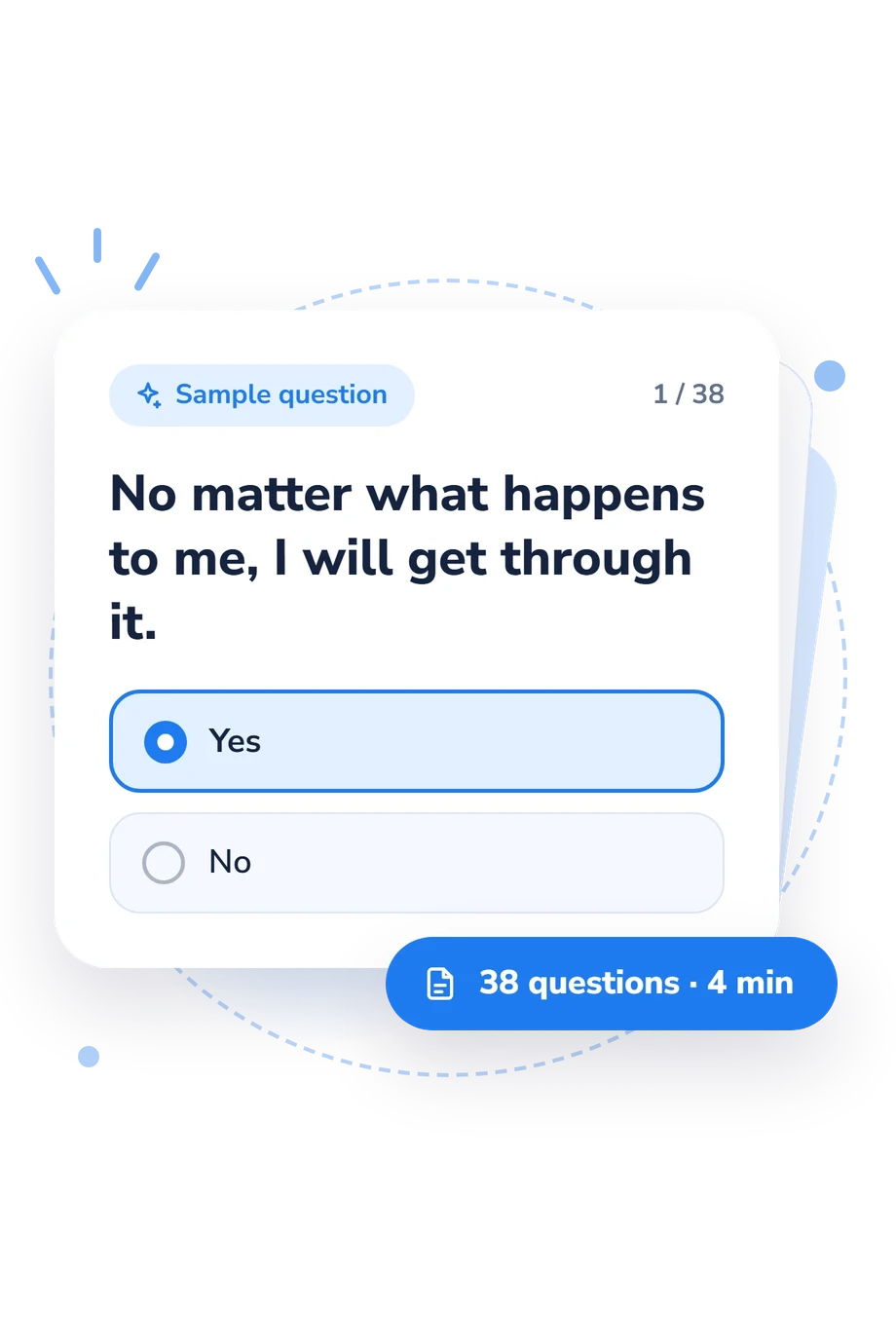
Example Questions From the Test
- Yes
- No
- Yes
- No
- Yes
- No
Suicidal Ideation Test - Description and methodology of the test
For people worried about thoughts of death, hopelessness, or losing the will to continue, this specific suicidal test helps organize current thoughts and risk-related concerns. This suicidal ideation test is intended for self-reflection when emotional pain, exhaustion, irritability, or withdrawal feels difficult to describe. The result offers a structured indication of current risk-related tendencies and can help clarify whether further support deserves prompt attention.
What This Assessment Explores
The questionnaire estimates risk for suicidal behavior from item themes involving persistence, future concern, enjoyment of life, irritability, emotional exhaustion, hopelessness, withdrawal, and thoughts of not waking or no longer being alive. These are situations the items ask about; together they feed one overall risk estimate rather than defining separate protective or risk dimensions.
For readers seeking clarity, the question behind an am I suicidal quiz is current risk or distress; this assessment answers with graded displayed bands rather than a yes-or-no identity judgment. It reports one scale:
- Suicide Risk Level, 0-19, estimates the degree of risk for suicidal behavior; Low 0-5 suggests lower likelihood, Moderate 6-13 indicates an intermediate band, and High 14-19 indicates the highest displayed band.
This profile can help focus discussion of the present situation.
Methodology and Evidence Base
Each item uses a yes-or-no response, asking for a direct self-report judgment rather than a graded frequency or severity rating. Because the suicidal quiz asks only yes or no, each response requires a clear judgment about the statement; this simple format cannot capture degrees within an answer and depends on honest, consistent responses in the moment.
The result condenses responses into one score interpreted through the categories shown with the result. The displayed bands organize the total, but the scoring information does not explain how each answer is weighted, so current context remains important when interpreting the result.
The questionnaire is conceptually consistent with SL-19, associated with Yunatskevich's 1996 work; this identifies a conceptual relationship, not authorship, adaptation, or validation of the online version.
Current context, self-awareness, and response bias can influence self-report. If answers reflect an intention or plan to act, contact local emergency services or a crisis line immediately.
- Yunatskevich, P. I. SL-19 Test (Suicidal Personality). Saint Petersburg: Military Space Academy named after A. F. Mozhaisky, 1996.
- Yunatskevich, P. I. Fundamentals of Military Suicidology. Saint Petersburg: AEST Institute of Suicidology, 2018. 120 pp. ISBN 5-7199-0258-9.
- Grigoryeva, A. A., & Gavrichenkova, A. A. (2020). Use of Psychoactive Substances by Adolescents in Different Types of Auto-Aggressive Behaviour. Psychology and Law, 10(1), 116-122. 10.17759/psylaw.2020100110.
Updated: