
Suicidal Motivation Scale Test
How the Scales are Structured
Who Usually Takes This Test?
See How You Compare
Below is a preview of how scores are typically distributed across each scale.
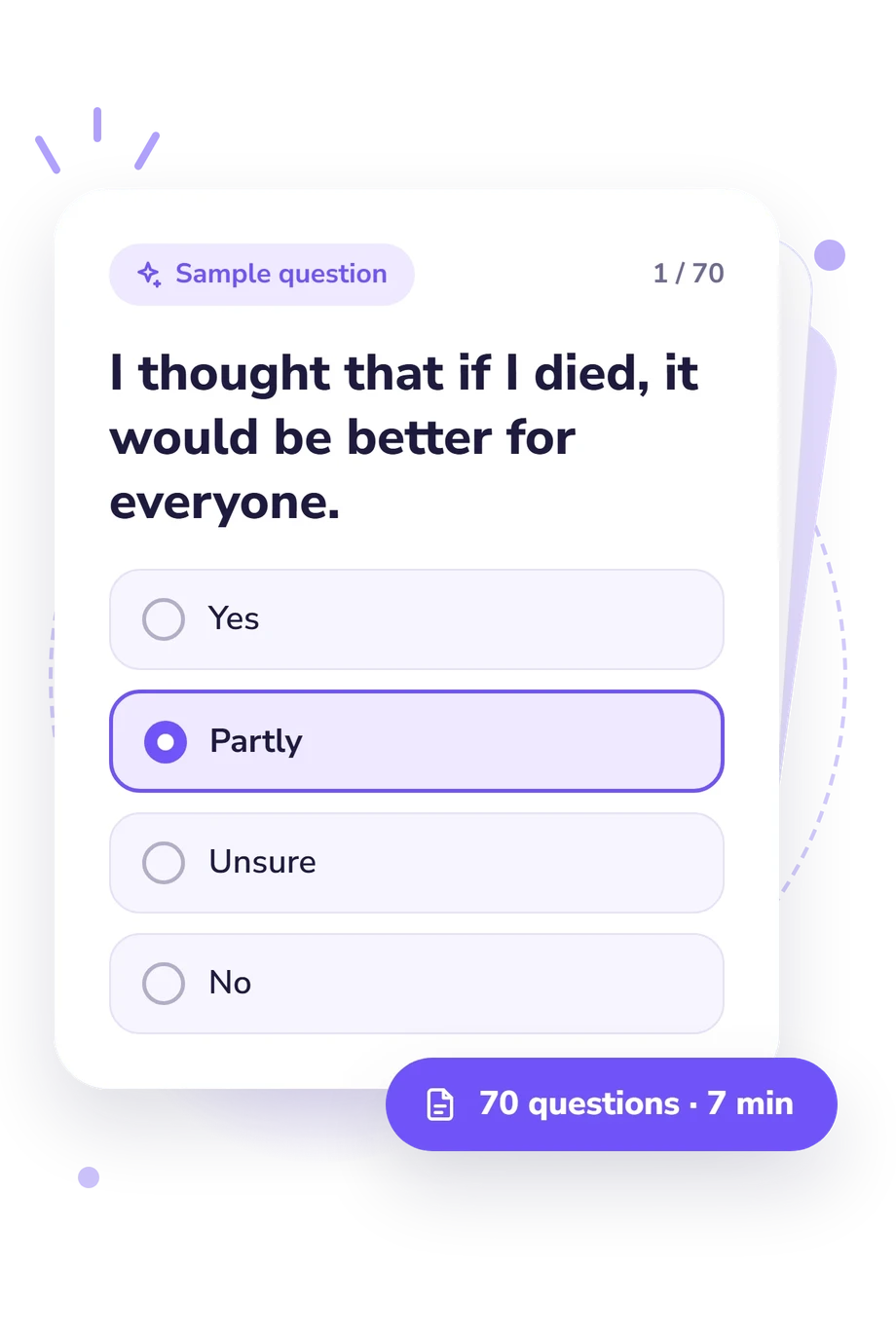
Example Questions From the Test
- Yes
- Partly
- Unsure
- No
- Yes
- Partly
- Unsure
- No
- Yes
- Partly
- Unsure
- No
Suicidal Motivation Scale Test - Description and methodology of the test
People who want to understand the motives behind suicidal thoughts may find the Suicidal Motivation Scale Test useful for structured self-reflection. As a suicidal motivation questionnaire, it considers whether these thoughts are linked with unbearable pain, guilt, anger, meaninglessness, concern for others, or imagined change after death. The profile can help a respondent notice which themes are most prominent and decide what experiences deserve closer attention.
What This Test Measures
People using it for self-reflection may recognize several motives at once, so the profile separates functions rather than assigning one explanation. The dimensions are:
- Heteropunitive (0-15) reflects motivation to punish others through one’s own self-destructive behavior.
- Self-Punitive (0-15) indicates self-blame, guilt, and self-punishment.
- Anesthetic (0-15) indicates wanting unbearable pain to stop.
- Post-Vital (0-15) indicates hope for relief or improvement after death.
- Instrumental (0-15) reflects using suicidal thoughts or behavior to influence others or elicit a reaction.
- Anomic (0-15) indicates emptiness, alienation, and lost life direction.
- Altruistic (0-15) indicates self-sacrifice imagined as helping loved ones.
The bands are Low 0-5, Moderate 6-10, and High 11-15. The suicidal motivation assessment is best read as a relative pattern of themes, not a complete account of a person’s situation. These dimensions can overlap in one profile.
Methodology and Evidence Base
The questionnaire uses brief first-person statements addressing themes such as death, suffering, guilt, anger, burden, meaning, relationships, or imagined change. The respondent chooses Yes, Partly, Unsure, or No; some items display the same options as 1-4. This format records agreement or uncertainty without requiring an explanation.
Scoring organizes answers into seven dimensions, each reported on a 0-15 range. Suicidal motivation test results show which themes receive greater or lesser endorsement within this questionnaire, rather than producing one overall motive.
The online questionnaire is conceptually consistent with the published Suicidal Motivation Test described by Vagin in 1999, but that relationship does not establish it as a standardized adaptation of the instrument. Later studies by Senkevich, Oreshkina, and Orlova connect motivational patterns with coping and existential crisis, while Shchetinina, Shchelkova, Chernov, and Kostyuk examine suicidal motivation alongside suicidal activity after a first psychotic episode. These are related studies on suicidal motivation in different contexts; they do not validate or standardize this questionnaire or its result bands.
Self-report scores may change with current distress, self-awareness, and candor, and no clinical cutoffs or norms are stated; the profile is therefore a structured aid for reflection rather than a diagnosis.
- Vagin, Yuri R. (1999). Prevention of Suicidal and Addictive Behavior in Adolescents. Perm: Perm State Medical Academy, 103 pp.
- Senkevich, Lyudmila, Alena Oreshkina, and Elena Orlova. (2019). Features of the Motivational Sphere and Coping Strategies of Mature Suicides in the Context of Their Existential Crisis. Advances in Social Science, Education and Humanities Research, vol. 374, pp. 394-402.
- Shchetinina, Evgeniya Vladimirovna, Olga Yuryevna Shchelkova, Nikita Vladimirovich Chernov, and Georgy Petrovich Kostyuk. (2025). Suicidal Activity and Suicidal Motivation among Patients after Their First Psychotic Episode. Psychology in Education, vol. 7, no. 2, pp. 256-274. 10.33910/2686-9527-2025-7-2-256-274
Updated: