
Family Attitudes Questionnaire Test
How the Scales are Structured
Who Usually Takes This Test?
See How You Compare
Below is a preview of how scores are typically distributed across each scale.
Example Questions From the Test
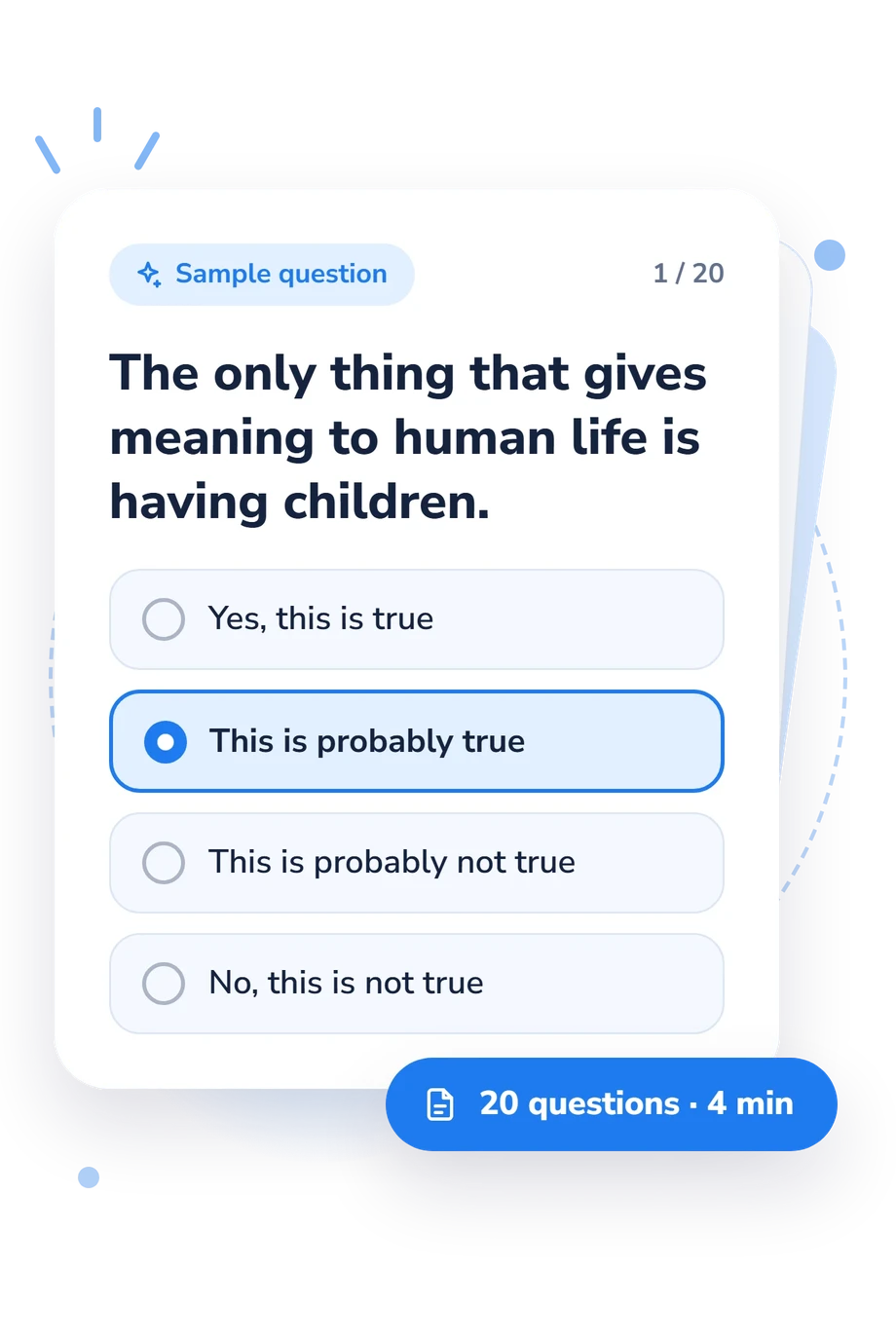
- Yes, this is true
- This is probably true
- This is probably not true
- No, this is not true
- Yes, that is true
- That is probably true
- That is probably not true
- No, that is not true
- Yes, true
- Probably true
- Probably not true
- No, not true
Family Attitudes Questionnaire Test - Description and methodology of the test
For readers examining how family life should work, this questionnaire offers a structured look at the importance of the sexual domain, shared or separate spousal activities, children, gender roles, and divorce. The Family Attitudes Questionnaire Test clarifies which expectations are endorsed more or less strongly and how priorities sit together. The resulting family attitudes profile gives personal reflection more structure.
What This Assessment Explores
The result separates family attitudes into five dimensions: sexual importance, spousal activities, children, gender roles, and divorce. The profile compares family beliefs without assuming one arrangement suits everyone.
These five scales organise the result:
- Sexual Domain (1-4) measures sexual importance; higher scores mean less importance. High importance 1-2; Moderate importance 2.1-3; Low importance 3.1-4.
- Autonomy/Dependence (1-4) measures preference for shared or separate activities; higher scores favor togetherness. More separate 1-2; Balanced 2.1-3; More together 3.1-4.
- Attitudes Toward Children (1-4) measures children’s importance; higher scores mean greater emphasis. Lower emphasis 1-2; Higher emphasis 2.1-4.
- Traditional Beliefs (1-4) measures patriarchal versus egalitarian roles; higher scores indicate less traditional views. More traditional 1-2; Mixed 2.1-3; More egalitarian 3.1-4.
- Attitudes Toward Divorce (1-4) measures divorce attitudes; higher scores indicate less acceptance. More tolerant 1-2; Less tolerant 2.1-4.
Methodology and Scientific Basis
Each statement describes a family situation or belief and offers four ordered responses, from agreement or yes to disagreement or no, with two intermediate options. The format captures degree without reducing attitudes to yes or no.
Responses produce separate 1-4 results, showing contrasts such as emphasis on children alongside egalitarian roles. Bands describe each direction; they do not create one overall family score.
The closest cited evidence is the Family Attitudes Questionnaire described by Duszynski, Shaffer, and Thomas (1983), which examines family-attitude dimensions. Thomas and Duszynski (1974) instead studied closeness to parents and family constellation, providing context about family relationships rather than evidence for this questionnaire’s five dimensions. This online questionnaire is conceptually consistent with the 1983 work, not presented as its adaptation.
No population norms accompany the displayed bands, so results are best read in personal context. Responses may reflect relationship history, current circumstances, cultural expectations, and self-awareness. The resulting family attitudes assessment helps notice patterns rather than rank them; it is not a clinical classification or standalone measure of relationship quality.
- Thomas, Caroline B., and Karen R. Duszynski. "Closeness to Parents and the Family Constellation in a Prospective Study of Five Disease States: Suicide, Mental Illness, Malignant Tumor, Hypertension and Coronary Heart Disease." Johns Hopkins Medical Journal, vol. 134, no. 5, 1974, pp. 251-270.
- Duszynski, Karen Rose, John Whitcomb Shaffer, and Caroline Bedell Thomas. "Dimensions of Family Attitudes among Female Medical Students." Educational and Psychological Measurement, vol. 43, no. 3, 1983, pp. 735-745. 10.1177/001316448304300307
- Shaffer, John W., Karen R. Duszynski, and Caroline B. Thomas. "Family Attitudes in Youth as a Possible Precursor of Cancer among Physicians: A Search for Explanatory Mechanisms." Journal of Behavioral Medicine, vol. 5, no. 2, 1982, pp. 143-163. 10.1007/BF00844805
Updated: