
Implicit Positive and Negative Affect Test (IPANAT)
How the Scales are Structured
Who Usually Takes This Test?
See How You Compare
Below is a preview of how scores are typically distributed across each scale.
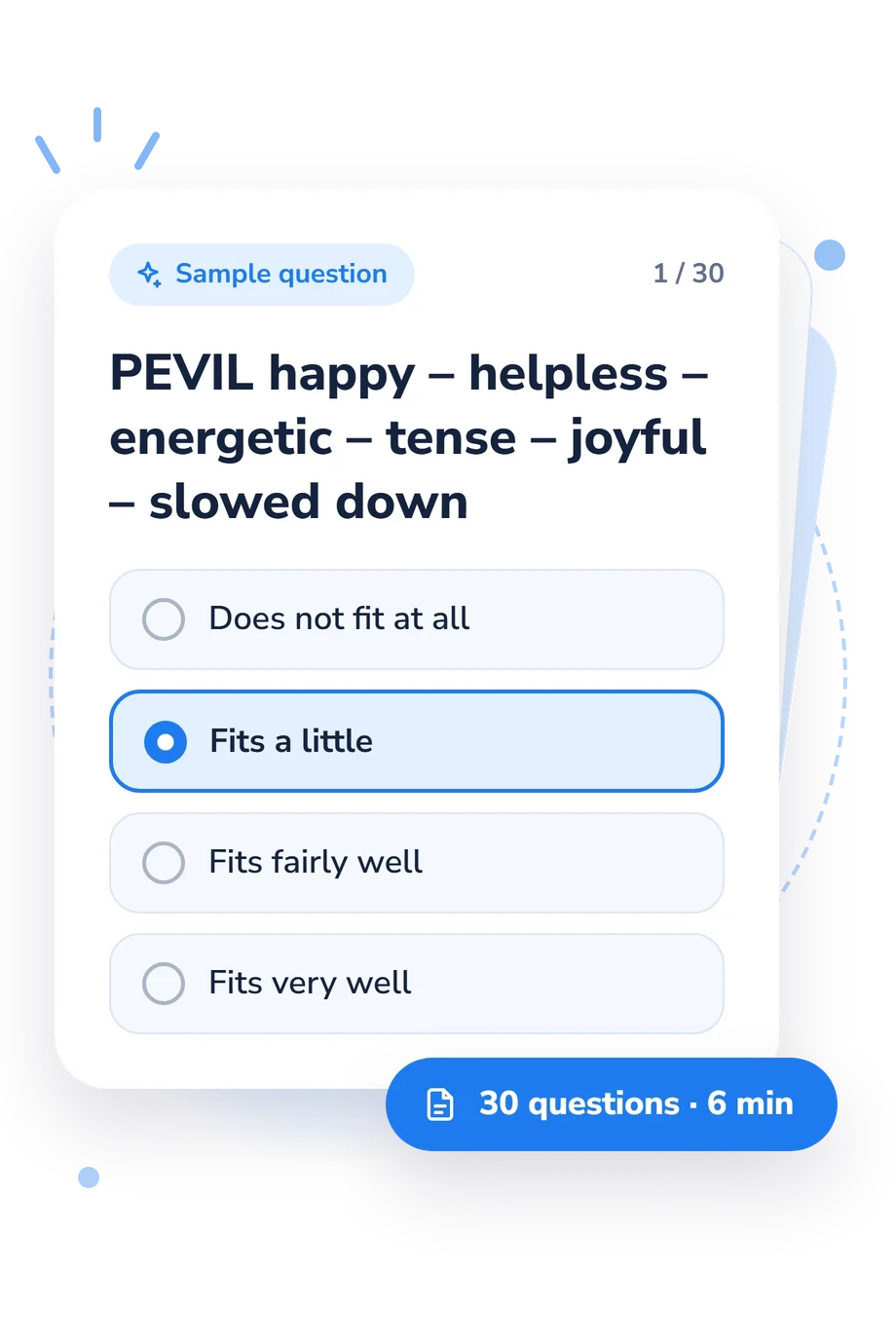
Example Questions From the Test
- Does not fit at all
- Fits a little
- Fits fairly well
- Fits very well
- Not suitable at all
- Suitable to a small extent
- Quite suitable
- Very suitable
- Does not fit at all
- Fits to a small extent
- Fits fairly well
- Fits very well
Implicit Positive and Negative Affect Test (IPANAT) - Description and methodology of the test
For readers who want to examine automatic emotional tendencies, the Implicit Positive and Negative Affect Test (IPANAT) provides a structured way to consider how pleasurable activation and distress-related reactions appear in their responses. Its indirect format suits people interested in emotional engagement, energy, tension, and calmness without requiring a direct account of their mood. This indirect format gives self-reflection a focus on affective responses to neutral-looking stimuli.
What This Assessment Explores
The questionnaire is intended for people who want a concise profile of two broad affective tendencies. Unfamiliar letter strings are paired with emotional adjectives, directing attention to the qualities attached to otherwise meaningless material. This indirect setup helps reveal patterns in positive and negative affect, including distress, energy, enthusiasm, concentration, apathy, or sadness.
The displayed result dimensions are:
- Negative Affect (NA), 1-4, reflects subjective distress and aversive emotional engagement; Low (1-1.5) suggests calmer responding, Moderate (1.6-2.5) indicates an intermediate level, and High (2.6-4) indicates stronger distress-related engagement.
- Positive Affect (PA), 1-4, reflects pleasurable engagement, energy, and concentration; Low (1-1.7) suggests reduced activation, Moderate (1.8-2.7) indicates an intermediate level, and High (2.8-4) indicates stronger activity and enthusiasm.
Together, the two scales describe separate levels of positive and negative affective involvement, rather than opposite ends of a single continuum.
Methodology and Scientific Basis
Each item pairs an unfamiliar artificial word such as PEVIL or REVLE with six descriptors: happy, helpless, energetic, tense, joyful, and slowed down. The respondent rates fit on a four-point continuum from not at all to very well. Responses are summarised into affective scores; each answer's exact contribution is unspecified.
This indirect association method assigns emotional qualities to meaningless material instead of asking directly about mood. The IPANAT questionnaire therefore examines affective tendencies through judgments about neutral-looking stimuli, with attention and consistency still relevant.
This online questionnaire is conceptually consistent with the published IPANAT, not presented as its original instrument or a validated online adaptation. The 2009 study by Quirin, Kazén, and Kuhl introduced and evaluated the instrument; later cross-cultural work examined it across ten countries. Related research examined implicit affectivity alongside circadian and reactive cortisol. The displayed bands are result categories for this online questionnaire, not population norms unless that status is documented. Context, response bias, self-awareness, and unfamiliar strings can influence results, so use the profile for reflection rather than diagnosis.
- Quirin, M., Kazén, M., & Kuhl, J. (2009). When nonsense sounds happy or helpless: The Implicit Positive and Negative Affect Test (IPANAT). Journal of Personality and Social Psychology, 97(3), 500-516. 10.1037/a0016063
- Quirin, M., Wróbel, M., Norcini Pala, A., Stieger, S., Brosschot, J., Kazén, M., Hicks, J. A., Mitina, O., Shanchuan, D., Lasauskaite, R., Silvestrini, N., Steca, P., Padun, M. A., & Kuhl, J. (2018). A cross-cultural validation of the implicit positive and negative affect test (IPANAT): Results from ten countries across three continents. European Journal of Psychological Assessment, 34(1), 52-63. 10.1027/1015-5759/a000315
- Quirin, M., Kazén, M., Rohrmann, S., & Kuhl, J. (2009). Implicit but not explicit affectivity predicts circadian and reactive cortisol: Using the Implicit Positive and Negative Affect Test. Journal of Personality, 77(2), 401-425. 10.1111/j.1467-6494.2008.00552.x
Updated: