
Classroom Psychological Climate Scale Test
How the Scales are Structured
Who Usually Takes This Test?
See How You Compare
Below is a preview of how scores are typically distributed across each scale.
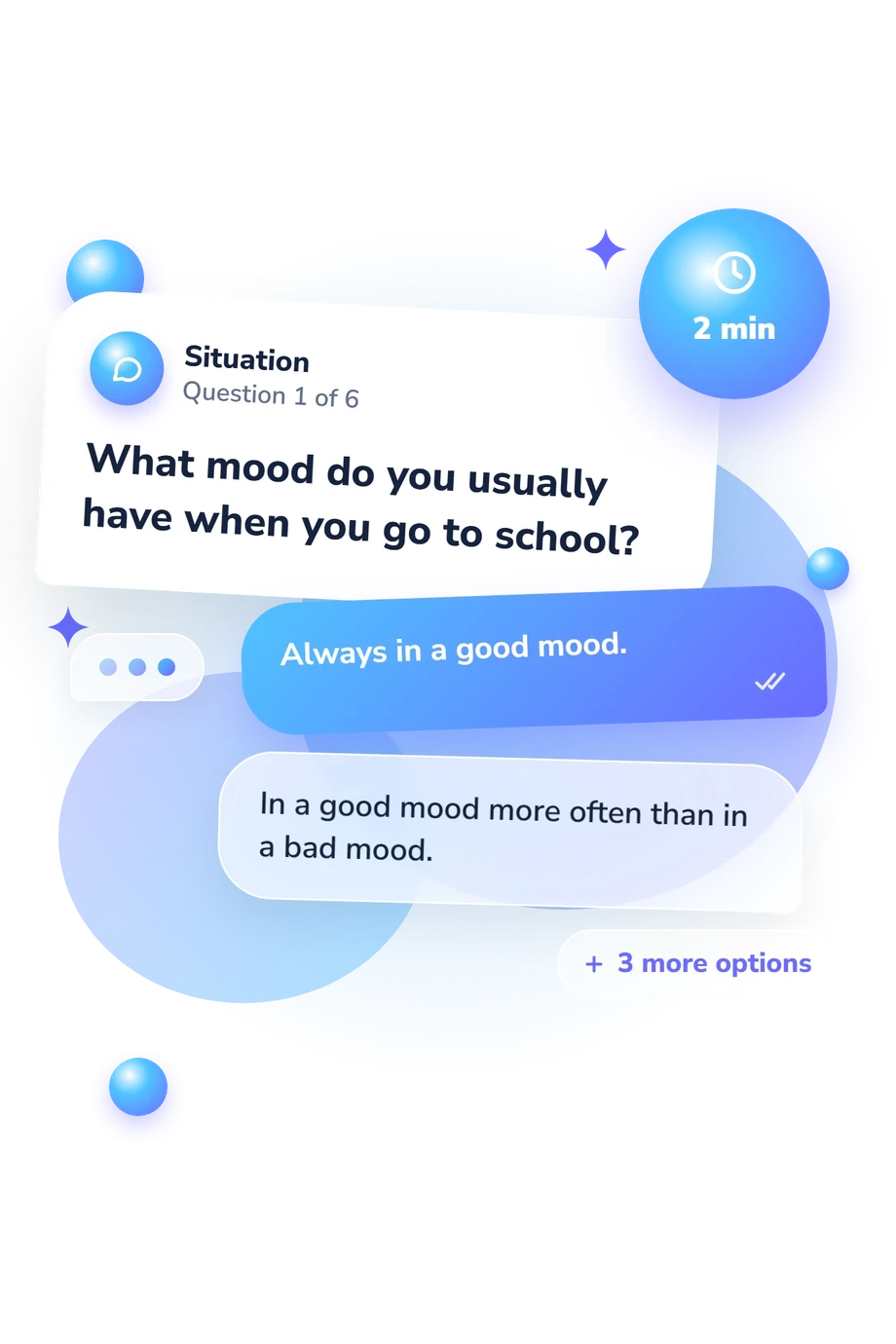
Example Questions From the Test
- Always in a good mood.
- In a good mood more often than in a bad mood.
- Indifferent.
- In a bad mood more often than in a good mood.
- Always in a bad mood.
- Yes, I like them.
- I like many, but not all.
- I feel indifferent.
- I like some, but not many.
- I do not like anyone.
- Never.
- Rarely.
- It makes no difference to me where I study.
- Often.
- I think about it all the time.
Classroom Psychological Climate Scale Test - Description and methodology of the test
Students who want to understand how their classroom feels may use this questionnaire to organise impressions of belonging, peer relationships, teacher contact, and school satisfaction. The Classroom Psychological Climate Scale Test turns those experiences into a concise result profile. As a classroom climate assessment, it can clarify whether the environment is experienced as supportive, mixed, or strained.
What This Assessment Measures
Instead of academic performance, this classroom climate questionnaire examines students' experience of the social atmosphere at school. Psychological climate includes peer contact, willingness to remain with the group, school satisfaction, and perceived teacher treatment.
The themes represented in the result are:
- Mood indicates whether school feels positive, indifferent, or negative.
- Peer relationships indicate whether the student feels accepted or disconnected.
- Class belonging and satisfaction indicate whether the learner feels settled or considers leaving.
- Teacher contact captures whether communication feels respectful, neutral, rude, or degrading.
The single scale, Psychological Climate Assessment, runs from 6-30: Positive climate (6-12), Neutral/mixed climate (13-18), and Negative climate (19-30). Low scores reflect a positive perception and satisfaction with classmate relationships; middle scores may reflect indifference or another significant peer group; high scores reflect a negative perception and may be associated with communication difficulties.
Methodology and Evidence Base
Each item offers five ordered choices, moving from favorable experience through an indifferent middle response to unfavorable experience. This makes it a brief self-report measure of perceived classroom behavior and relationships. Together, the items cover mood on arriving at school, relationships with classmates, willingness to stay in the class, school satisfaction, and the perceived tone of teacher interactions.
The displayed result spans 6-30 and is divided into the three bands named above; the point-assignment and weighting method, as well as any population standardisation, are not defined for this questionnaire.
The questionnaire is conceptually consistent with the Fedorenko Classroom Psychological Climate Questionnaire, but it is not documented as an adaptation of that instrument.
Interpretation should stay close to the respondent’s current perspective because honesty, recent events, social position, and mood can affect the result. Its bands describe perceived classroom climate rather than establish a disorder or prove the cause of a problem.
- Petrushin, V. I. Psychological Aspects of the Teacher's and Class Teacher's Work. Moscow: Pedagogical Search, 2001, 160 pp. ISBN 5-901030-46-10.
- Faizulina, E. A., and Khamatnurova, E. N. Development of a Program and Methodological Recommendations for Bullying Prevention among Students in Secondary Vocational Education. Pedagogical Education, 2023, 4(2), 216-224.
- Wang, M.-T., and Degol, J. L. School Climate: A Review of the Construct, Measurement, and Impact on Student Outcomes. Educational Psychology Review, 2016, 28(2), 315-352. 10.1007/s10648-015-9319-1.
Updated: