
Autism Test for Teens
How the Scales are Structured
Who Usually Takes This Test?
See How You Compare
Below is a preview of how scores are typically distributed across each scale.
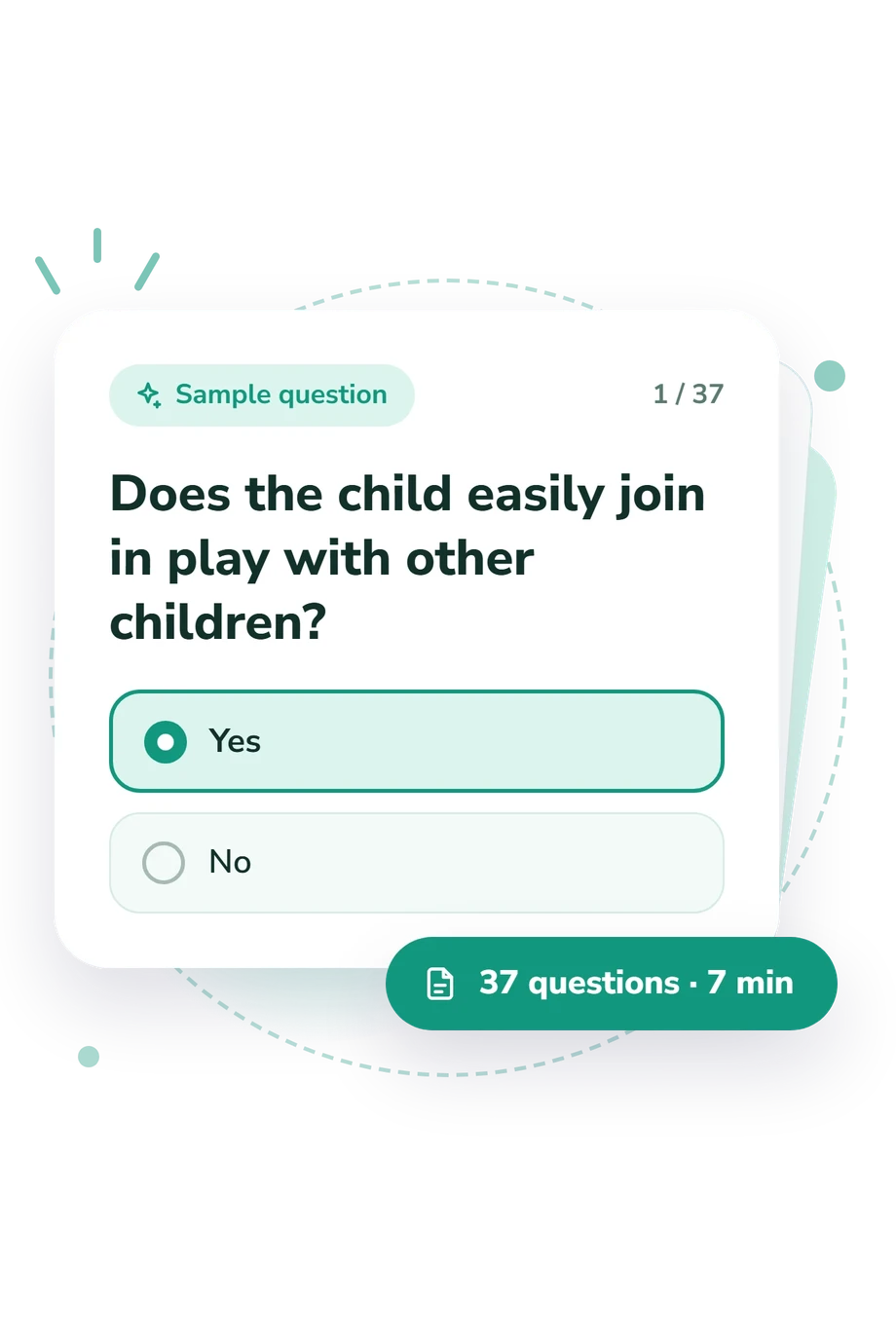
Example Questions From the Test
- Yes
- No
- Yes
- No
- Yes
- No
Autism Test for Teens - Description and methodology of the test
Parents and caregivers who want to organize concerns about a child’s social communication may use this autism test for teens as a structured first look at everyday behavior. It is designed to turn observations about conversation, friendships, imagination, and repeated patterns into one structured score that can support more focused reflection. Families may find this autism test for kids useful when they need clearer language for discussing what they notice.
What This Assessment Explores
The questionnaire looks across social communication, peer interaction, imagination, developmental history, and distinctive behaviors rather than treating one response as decisive. For families considering this autism spectrum test for a child, its value lies in bringing several observable domains together.
The main areas represented by the items are:
- Social reciprocity shows whether the child joins play, forms friendships, notices peer expectations, and sustains back-and-forth contact.
- Communication reflects conversation, literal interpretation, unusual language, voice, eye contact, and social tact.
- Imagination and interests indicate how pretend play, preferred topics, and attention to other people’s interests fit together.
- Repetitive or distinctive behavior captures unusual movements, repeated phrases, atypical self-reference, and other noticeable patterns.
These responses contribute to the Childhood Autism Spectrum Scale (0-31), which is described as a screening measure of autistic traits in children. The displayed bands are Within expected range 0-14 and Elevated autistic traits 15-31.
Methodology and Evidence Base
Each item presents a Yes/No choice, so the adult respondent selects the answer that best matches the child’s usual pattern. Questions combine present-day observations with developmental history, such as early speech, pretend play, and self-care.
An adult caregiver records familiar observations about a child while completing this child autism test, rather than relying on one-off impressions.
The online scoring display reports one combined result. Its point assignment is not specified, so readers should interpret the shown total and result band rather than infer a hidden weighting system.
The structure is conceptually consistent with the parent-completed CAST screening instrument reported by Scott and colleagues in 2002. This questionnaire is not an adaptation of that study version; the research therefore supports its framework, not identical validation. Later CAST studies examined test accuracy and test-retest reliability in the original child screening context.
The format is also an online autism screening questionnaire that depends on one observer’s memory, expectations, language, and current circumstances. No separate adolescent norms are stated for this version, and an elevated band is a screening signal rather than a diagnosis; broader assessment is appropriate when concerns persist.
- Scott, Fiona J.; Baron-Cohen, Simon; Bolton, Patrick; Brayne, Carol. The CAST (Childhood Asperger Syndrome Test): Preliminary Development of a UK Screen for Mainstream Primary-School-Age Children. Autism, 6(1), 9-31, 2002. 10.1177/1362361302006001003
- Williams, Jo; Scott, Fiona J.; Stott, Carol; Allison, Carrie; Bolton, Patrick; Baron-Cohen, Simon; Brayne, Carol. The CAST (Childhood Asperger Syndrome Test): Test Accuracy. Autism, 9(1), 45-68, 2005. 10.1177/1362361305049029
- Williams, Jo; Allison, Carrie; Scott, Fiona J.; Stott, Carol; Bolton, Patrick; Baron-Cohen, Simon; Brayne, Carol. The Childhood Asperger Syndrome Test (CAST): Test-Retest Reliability. Autism, 10(4), 415-427, 2006. 10.1177/1362361306066612
Updated: