
Freudly+971 508685814hello@freudly.ai
Freudly
self-concept

Self-Attitude Questionnaire Test
Take the online Self-Attitude Questionnaire Test - AI psychologist FreudlyYou can take Self-Attitude Questionnaire Testhere. Online version of a simple and accurate psychological test with interpretation.en
Understand your self-image and self-attitude in about 11 minutes. Get clear, actionable insights to support self-esteem, motivation, and growth in therapy or coaching.
Start Online Test
Questions: 5711 minutes
08:30
October 2, 2025
October 2, 2025
Material has been updated
October 2, 2025
Material has been published
27,083 views
1,672 completions
1,343 likes
Verified by Daniel Hall
Psychologist with 25 years of experience
Share
Scale Explorer

How the Scales are Structured

example score
62/100
Self-Liking (SL)
Measures the degree of friendliness versus criticism toward one’s own self, reflecting self-acceptance and self-compassion.
Low
Moderate
High
039: Low | 4069: Moderate | 70100: High
A score of 62 falls in the Moderate range, suggesting generally friendly self-attitude with some remaining tendencies toward self-criticism in certain situations.
example score
64/100
Self-Confidence (SC)
Measures belief in one’s abilities, independence, and perceived capacity to manage and direct one’s life.
Low
Moderate
High
039: Low | 4069: Moderate | 70100: High
A score of 64 falls in the Moderate range, suggesting a generally stable sense of capability and autonomy with some areas where confidence may vary by situation.
example score
41/100
Self-Respect (SR)
Measures self-respect, reflecting confidence in your abilities, energy, independence, and sense of personal agency.
Low
Moderate
High
039: Low | 4069: Moderate | 70100: High
A score of 41 falls in the Moderate range, suggesting a generally present but somewhat variable sense of self-confidence and personal control.
example score
48/100
Self-Interest (SI)
Self-interest measures interest in one’s own thoughts and feelings and confidence in being interesting to others.
Low
Moderate
High
039: Low | 4069: Moderate | 70100: High
A score of 48 falls in the Moderate range, suggesting a balanced level of self-reflection and self-support with room to deepen interest in inner experiences.
example score
66/100
Expected Attitude (EA)
Expected attitude measures how positively or negatively a person anticipates others will relate to them.
Negative expectations
Mixed expectations
Positive expectations
039: Negative expectations | 4069: Mixed expectations | 70100: Positive expectations
A score of 66 suggests generally mixed expectations, leaning toward anticipating acceptance rather than dislike from others.
example score
53/100
Self-Understanding (SU)
Measures how clearly and consistently a person recognizes and makes sense of their feelings, motives, and actions.
Limited self-awareness
Developing self-understanding
Strong self-understanding
049: Limited self-awareness | 5074: Developing self-understanding | 75100: Strong self-understanding
A score of 53 suggests a developing level of reflection, with some insight into inner states and behavior alongside areas where self-clarity may still be forming.
example score
50/100
Self-Interest (SI)
Measures interest in one’s own thoughts and feelings and confidence in one’s personal significance to others.
Low
Moderate
High
033: Low | 3466: Moderate | 67100: High
A score of 50 indicates a moderate level of self-interest, suggesting a generally balanced curiosity about inner experiences and a fairly stable sense of personal significance to others.
example score
7/100
Self-Blame (SB)
This scale measures the tendency to criticize oneself and attribute problems or shortcomings to oneself.
Low self-blame
Moderate self-blame
High self-blame
033: Low self-blame | 3466: Moderate self-blame | 67100: High self-blame
A score of 7 falls in the Low self-blame range, suggesting minimal self-critical or self-accusing attitudes at this time.
example score
46/100
Self-Guidance (SG)
Self-Guidance measures how independently a person can make decisions and manage their life based on their self-image.
Low autonomy
Moderate autonomy
High autonomy
033: Low autonomy | 3466: Moderate autonomy | 67100: High autonomy
A score of 46 indicates moderate self-guidance, suggesting some capacity for independent decision-making alongside a tendency to rely on external guidance in certain situations.
example score
50/100
Self-Acceptance (SA)
Self-acceptance measures how fully a person embraces themselves, including both strengths and weaknesses.
Low
Moderate
High
033: Low | 3466: Moderate | 67100: High
A score of 50 falls in the Moderate range, suggesting a generally balanced self-view with some areas of self-criticism or ambivalence alongside acceptance.
example score
48/100
Perceived Attitudes of Others (PAoO)
Measures how positively or negatively a person expects others to relate to and support them.
Expecting antipathy
Mixed expectations
Expecting support
033: Expecting antipathy | 3466: Mixed expectations | 67100: Expecting support
A score of 48 falls in the mixed expectations range, suggesting the person anticipates neither clear support nor clear antipathy from others.
example score
71/100
Global Self-Attitude (GSA)
Global Self-Attitude measures an overall positive versus negative orientation toward one’s own self.
Low
Moderate
High
049: Low | 5074: Moderate | 75100: High
A score of 71 falls in the Moderate range, suggesting a generally positive self-attitude with some remaining self-criticism or internal dissatisfaction at times.
Start Online Test
just completed the test
DATA-BASED USER COHORTS

Who Usually Takes This Test?

Therapy and counseling clients
41%OF USERS
People in psychotherapy who want to understand their self-esteem, self-criticism, and inner conflicts to guide treatment goals.
Coaching and growth seekers
34%OF USERS
Individuals focused on personal development who want a clear picture of how they relate to themselves and what holds them back in decisions and behavior.
Practicing psychologists and coaches
25%OF USERS
Professionals who use it as a quick diagnostic tool to assess self-attitude dimensions and tailor support or interventions.
BASED ON AGGREGATED, ANONYMIZED DATA FROM TENS OF THOUSANDS OF FREUDLY USERS.
Benchmarking

See How You Compare

Once you complete the test, your results are compared with real-world data from people in your country.
Below is a preview of how scores are typically distributed across each scale.
Autosympathy (A)
Autosympathy (A)
Average
36.6
Normal range
17.755.4
min.
0
max.
100
This curve shows how scores are typically distributed.
Once you complete the test, your result will appear on the scale so you can see how you compare.
1: Self-confidence (1S)
Average
35
Normal range
22.847.2
min.
0
max.
100
This curve shows how scores are typically distributed.
Once you complete the test, your result will appear on the scale so you can see how you compare.
Self-esteem (S)
Self-esteem (S)
Average
57.4
Normal range
44.969.9
min.
0
max.
100
This curve shows how scores are typically distributed.
Once you complete the test, your result will appear on the scale so you can see how you compare.
Self-interest (S)
Self-interest (S)
Average
74
Normal range
56.691.3
min.
0
max.
100
This curve shows how scores are typically distributed.
Once you complete the test, your result will appear on the scale so you can see how you compare.
Expected attitude (Ea)
Average
73.3
Normal range
59.986.8
min.
0
max.
100
This curve shows how scores are typically distributed.
Once you complete the test, your result will appear on the scale so you can see how you compare.
7: Self-Understanding (7S)
Average
52.5
Normal range
37.667.4
min.
0
max.
100
This curve shows how scores are typically distributed.
Once you complete the test, your result will appear on the scale so you can see how you compare.
6: Self-Interest (6S)
Average
35.7
Normal range
21.250.2
min.
0
max.
100
This curve shows how scores are typically distributed.
Once you complete the test, your result will appear on the scale so you can see how you compare.
5: Self-blame (5S)
5: Self-blame (5S)
Average
49.1
Normal range
30.367.8
min.
0
max.
100
This curve shows how scores are typically distributed.
Once you complete the test, your result will appear on the scale so you can see how you compare.
4: Self-Guidance (4S)
Average
31.8
Normal range
14.149.4
min.
0
max.
100
This curve shows how scores are typically distributed.
Once you complete the test, your result will appear on the scale so you can see how you compare.
3: Self-Acceptance (3S)
Average
66.8
Normal range
51.582
min.
0
max.
100
This curve shows how scores are typically distributed.
Once you complete the test, your result will appear on the scale so you can see how you compare.
2: Attitudes of Others (2AoO)
Average
68.4
Normal range
55.981
min.
0
max.
100
This curve shows how scores are typically distributed.
Once you complete the test, your result will appear on the scale so you can see how you compare.
Global Self-Attitude (S) (GS()
Average
27.2
Normal range
12.342.2
min.
0
max.
100
This curve shows how scores are typically distributed.
Once you complete the test, your result will appear on the scale so you can see how you compare.
Featured On
SAMPLE QUESTIONS

Example Questions From the Test

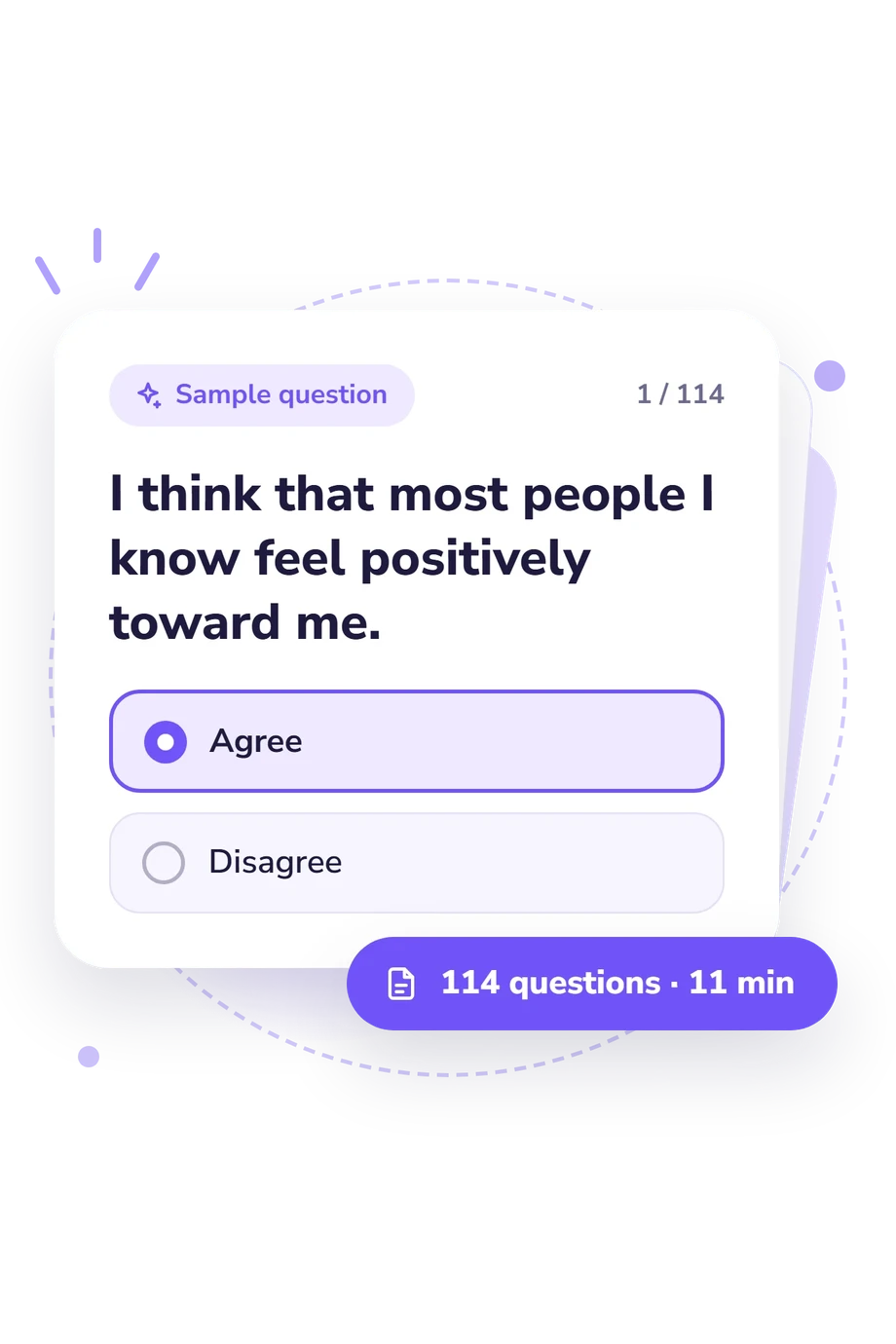
You are asked to respond to a series of statements describing possible characteristics of your personality, habits, interests, and related areas. There are no “good” or “bad” answers to these items, as each person is entitled to their own perspective.
    • Agree
    • Disagree
    • Agree
    • Disagree
    • Agree
    • Disagree
WHAT THE TEST MEASURES
About This Assessment
Self-Relation Questionnaire Test, SOR

Self-Attitude Questionnaire Test - Symptoms and Signs

self-concept
self-attitude
self-acceptance
willpower traits

This self-report measure is used to characterize how individuals perceive and relate to themselves across general and more specific domains. The Self-Attitude Questionnaire provides a structured way to describe self-directed attitudes that may be clinically relevant to self-esteem, motivation, and decision-making.

The instrument includes 57 items and typically takes about 11 minutes to complete. It yields a profile of overall self-attitude as well as narrower components (e.g., self-respect, self-liking, self-interest, and self-expectations), which can help guide case formulation and treatment planning. Authors listed: M. Rosenberg and S. Coopersmith. In clinical and counseling settings, the Self-Attitude Questionnaire may be used alongside interview and other measures to inform assessment of self-concept and related functioning.

Author: M. Rosenberg, S. Coopersmith
Literature: Anastasi, A., & Urbina, S. Psychological testing. Prentice Hall. 1997.; Harter, S. The construction of the self: A developmental perspective. Guilford Press. 1999.
Popular tests
Comments
Leave a Comment