
Socio-Psychological Personality Type Test
How the Scales are Structured
Who Usually Takes This Test?
See How You Compare
Below is a preview of how scores are typically distributed across each scale.
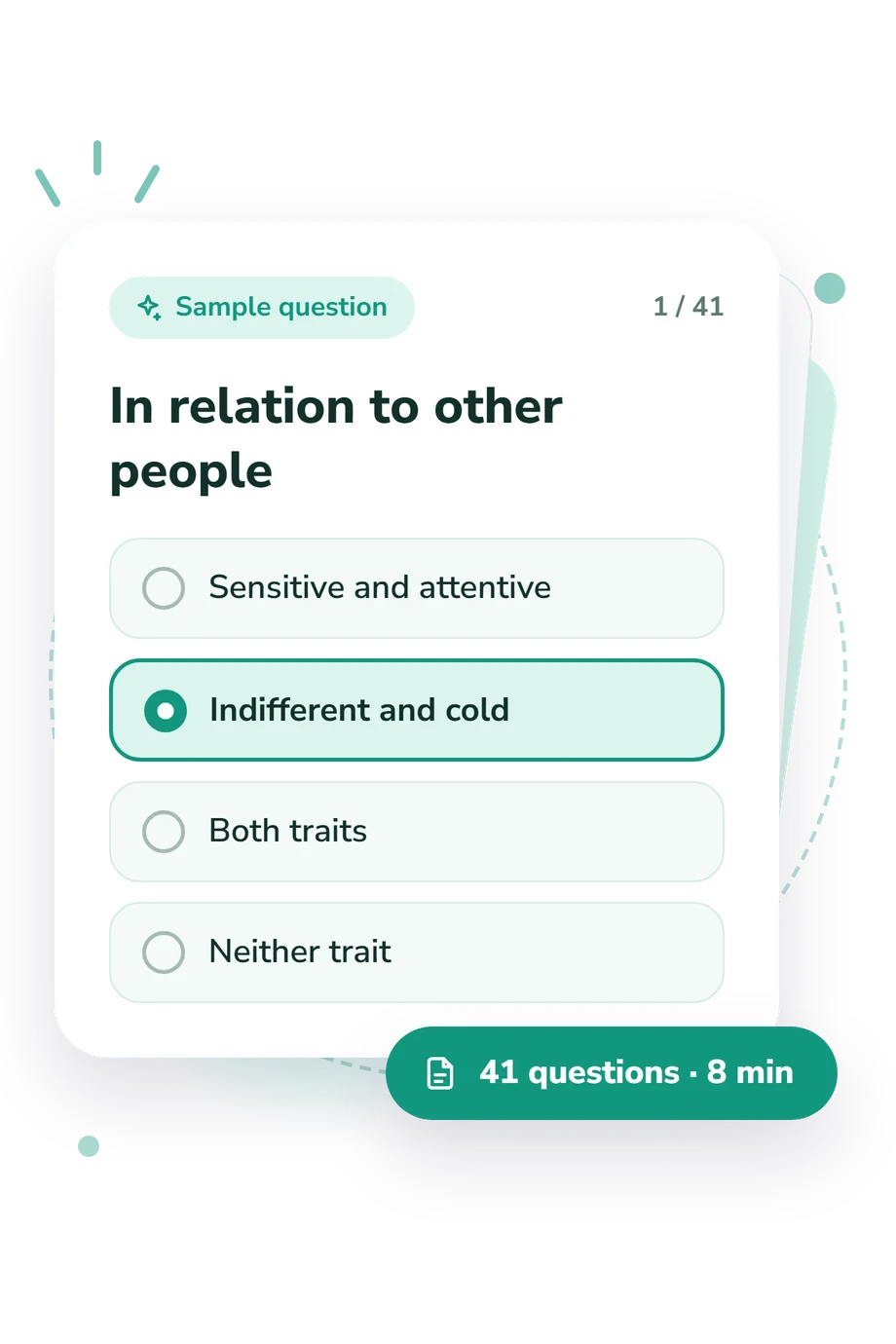
Example Questions From the Test
- Sensitive and attentive
- Indifferent and cold
- Both traits
- Neither trait
- Truthful, honest
- Dishonest, deceitful
- Both traits
- Neither trait
- Sincere, open
- Reserved
- Both traits
- Neither trait
Socio-Psychological Personality Type Test - Description and methodology of the test
People who want a clearer picture of their interpersonal habits can use this questionnaire to examine recurring ways of responding in everyday situations. The Socio-Psychological Personality Type Test offers a structured result for considering possible areas for growth. This personality type assessment can prompt more deliberate choices in cooperation, self-presentation, and communication, without reducing a complex person to a single label.
What This Assessment Measures
Questions compare descriptions of conduct, group behavior, activity habits, self-evaluation, and self-control. Examples contrast honesty with deceit, patience with irritability, initiative with passivity, and compassion with self-centeredness.
This social psychological personality test also covers approval, criticism, status, obligations, and cooperation. The represented items cluster into four thematic groupings, not four separate scales:
- Relationships show warmth, honesty, tact, patience, and tolerance.
- Group life reflects belonging, peer standing, loyalty, competition, and reactions to others.
- Activity habits indicate responsibility, rules, initiative, persistence, and engagement.
- Self-orientation captures confidence, self-criticism, organization, promises, and abilities.
Together, these contexts contribute to one result about socio-psychological personality type, concerning typical behavior in group settings, interpersonal relationships, and preferred interaction styles. The displayed scale, Socio-Psychological Personality Type (0-100), summarizes this pattern. Its bands are Low expression (0-33), Moderate expression (34-66), and High expression (67-100); they indicate degree, not identity.
Methodology and Evidence Base
The sampled items present contrasting descriptions, such as calm versus abrupt or persistent versus not persistent, followed by choices indicating one trait, the other, both, or neither. Some of these items use none of these traits, so the observed response format asks respondents to compare self-perceived qualities. Responses are combined into a displayed result; because item-level point values are not stated, the contribution of any single choice should not be inferred.
This is an online self-report questionnaire. Its themes are conceptually consistent with Miniyarov’s 2000 work on the diagnostic and correctional aspects of family education, but this online version is not established as a validated adaptation of that published work. Related context from Davletbaeva’s 2019 study examines social and psychological personality type alongside student behavior, but it does not validate this online version.
The online socio-psychological personality type quiz format makes responses sensitive to current relationships, self-awareness, and the wish to answer favorably. Interpret the bands as a structured reflection on recurring tendencies, not a clinical classification or complete account of personality.
- Miniyarov, Valery Maksimovich. (2000). Psychology of Family Education (Diagnostic and Correctional Aspect). Moscow: Moscow Psychological and Social Institute; Voronezh: NPO MODEK Publishing House, 256 pp. ISBN 5-89502-183-2; ISBN 5-89395-255-3.
- Davletbaeva, Zinfira Kinyabulatovna. (2019). Analysis of Results of the Study of Manifestation Asocial Behavior in Students Depending on the Features of Social and Psychological Personality Type. Izvestiya of the Samara Russian Academy of Sciences Scientific Center: Social, Humanitarian, Medicobiological Sciences, 21(2), 27-34.
Updated: