
Attributional Style for Successes and Failures Questionnaire (STONE-10) Test
How the Scales are Structured
Who Usually Takes This Test?
See How You Compare
Below is a preview of how scores are typically distributed across each scale.
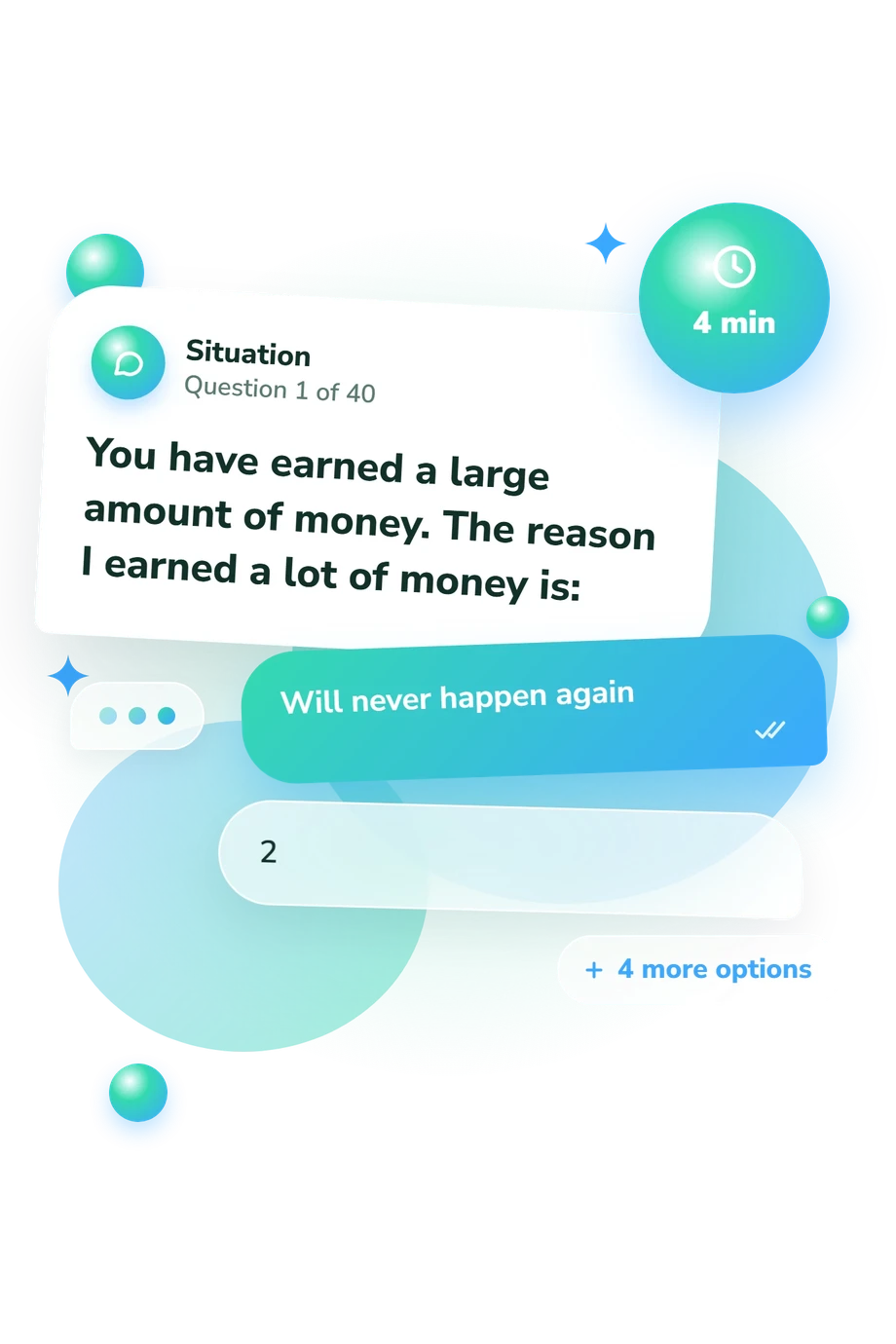
Example Questions From the Test
- Will never occur again
- 2
- 3
- 4
- 5
- Will always exist
- Only this particular situation
- 2
- 3
- 4
- 5
- All situations in my life
- Will never happen again
- 2
- 3
- 4
- 5
- Will always be the case
Attributional Style for Successes and Failures Questionnaire (STONE-10) Test - Description and methodology of the test
People who notice recurring ways of assigning causes to setbacks and achievements may use the Attributional Style for Successes and Failures Questionnaire (STONE-10) Test to map habitual attributional patterns. It examines whether causes stay situation-specific or extend across life, and seem temporary or lasting. As an attributional style questionnaire, it can show where interpretations stay bound to circumstances or become broader assumptions, without reducing patterns to a fixed personality label.
What This Assessment Explores
The questionnaire examines explanations of outcomes in achievement, failure, feedback, work and important opportunities. The result reveals an explanatory style that keeps causes situation-specific or makes them global, and treats them as temporary or enduring.
The four dimensions are:
- Globality of Failures (5-30) - setback reach: Specific (5-15); Somewhat global (16-27); Highly global (28-30). Lower scores reflect specific, optimistic, adaptive explanations.
- Stability of Failures (5-30) - cause duration: Low stability attribution (5-14); Moderate stability attribution (15-24); High stability attribution (25-30). Lower scores reflect flexible, adaptive explanations.
- Globality of Successes (5-30) - success reach: Situational view of success (5-15); Moderately global success (16-26); Highly global success (27-30). Higher scores reflect more optimistic explanations.
- Stability of Successes (5-30) - cause duration: Less stable success attribution (5-18); Moderately stable success attribution (19-24); Highly stable success attribution (25-30). Higher scores reflect more optimistic explanations.
Methodology and Scientific Basis
Each scenario uses plain language and a six-point continuum. Paired prompts distinguish whether a cause is stable over time or extends beyond the immediate situation, so the respondent judges persistence and reach separately. Positive and negative events are both represented, including achievement, failure, feedback, selection and unfinished work.
The questionnaire produces four dimensions of success and failure attribution, separating explanations of successes from explanations of failures. Respondents rate scenarios on six-point scales and receive four displayed dimensions with their ranges and result bands; no item-weighting or aggregation formula is specified.
The closest evidence is STONE-10 (Gordeeva et al., 2019), alongside the STONE questionnaire by Gordeeva, Osin and Shevyakhova (2009) and the earlier Attributional Style Questionnaire by Peterson et al. (1982). The questionnaire is conceptually consistent with the cited STONE and attributional-style work.
Interpret the profile across both event types and circumstances. Mood, memory, self-awareness and pressure to answer consistently can influence self-report, so the result is best treated as a structured snapshot of explanatory habits rather than a fixed conclusion.
- Gordeeva, T. O., Sychev, O. A., Osin, E. N., & Titova Gransham, V. A. (2019). Brief Questionnaire of Optimistic Attributional Style. Psychological Journal, 40(6), 76-86. 10.31857/S020595920007323-1
- Gordeeva, T. O., Osin, E. N., & Shevyakhova, V. Yu. (2009). Diagnostics of Optimism as a Style of Explaining Successes and Failures: STONE Questionnaire. Moscow: Smysl. 152 pp.
- Peterson, C., Semmel, A., von Baeyer, C., Abramson, L. Y., Metalsky, G. I., & Seligman, M. E. P. (1982). The Attributional Style Questionnaire. Cognitive Therapy and Research, 6(3), 287-299. 10.1007/BF01173577
Updated: