
Claustrophobia test

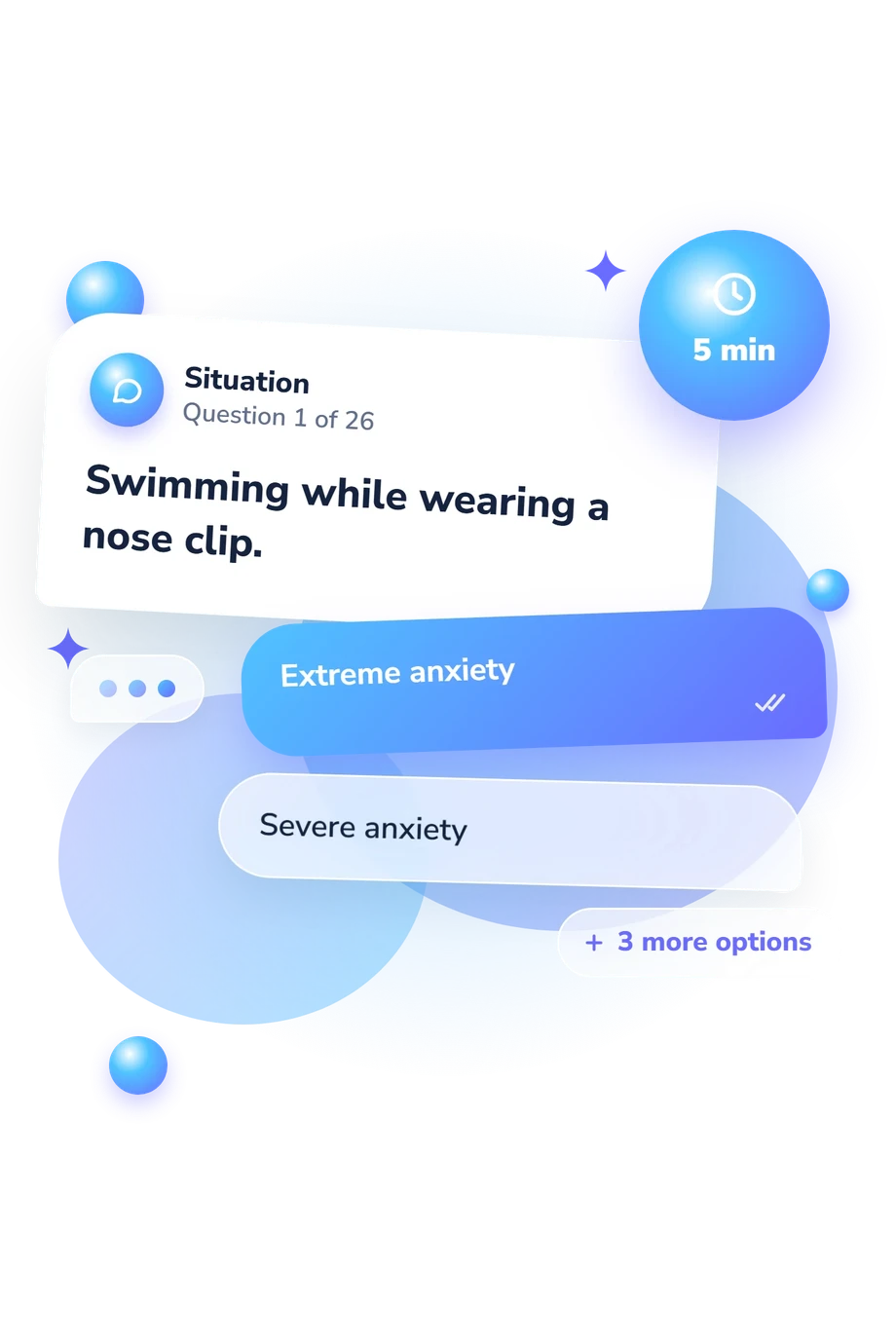
This 26-item questionnaire separates claustrophobia-related anxiety into two independent dimensions — fear of restriction and fear of suffocation — giving a precise picture of which aspect of confined spaces triggers the strongest response. Complete this claustrophobia test in about 5 minutes to identify your anxiety profile and get a clear target for exposure therapy or CBT-based treatment.
Start Online Test
Questions265 minutes
Hi! My name is Freudly, i am an AI therapist, I will give you an interpretation of the test after you complete it.
08:30
October 2, 2025
October 2, 2025
Material has been updated
16,232 views
2,235 completions
1,619 likes
Verified by Daniel Hall
Psychologist with 25 years of experience
Share
Scale Explorer

How the Scales are Structured

example score
23/48
Fear of Restriction (FoR)
Measures anxiety related to being unable to move freely or exit an enclosed space.
Low
High
033Low3448High
A score of 23 falls in the Low range, suggesting relatively mild anxiety about confinement and difficulty leaving enclosed spaces.
example score
29/56
Fear of Suffocation (FoS)
Measures anxiety related to sensations of air shortage or inability to breathe in confined or enclosed spaces.
Low
Elevated
017Low1856Elevated
A score of 29 falls in the Elevated range, suggesting a notable level of discomfort or fear tied to breathing sensations in confined situations.
example score
58/104
Claustrophobia Scale (CS)
Measures the severity of fear and discomfort related to being in enclosed or confined spaces.
Low
Elevated
048Low49104Elevated
A score of 58 falls in the Elevated range, suggesting a higher-than-average level of claustrophobia-related fear or discomfort in confined situations.
Start Online Test
just completed the test
DATA-BASED USER COHORTS

Who Usually Takes This Test?

People fearing tight spaces
41%OF USERS
They feel panic or strong discomfort in elevators, crowded transport, small rooms, or MRI scanners and want to understand how severe it is.
Those with breathing anxiety
34%OF USERS
They mainly worry about not getting enough air or choking sensations in enclosed places and want to separate body panic from situational fear.
Clients in anxiety therapy
25%OF USERS
They take the test to clarify which part of their claustrophobia to target first in counseling—fear of suffocation or fear of restriction.
BASED ON AGGREGATED, ANONYMIZED DATA FROM TENS OF THOUSANDS OF FREUDLY USERS.
Benchmarking

See How You Compare

Once you complete the test, your results are compared with real-world data from people in your country.
Below is a preview of how scores are typically distributed across each scale.
Fear of limitation (Fol)
Average
17.7
Normal range
11.823.6
min.
0
max.
48
Majority
This curve shows how scores are typically distributed.
Once you complete the test, your result will appear on the scale so you can see how you compare.
Fear of suffocation (Fos)
Average
39.2
Normal range
30.448.1
min.
0
max.
56
Majority
This curve shows how scores are typically distributed.
Once you complete the test, your result will appear on the scale so you can see how you compare.
Claustrophobia Scale (CS)
Average
56.9
Normal range
38.874.9
min.
0
max.
104
Majority
This curve shows how scores are typically distributed.
Once you complete the test, your result will appear on the scale so you can see how you compare.
Featured On
CLEAR ANSWERS TO COMMON QUESTIONS

Frequently Asked Questions

What does this claustrophobia test measure?
This claustrophobia test measures anxiety in enclosed spaces across two independent subscales: fear of restriction — distress about being unable to move or escape — and fear of suffocation — anxiety tied to sensations of air shortage or difficulty breathing. Scoring both dimensions separately helps identify which aspect of claustrophobic fear is driving avoidance and panic.
How long does it take and how many items are included?
The questionnaire includes 26 items and typically takes about 5 minutes to complete. For each item, imagine the described situation and rate how much anxiety you would feel, based on your typical reaction rather than a best or worst case.
Who should take a claustrophobia test?
Anyone who experiences strong discomfort, panic attacks, or avoidance behavior in elevators, small rooms, crowded transport, tunnels, or MRI equipment can benefit from taking it. Therapists use it during intake to map the specific fear mechanism before starting exposure therapy, and medical staff use it to screen patients before MRI scans.
How are the results of a claustrophobia assessment interpreted?
Higher scores on the Fear of Restriction subscale suggest anxiety is primarily driven by feeling physically trapped or unable to exit. Higher scores on the Fear of Suffocation subscale point to anxiety rooted in breathing sensations. The total CLQ score reflects overall claustrophobic symptom severity. Results are screening indicators and should be considered alongside clinical history and functional impairment.
What is the difference between fear of restriction and fear of suffocation?
Fear of restriction refers to distress about being physically confined or unable to leave — such as being in a locked room or a crowded elevator. Fear of suffocation refers to anxiety about air supply and breathing — triggered by situations like wearing a nose clip, poor ventilation, or being inside an MRI scanner. These two dimensions often co-occur but respond to different treatment targets in CBT and exposure therapy.
Can this claustrophobia questionnaire track progress during therapy?
Yes. Repeated administration with consistent instructions allows the CLQ to detect meaningful reductions in fear of enclosed spaces over the course of treatment. Comparing subscale scores before and after an intervention shows which dimension — restriction or suffocation anxiety — has responded to therapy and which may need further exposure work.
Is this test used before MRI scans or medical procedures?
Yes. The CLQ is frequently used in medical settings to screen patients for claustrophobic symptoms before MRI or other enclosed procedures. High suffocation subscale scores in particular help staff identify patients who may require open-bore equipment, pre-procedure relaxation techniques, or sedation to complete the scan safely.
WHAT THE TEST MEASURES
About This Assessment
Claustrophobia Test, CLQ

The claustrophobia test is a 26-item self-report instrument that measures anxiety in confined spaces across two clinically distinct subscales: fear of restriction — distress related to being unable to move freely or escape — and fear of suffocation — anxiety tied to sensations of air shortage or difficulty breathing in enclosed environments. Scores on each subscale are calculated independently, revealing which dimension of claustrophobic fear is most prominent and which should be prioritized in treatment.

Why Take a Claustrophobia Test

Claustrophobic symptoms vary significantly between individuals: some people are primarily triggered by physical restriction — such as crowded spaces, tight clothing, or locked rooms — while others react most strongly to sensations of suffocation, such as difficulty breathing through a nose clip or poor ventilation. Treating both as a single undifferentiated phobia leads to less effective therapy outcomes; an accurate claustrophobia assessment that separates these two dimensions allows clinicians to design exposure therapy or CBT programs that target the specific fear mechanism driving avoidance.

A claustrophobia questionnaire is also frequently used before medical procedures such as MRI scans to identify patients at risk of panic attacks in confined equipment, allowing staff to prepare appropriate support interventions in advance.

What the Assessment Measures

  • Fear of Restriction (FR subscale) — anxiety related to being unable to move freely, exit an enclosed space, or escape a confined situation; commonly triggered by elevators, locked rooms, crowded transport, or tight spaces.
  • Fear of Suffocation (FS subscale) — anxiety linked to sensations of air shortage or difficulty breathing in enclosed environments; triggered by situations such as wearing a nose clip, poor ventilation, or being inside MRI equipment.
  • Total CLQ score — an overall index of claustrophobic symptoms severity combining both subscales, used to gauge overall phobia intensity and track change across treatment.

Who This Assessment Is For

The claustrophobia test is appropriate for adults who experience panic attacks, strong discomfort, or avoidance behavior in elevators, small rooms, crowded transport, tunnels, or medical scanning equipment. Therapists use the claustrophobia assessment during intake to establish which fear dimension — restriction or suffocation — is dominant, and to set a clear baseline for monitoring progress through exposure therapy or CBT. Medical staff use it to screen patients before MRI procedures to identify those who may need sedation, extended preparation, or open-bore alternatives. No clinical background is required — each item describes a concrete situation and respondents rate how much anxiety they would feel.

Clinical Validity and Use in Practice

The CLQ was developed by Radomsky, Rachman, and colleagues and published in the Journal of Anxiety Disorders (2001), where it demonstrated strong psychometric properties including good internal consistency across both subscales and adequate test-retest reliability. The two-factor structure — restriction and suffocation — has been replicated across clinical and non-clinical samples and aligns with theoretical models of specific phobia that distinguish between different anxiety disorder subtypes. Results are screening-level indicators of claustrophobic anxiety and should be interpreted alongside clinical history, current symptoms, and functional impairment rather than used as a standalone diagnosis. Repeated administration with identical instructions makes the instrument sensitive to treatment-related change, making it a practical outcome measure for exposure-based interventions targeting fear of enclosed spaces.

Author: psytests.org (2023)
Literature: Radomsky, A. S., Rachman, S., Thordarson, D. S., McIsaac, H. K., & Teachman, B. A. The claustrophobia questionnaire. Journal of Anxiety Disorders. 2001.
Test Question Form
You Might Also Like
Social Phobia Inventory (SPIN)
Social anxiety can substantially interfere with interpersonal functioning,…
Start Test
Futurophobia Scale
Fear about the future can meaningfully affect adolescents’ mood, behavior,…
Start Test
Popular tests
Narcissistic Personality Inventory (NPI)
This self-report measure is used to assess narcissism as a personality trai…
Start Test
Yale-Brown Obsessive Compulsive Scale (Y-BOCS)
This measure is used to rapidly quantify the current severity of obsessive…
Start Test
CRAFFT Screening Test (CRAFFT 2.1)
This brief screening measure is designed to identify potential alcohol and…
Start Test
Patient Health Questionnaire-9 (PHQ-9)
This measure is commonly used to quickly screen for the presence and severi…
Start Test
Maslach Burnout Inventory (MBI)
This self-report measure is used to assess occupational burnout symptoms in…
Start Test
Adolescent Anxiety Questionnaire
This measure is designed to support a brief appraisal of anxiety symptoms a…
Start Test
Emotional Creativity Inventory (ECI)
This self-report measure assesses individual differences in the originality…
Start Test
Horne–Ostberg Morningness–Eveningness Questionnaire (MEQ)
Circadian preferences influence typical patterns of alertness and sleep tim…
Start Test
Ambivalent Sexism Inventory (ASI)
This measure is designed to assess attitudes toward women, including both o…
Start Test
Internalized Misogyny Scale (IMS)
This measure is designed to assess internalized negative beliefs and stereo…
Start Test
Perceived Stress Scale (PSS-10)
This self-report measure assesses the degree to which individuals appraise…
Start Test
Impulsive Behavior Scale (SUPPS-P)
Impulsivity is a multidimensional construct that is often assessed with bri…
Start Test
Clinical Institute Withdrawal Assessment for Alcohol, Revised (CIWA-Ar)
This rating scale is used to rapidly assess the severity of alcohol withdra…
Start Test
Positive and Negative Affect Schedule (PANAS)
This measure provides a brief self-report assessment of current or typical…
Start Test
Light Triad Scale (LTS)
This self-report measure assesses prosocial personality tendencies and orie…
Start Test
Suicidal Ideation Scale
In clinical settings, the Suicidal Ideation Scale is used to structure an i…
Start Test
Body Dysmorphic Disorder Scale (BDD-D)
This brief self-report measure is designed to screen for and quantify distr…
Start Test
Beck Anxiety Inventory (BAI)
This measure is a brief self-report inventory used to screen for anxiety sy…
Start Test
Differential Test of Perfectionism
This instrument is used to screen for perfectionism-related attitudes and t…
Start Test
Locus of Control Scale
This measure assesses generalized expectancies regarding the degree to whic…
Start Test
New Apathy Scale
This brief self-report measure is used to screen for apathy-related symptom…
Start Test
Perth Alexithymia Questionnaire (PAQ)
This measure assesses individual differences in alexithymia, including diff…
Start Test
Social Intelligence Scale
This brief self-report measure is designed to support rapid screening of in…
Start Test
Fear Test
This measure is designed to evaluate individual differences in fear-related…
Start Test
Neuroticism Level Scale
The measure is intended for brief screening of an individual’s propensity t…
Start Test
Aggressiveness Indicators Screening Questionnaire
This screening tool is designed to quickly identify behavioral indicators a…
Start Test
Comments
Leave a Comment