
Nonverbal Behavior Strategies in Conflict Situations Test
How the Scales are Structured
Who Usually Takes This Test?
See How You Compare
Below is a preview of how scores are typically distributed across each scale.
Example Questions From the Test
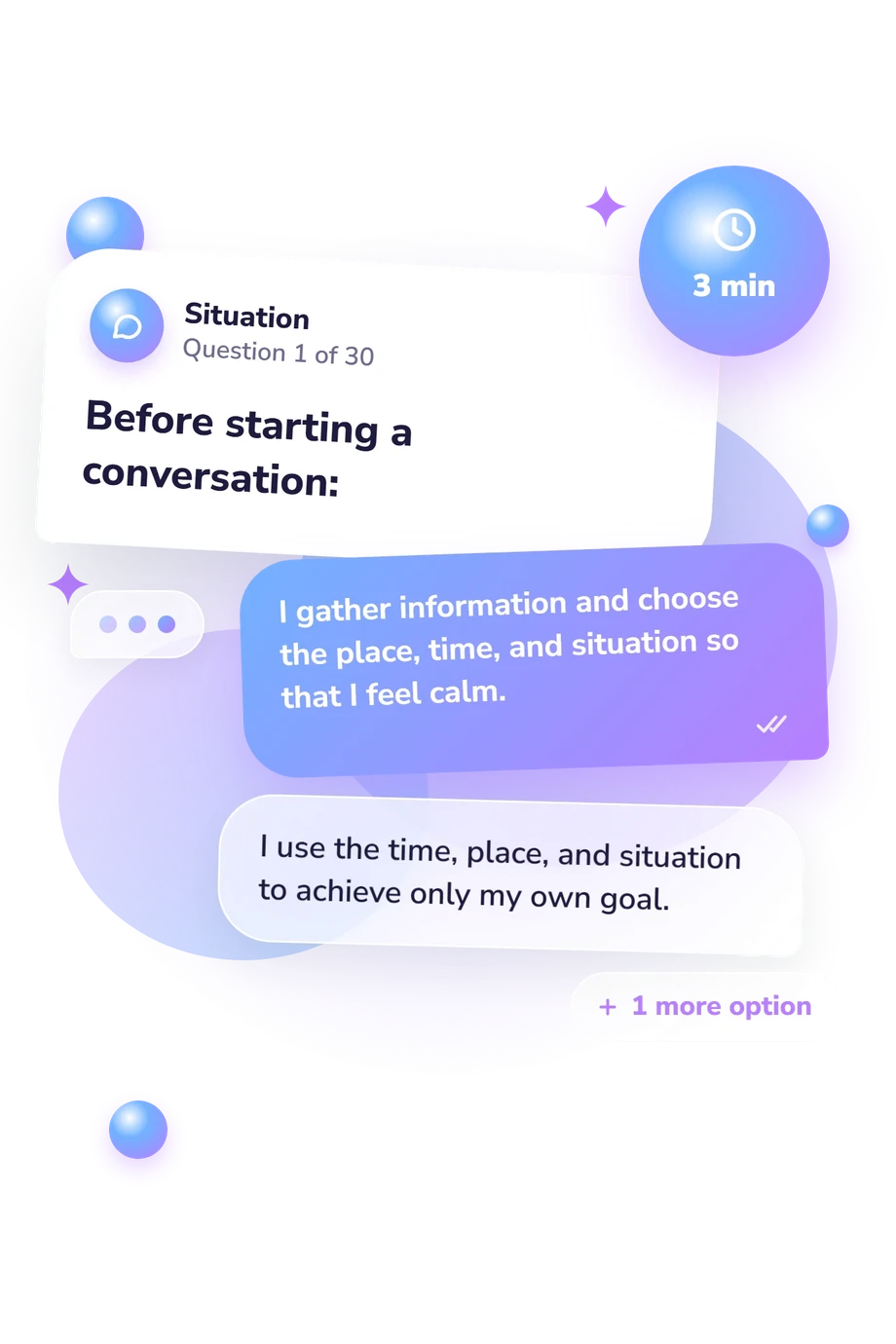
- I clarify and choose the place, time, and situation so that I feel calm.
- I use the time, place, and situation to achieve only my own goal.
- I suggest meeting on neutral territory at a scheduled time, regardless of anyone’s personal preferences.
- so that each of us can see the other freely and there are no barriers between us (a table, a chair, etc.).
- comfortable for me—so that I can feel protected and have something to lean on.
- such that I can see the other person clearly at all times, and I have more opportunity to influence them and more freedom to move.
- in a corner position
- across the table
- on the same side of the table
Nonverbal Behavior Strategies in Conflict Situations Test - Description and methodology of the test
For readers who want to understand their conduct when disagreements become tense, the Nonverbal Behavior Strategies in Conflict Situations Test offers a structured look at recurring interaction choices. It is suited to self-reflection after difficult conversations, where tone, gaze, posture, distance, and timing may shape an exchange as much as spoken content. Taken together, the answers form a conflict behavior profile rather than defining a fixed identity.
What This Assessment Explores
Readers can consider nonverbal choices in tense discussions. As a conflict strategy assessment, it examines posture, gaze, distance, voice, timing, and withdrawal. The profile shows tendencies; definitions explain higher scores.
- Manipulative (0-9) measures covert influence, pressure, withheld information, or intolerable situations; Low 0-3, Moderate 4-5, High 6-9.
- Defensive-Insecure (0-9) measures self-protection, anxiety, and withdrawal; Low defensiveness 0-3, Moderate defensiveness 4-5, High defensiveness 6-9.
- Competitive/Confrontational (0-9) measures rigid self-assertion, dominance, or opponent suppression; Low competitiveness 0-3, Moderate competitiveness 4-5, High competitiveness 6-9.
- Neutral-Independent (0-9) measures uncertainty and detachment; higher results indicate tension and self-control; Low detachment 0-3, Moderate detachment 4-5, High detachment 6-9.
- Collaborative (0-9) measures openness, cooperation, and mutual attention; Low partnering 0-3, Moderate partnering 4-6, High partnering 7-9.
Methodology and Scientific Basis
Each item presents a conflict situation with three responses involving seating, eye contact, gestures, vocal control, pressure, disagreement, or endings. Choosing the closest response makes this a situational self-report of preferred reactions, not direct observation.
The scoring display organizes answers into five profile totals. Because the questionnaire does not state how many points each option contributes, read the result as a pattern across dimensions rather than a reconstructed item formula. The displayed bands provide the questionnaire's interpretation levels for each scale.
The questionnaire is conceptually consistent with Leonov's 2022 book Conflictology, which presents conflict behavior as recognizable interaction strategies. A 2023 study by Usoskaya and Smirnova connects emotional intelligence with nonverbal behavior in conflict-tension situations, while the work of Lochman and Allen examines couples’ nonverbal communication during conflict. This nonverbal behavior test is conceptually consistent with those works, not an adaptation or validation of them.
Self-awareness, memory, and current emotional context can affect answers, so results may vary across situations. They describe tendencies in conflict communication, not a diagnosis or complete account of how someone behaves.
- Leonov, Nikolai I. Psychology of Conflict: Methods for Studying Conflicts and Conflict Behavior. 3rd ed., revised and expanded. Moscow: Yurait, 2022, 264 pp. ISBN 978-5-534-12570-2.
- Usoskaya, Darya O., and Yulia S. Smirnova. "The Relationship Between Emotional Intelligence and Nonverbal Behavior in Conflict-Tense Situations." In Social Psychology: Issues of Theory and Practice: Proceedings of the Eighth International Scientific-Practical Conference in Memory of M. Yu. Kondratyev. Moscow: Moscow State University of Psychology and Education, 2023, pp. 850-852. ISBN 978-5-94051-289-9.
- Lochman, John E., and George Allen. "Nonverbal Communication of Couples in Conflict." Journal of Research in Personality 15, no. 2 (1981): 253-269. 10.1016/0092-6566(81)90024-6.
Updated: