
Toronto Alexithymia Scale (TAS-20) Test
How the Scales are Structured
Who Usually Takes This Test?
See How You Compare
Below is a preview of how scores are typically distributed across each scale.
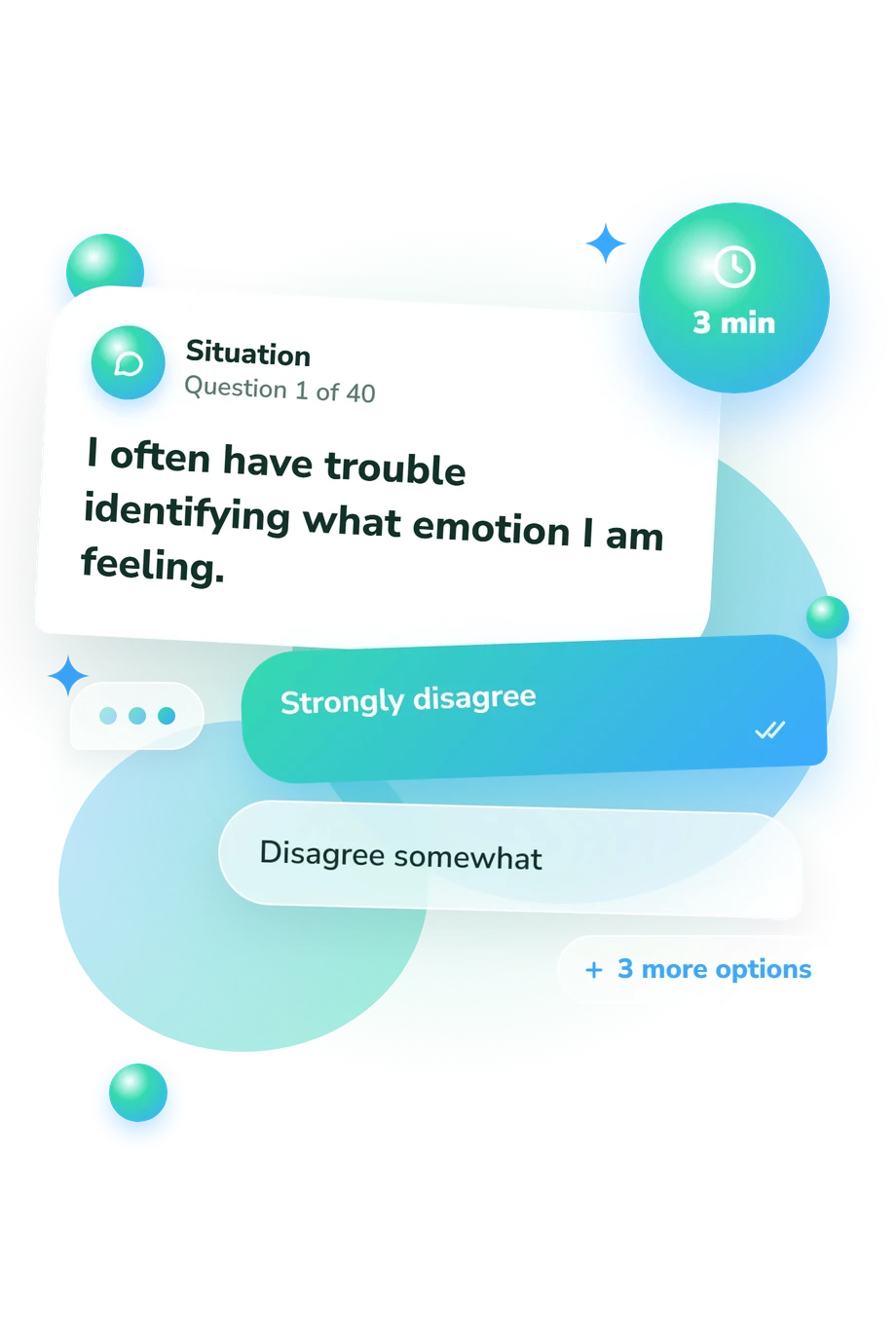
Example Questions From the Test
- Strongly disagree
- Disagree
- Neither agree nor disagree
- Agree
- Strongly agree
- Strongly disagree
- Disagree
- Neither agree nor disagree
- Agree
- Strongly agree
- Strongly disagree
- Disagree
- Neither agree nor disagree
- Agree
- Strongly agree
Toronto Alexithymia Scale (TAS-20) Test - Description and methodology of the test
People seeking a clearer picture of emotional awareness can use the Toronto Alexithymia Scale (TAS-20) Test to examine how they notice, name, and communicate feelings. It is intended for self-reflection when someone wants more detail than a general mood check can provide. An alexithymia questionnaire can reveal whether the strongest pattern concerns recognizing emotions, putting them into words, or concentrating on external events.
What This Assessment Explores
This assessment treats alexithymia as a pattern involving emotional recognition, emotional language, and attention. The result is a profile rather than a personality label. The TAS-20 test helps show which dimension is prominent; higher overall values may indicate impairment in emotional awareness and expression and are associated with increased risk of psychosomatic disorders.
The four displayed scales describe these result dimensions:
- Externally Oriented Thinking (8-40) assesses focus on outward events over inner experience: More emotionally reflective (8-15), Balanced focus (16-25), Strong external focus (26-40).
- Difficulty Describing Feelings (5-25) measures how readily emotions are put into words: Low difficulty (5-17) or High difficulty (18-25).
- Difficulty Identifying Feelings (7-35) measures recognition of emotions and bodily sensations: Low difficulty (7-11), Moderate difficulty (12-24), High difficulty (25-35).
- Overall Alexithymia (20-100) summarizes identification and description difficulties plus external focus: Low (20-39), Borderline (40-63), High (64-100).
Methodology and Scientific Basis
Each statement uses five response options, from Strongly disagree to Strongly agree. The wording addresses emotional and bodily awareness, putting feelings into words, preferences for analyzing external matters, and comfort with reflection. The catalogue provides subscale and overall totals with the displayed bands, but it does not specify how each individual response contributes to those totals.
Methodologically, the relevant instrument is the Toronto Alexithymia Scale (TAS-20) (Bagby et al., 1994), whose framework separates emotional identification, emotional description, and externally oriented thinking. Published studies examined convergent, discriminant, and concurrent validity, then reliability and factorial validity in community populations and across languages and cultures. This online questionnaire presents the published TAS-20 structure. The cited studies support the instrument’s psychometric evidence, but they do not establish these catalogue bands as universal population norms.
This Toronto Alexithymia Scale assessment is best read as a structured self-report profile. Self-report can be shaped by current stress, mood, self-awareness, cultural context, and willingness to disclose, so the result cannot determine causes, diagnose alexithymia, or replace broader assessment.
- Bagby, R. M., Parker, J. D. A., & Taylor, G. J. (1994). The twenty-item Toronto Alexithymia Scale-I. Item selection and cross-validation of the factor structure. Journal of Psychosomatic Research, 38(1), 23-32. 10.1016/0022-3999(94)90005-1
- Bagby, R. M., Taylor, G. J., & Parker, J. D. A. (1994). The Twenty-item Toronto Alexithymia Scale-II. Convergent, discriminant, and concurrent validity. Journal of Psychosomatic Research, 38(1), 33-40. 10.1016/0022-3999(94)90006-x
- Parker, J. D. A., Taylor, G. J., & Bagby, R. M. (2003). The 20-Item Toronto Alexithymia Scale: III. Reliability and factorial validity in a community population. Journal of Psychosomatic Research, 55(3), 269-275. 10.1016/S0022-3999(02)00578-0
- Taylor, G. J., Bagby, R. M., & Parker, J. D. A. (2003). The 20-Item Toronto Alexithymia Scale: IV. Reliability and factorial validity in different languages and cultures. Journal of Psychosomatic Research, 55(3), 277-283. 10.1016/S0022-3999(02)00601-3
Updated: