
Civic Identity Types Test
How the Scales are Structured
Who Usually Takes This Test?
See How You Compare
Below is a preview of how scores are typically distributed across each scale.
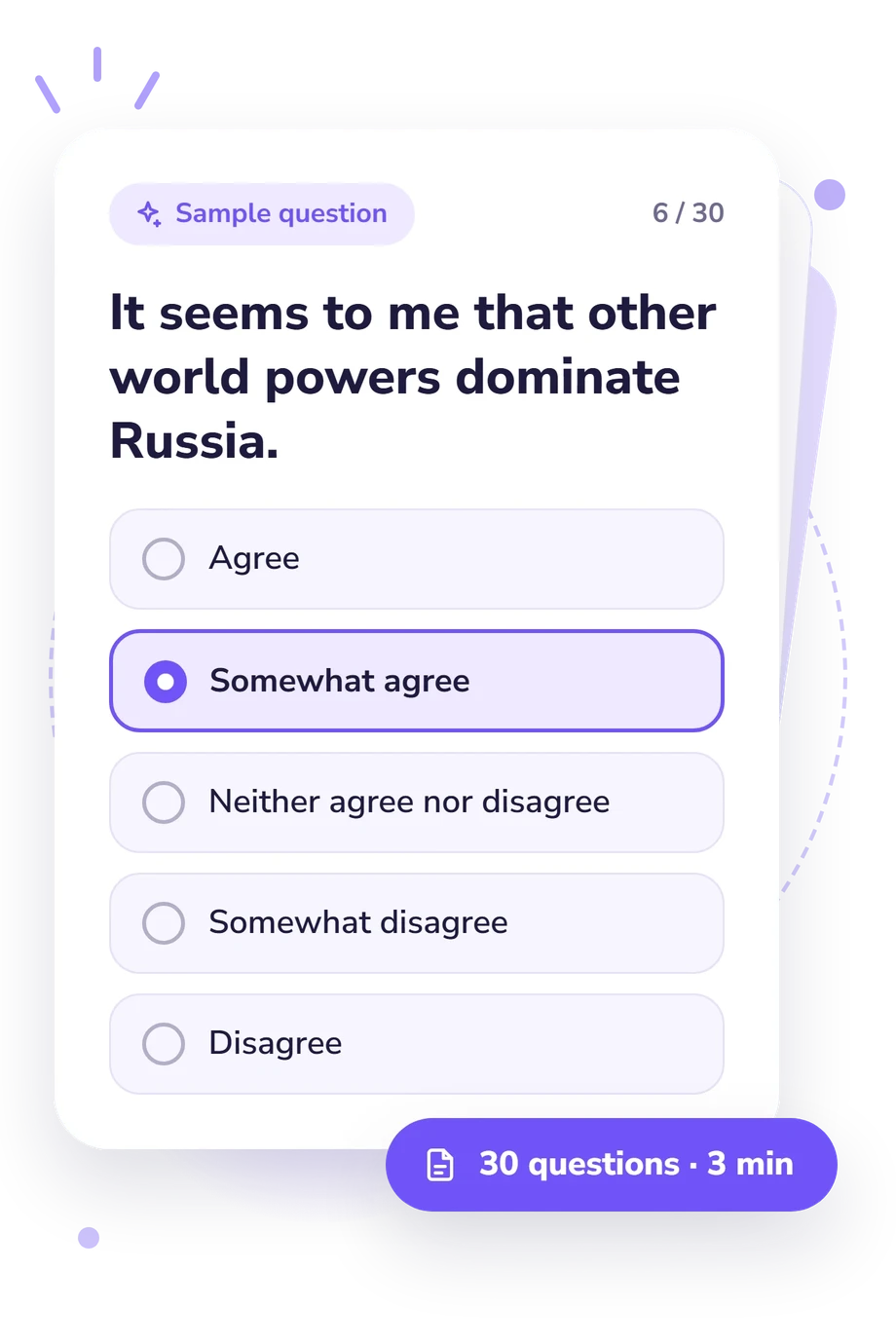
Example Questions From the Test
- Agree
- Somewhat agree
- Neither agree nor disagree
- Somewhat disagree
- Disagree
- Agree
- Somewhat agree
- Neither agree nor disagree
- Somewhat disagree
- Disagree
- Agree
- Somewhat agree
- Neither agree nor disagree
- Somewhat disagree
- Disagree
Civic Identity Types Test - Description and methodology of the test
People who want to examine how they relate to citizenship, national belonging, and the place they assign to collective interests may find the Civic Identity Types Test useful. It is intended for self-reflection by readers interested in a civic identity assessment, particularly when pride, discomfort, solidarity, or national exceptionalism are hard to distinguish. The result describes the respondent’s profile across the three dimensions rather than a permanent personal label.
What This Assessment Explores
The questionnaire examines civic identification through perceived national status, belonging, solidarity with citizens, and the place of national interests relative to individual or other peoples’ interests. It also addresses shame, inferiority, pride, openness, and exceptional claims about the nation. As a national identity questionnaire, it helps describe the direction and intensity of these attitudes in the respondent’s present outlook.
The three displayed dimensions are:
- Negative (0-20) measures discomfort, perceived national inferiority, and reluctance to show civic affiliation; Low 0-6, Moderate 7-13, High 14-20.
- Positive (0-20) reflects comfort with citizenship and moderate, normative patriotism; Low 0-6, Moderate 7-14, High 15-20.
- Hyper-Positive (0-20) indicates civic narcissism or fanaticism and readiness to subordinate other interests to national goals; Low 0-6, Moderate 7-13, High 14-20.
Together, the profile describes discomfort and avoidance, comfortable civic identification, and hyper-positive national centrality across three dimensions.
Methodology and Scientific Basis
Each item uses a five-point agreement response, moving from agreement through neutrality to disagreement, with wording addressing citizenship, national unity, status, rights, and national priorities. The questionnaire groups responses into the three dimensions above and displays a separate score for each.
The closest conceptual basis is Borisov’s civic-identity typology (2016); this online questionnaire is conceptually consistent with it but is not documented as an adaptation.
The resulting civic identity profile should be read by comparing the bands with your answers and circumstances. The displayed bands should be read as descriptive result categories for this questionnaire, without being treated as validated clinical cutoffs or population norms unless such status is documented; self-report can be shaped by current political events, social desirability, and personal interpretations of nationality, so the profile is best used for reflection rather than as a complete account of civic identity.
- Borisov, R. V. (2016). Civic Identity in Terms of Psychodiagnostics. Bulletin of Dagestan State University. Series 2: Humanities, 31(4), 95-99. DOI 10.21779/2542-0313-2016-31-4-95-99.
- Borisov, R. V. (2013). Theoretical and Conceptual Understanding of the Phenomenon of Civic Identity. Psychology of Education in Multicultural Space, 4(24), 5-12.
- Belovol, E. V., Melkov, S. V., Puchkova, E. B., Sakharova, T. N., & Podymov, N. A. (2021). Theoretical Approaches to the Development and Testing of the “Person’s Civic Identity Profile” Questionnaire. Pedagogy and Psychology of Education, (4), 101-123. DOI 10.31862/2500-297X-2021-4-101-123.
Updated: