
Socio-Personal Maturity as an Indicator of Readiness for Parenthood Test
How the Scales are Structured
Who Usually Takes This Test?
See How You Compare
Below is a preview of how scores are typically distributed across each scale.
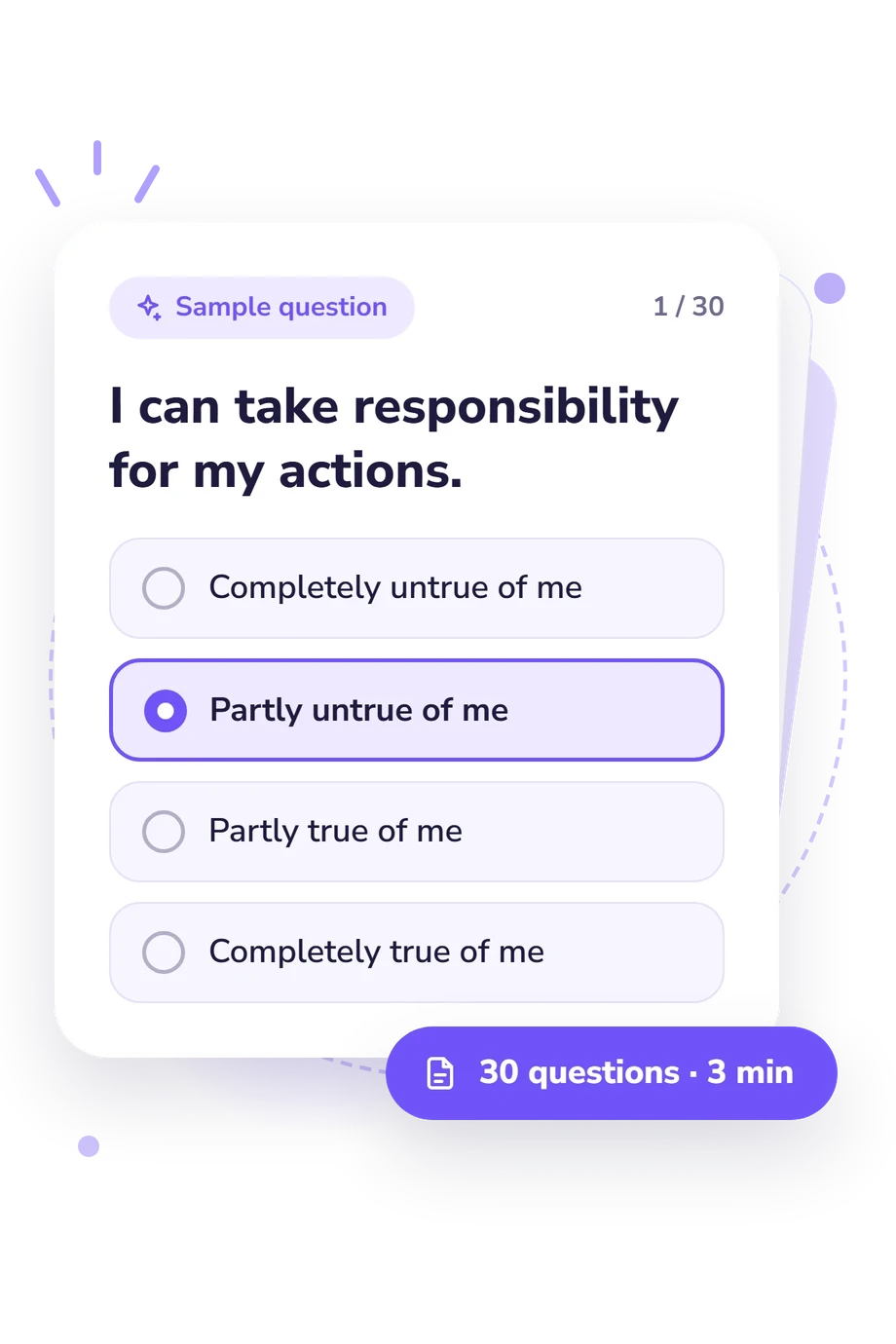
Example Questions From the Test
- Not at all true of me
- Mostly not true of me
- Partially true of me
- Completely true of me
- Not at all true of me
- Mostly not true of me
- Partly true of me
- Completely true of me
- Does not describe me at all
- Describes me partly not
- Describes me partly
- Describes me completely
Socio-Personal Maturity as an Indicator of Readiness for Parenthood Test - Description and methodology of the test
Adults considering parenthood can use this parental readiness questionnaire to examine how their everyday attitudes and resources relate to raising a child. The Socio-Personal Maturity as an Indicator of Readiness for Parenthood Test focuses that reflection on responsibility, care, and attitudes toward the parental role. Its overall band can guide reflection on how confidently the respondent approaches responsibility, care, and parental attitudes.
What This Assessment Explores
Readiness is self-reported maturity, not a prediction of future parenting. The questions explore gender identity, responsibility, independence, care, childrearing attitudes, perception of the parental role, and awareness of responsibility for a child and one’s parental position. These themes describe item content and contribute to one overall scale; they are not separate findings.
The displayed Socio-Personal Maturity scale ranges from 15-60: Developing 15-29, Adequate 30-44, and Well-developed 45-60. These bands describe the overall level indicated by the combined responses.
For someone weighing readiness to become a parent, the questionnaire offers a snapshot of orientation toward adult responsibility and the parental role. The item themes are:
- Responsibility shows how the respondent handles obligations involving a child.
- Independence reflects decision-making and care confidence.
- Childrearing attitudes show whether parenthood and a child’s wishes are valued.
- Empathic caregiving indicates sensitivity to a child’s distress.
Methodology and Scientific Basis
Each item presents a first-person statement about responsibility, decision-making, care, parenthood, or a child’s needs. The respondent chooses one of four ordered options, from not at all or mostly untrue to partly true and completely true. Minor wording differences preserve the same self-rating task.
Responses contribute to one combined result. This socio-personal maturity assessment summarizes the respondent’s response themes as a snapshot of orientation toward adult responsibility and the parental role. The band is most useful when read alongside the situations that prompted agreement or hesitation.
The questionnaire is conceptually consistent with Zavgorodnyaya and Evstratova (2020) on psychological readiness for parenthood and with Lada-Masko and Kazmierczak (2021) on maturity to parenthood. It is not an adaptation of either work, so those studies do not supply norms or validation for this online version.
Because the measure is self-report, scores can shift with current circumstances, expectations, social desirability, and self-awareness. Treat the result as a structured reflection on present perceptions, not a standalone judgement about parenting capacity.
- Zavgorodnyaya, I. V. (2013). Psychological Crisis of Pregnancy. Voronezh: Nauchnaya Kniga.
- Zavgorodnyaya, I. V., & Evstratova, M. S. (2020). Psychological Readiness for Parenthood in Young Men and Women. In Current Issues of Reproductive Health and Formation of Family Values among Students of the Voronezh Region: Proceedings of the Expert Scientific-Practical Online Conference, Voronezh, June 9, 2020 (pp. 37-42). Moscow: Mir Nauki. ISBN 978-5-6044337-5-1.
- Lada-Masko, A. B., & Kazmierczak, M. (2021). Measuring and Predicting Maturity to Parenthood: What Has Personality Got to Do with It? Journal of Clinical Medicine, 10(24), 5802. 10.3390/jcm10245802
Updated: