
Pain Relievers Comprehension Quiz
How the Scales are Structured
Who Usually Takes This Test?
See How You Compare
Below is a preview of how scores are typically distributed across each scale.
Example Questions From the Test
- They always cause drowsiness while relieving pain.
- They can reduce inflammation as well as pain and fever.
- They treat bacterial infections that cause pain.
- They numb the skin or tissue where pain begins.
- Ibuprofen
- Acetaminophen (paracetamol)
- Naproxen
- Aspirin
- The drug responsible for the intended medicinal effect
- The substance that determines the product's expiration date
- The flavoring used to make the medicine easier to take
- Every substance that could cause an allergic response
Pain Relievers Comprehension Quiz - Description and methodology of the test
People who want a practical check of medicine knowledge can use this assessment to examine label reading, active ingredients, and responses to common safety situations. Designed for people and caregivers making everyday over-the-counter decisions, the pain relievers comprehension quiz offers one overall comprehension band for the situations covered. This comprehension quiz on pain relievers summarizes performance across the situations presented.
What This Assessment Explores
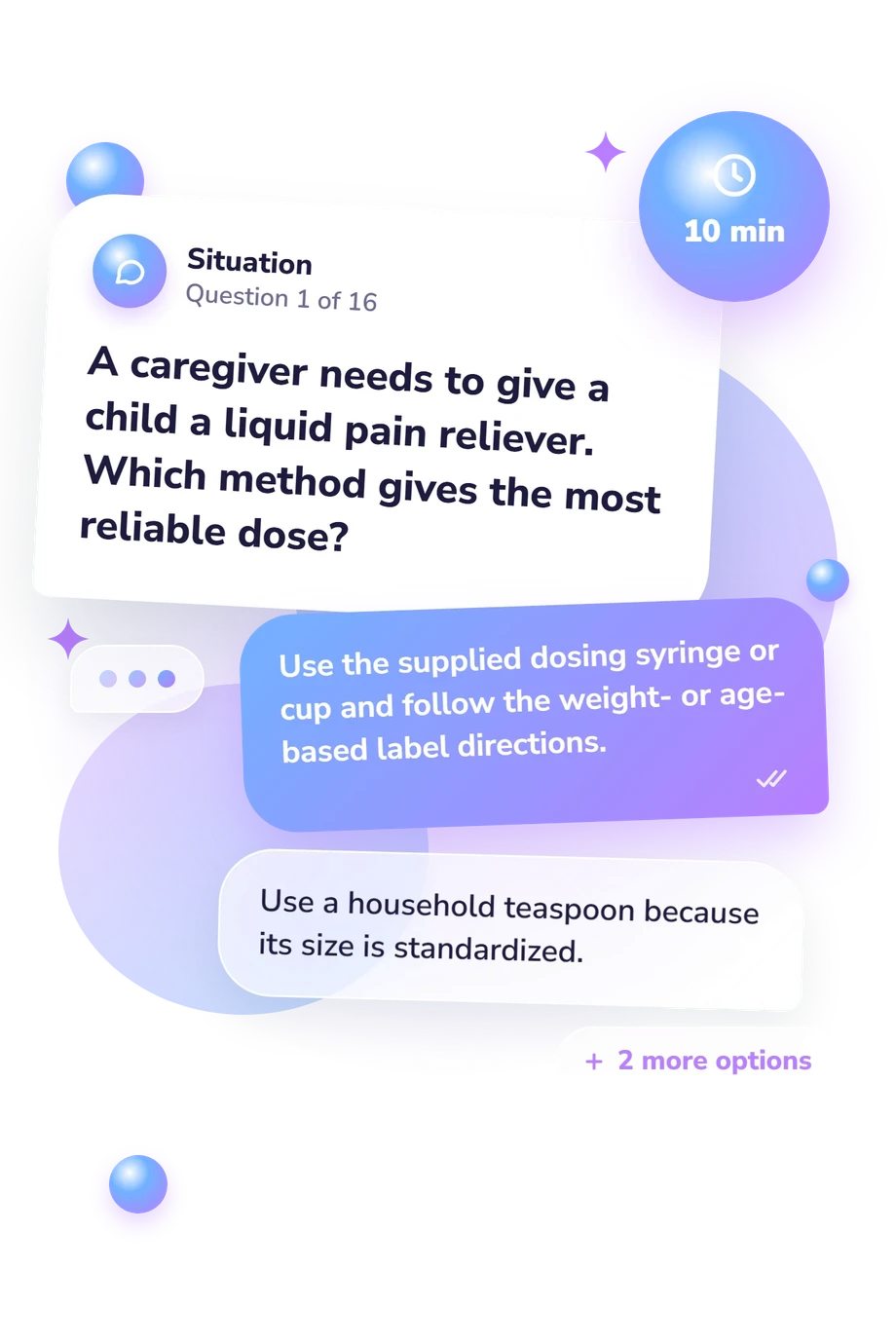
The questionnaire checks understanding of nonprescription pain medicines, not personal symptom severity. Its scenarios address measuring liquid doses, reading “extra strength” labels, comparing active ingredients, distinguishing NSAIDs from acetaminophen, and recognizing situations involving pregnancy, liver disease, ulcers, blood thinners, or suspected overdose. It helps readers review medicine-safety decisions. Better over-the-counter pain reliever safety knowledge means knowing when to follow directions, pause, or seek advice.
The result uses one scale, Pain Relievers Knowledge (0-16): Foundation to Build (0-6), Developing Comprehension (7-12), or Strong Comprehension (13-16). These bands describe educational comprehension. Key themes include:
- Dose and label reading show whether directions can be applied accurately.
- Ingredient awareness shows whether drug classes and duplicate products are recognized.
- Risk judgment shows whether personal circumstances change the safest next step.
- Warning-sign recognition shows whether continued self-treatment should stop.
Methodology and Evidence Base
Each item presents a scenario with four answer choices, asking for the safest or most accurate principle. It tests applied knowledge: label instructions and medicine-safety concepts are transferred to practical decisions rather than rated as feelings or symptoms. The result is interpreted through the displayed educational bands. This includes pain medication label reading as a practical skill, alongside recognizing duplicate ingredients and risk situations.
The content is conceptually consistent with Magadmi et al. (2022), whose work on self-use of pain medicines connects with the questionnaire’s self-medication scenarios. Kontogiorgis et al. (2016) relates to its focus on paracetamol labeling, while Cryer et al. (2016) relates to NSAID overuse and misconceptions. King et al. (2011) is relevant to recognizing acetaminophen as an active ingredient across products. This questionnaire is not adapted from or validated by those studies, and their findings do not establish norms for its result.
Interpret the score as a snapshot of performance on these situations. Self-report is influenced by attention, memory, assumptions, and current context, so use the band to guide label review and questions for a pharmacist or clinician rather than determine treatment.
- Magadmi, Rania M., Kamel, Fatemah O., Hagras, Magda M., Alhmied, Hwraa I., Aljumaiy, Walla H., Saqat, Doaa F., and Magadmi, Mawadah M. Knowledge and Attitudes Regarding the Self-Use of Pain Medications in Saudi Arabia: A Cross-Sectional Study. Journal of Microscopy and Ultrastructure, 2021, 10(1), 15-19. 10.4103/JMAU.JMAU_47_20
- Kontogiorgis, Christos, Nena, Evangelia, Berberoglou, Eleftherios, Moschoni, Kyriaki, Polyzois, Spyros, Tselemponis, Athanasios, and Constantinidis, Theodoros C. Estimating Consumers’ Knowledge and Attitudes Towards Over-The-Counter Analgesic Medication in Greece in the Years of Financial Crisis: The Case of Paracetamol. Pain and Therapy, 2016, 5(1), 19-28. 10.1007/s40122-015-0042-x
- Cryer, Byron, Barnett, Michael A., Wagner, Jennifer, and Wilcox, C. Mel. Overuse and Misperceptions of Nonsteroidal Anti-inflammatory Drugs in the United States. The American Journal of the Medical Sciences, 2016, 352(5), 472-480. 10.1016/j.amjms.2016.08.028
- King, Jennifer P., Davis, Terry C., Bailey, Stacy C., Jacobson, Kara L., Hedlund, Laurie A., Di Francesco, Lorenzo, Parker, Ruth M., and Wolf, Michael S. Developing Consumer-Centered, Nonprescription Drug Labeling: A Study in Acetaminophen. American Journal of Preventive Medicine, 2011, 40(6), 593-598. 10.1016/j.amepre.2011.02.016
Updated: