
NR 228 Quiz 1
How the Scales are Structured
Who Usually Takes This Test?
See How You Compare
Below is a preview of how scores are typically distributed across each scale.
Example Questions From the Test
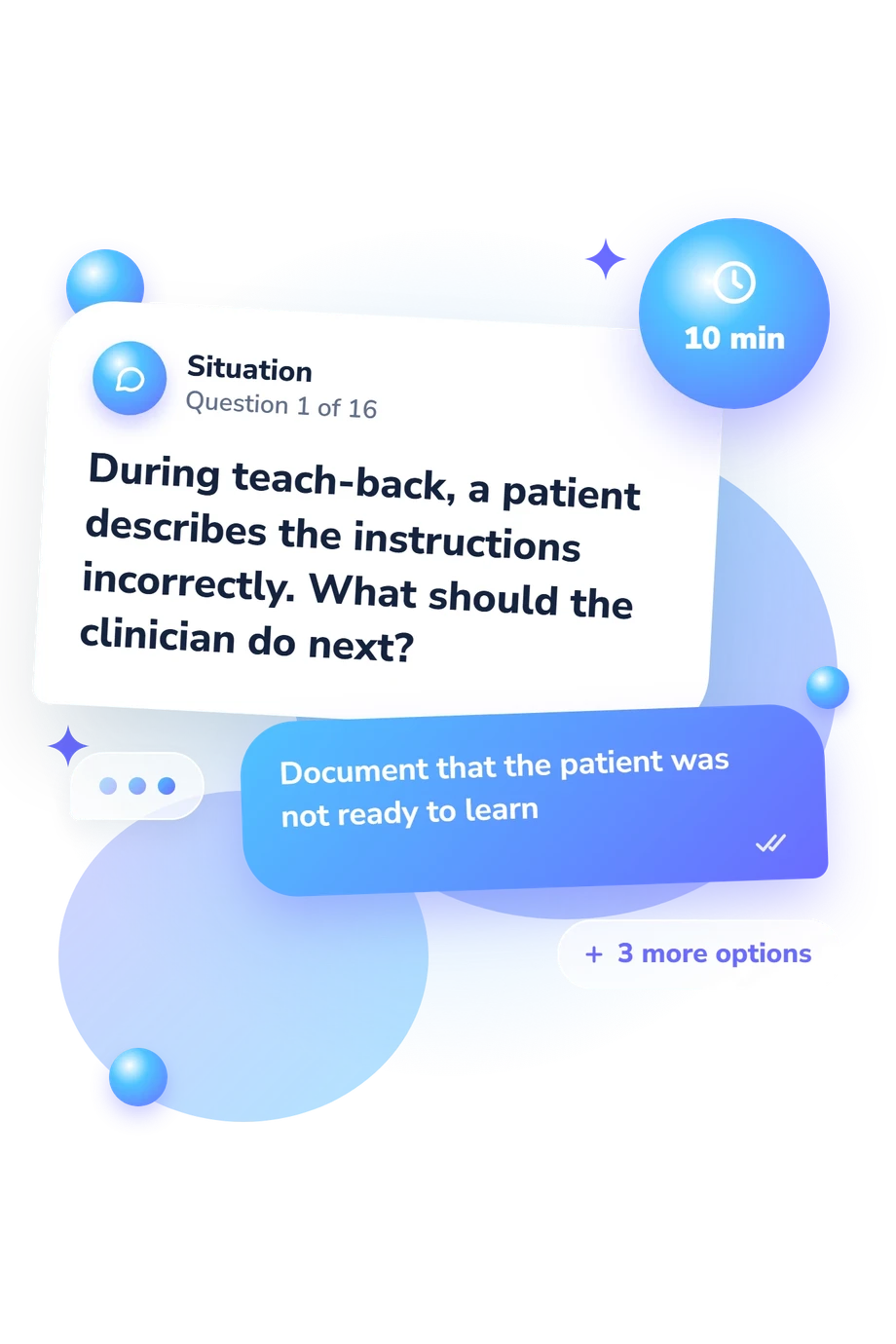
- Document that the patient was not ready to learn
- Repeat the original explanation word for word and end the discussion
- Give the patient a detailed handout to review later instead of discussing it further
- Explain the point again in a different way, then ask for another teach-back
- Most patients understand these directions the first time. Do you?
- This is basic information, but let me know if any part confused you.
- I explain this to many people, so I want to check how clearly I described it. What will you do when you get home?
- How strong would you say your reading skills are?
- Administer one oral dose on a bi-daily schedule.
- Take the medication via the oral route at two daily intervals.
- Take the medicine by mouth two times each day.
- Consume the prescribed medicine regularly, morning and evening.
NR 228 Quiz 1 - Description and methodology of the test
People reviewing health-literacy principles in healthcare settings can use the NR 228 Quiz 1 as a focused check of applied understanding. It suits readers who want to connect definitions with patient scenarios, communication choices, and service design. As a health literacy quiz, it shows the respondent’s overall level of knowledge and can guide general review of the covered principles.
What This Assessment Explores
The questionnaire examines practical knowledge rather than reading ability. Its scenarios cover teach-back, shame-sensitive communication, plain language, credible information, medication timing, decisions, informed consent, interpreters, and organizational access. Together, they show how health literacy operates in interactions and systems.
One reported result gives an overall level of knowledge rather than separate topic scores. It indicates performance on this quiz, not a judgment about intelligence or reading skill.
Across the questionnaire, NR228 Quiz 1 organizes its items into four thematic groups; these are not separate reported scores:
- Communication repair tests recognition of teach-back practices that support understanding.
- Information appraisal tests recognition of credible evidence and sources.
- Usability and numeracy test plain language, layouts, and medication intervals.
- Person-centered access tests preferences, consent, interpreters, and service barriers.
Methodology and Scientific Basis
Each item presents a healthcare situation with four answer choices and one best response. The displayed result uses the Health Literacy Knowledge scale, with 0-16 correct answers and three bands: Foundational Review (0-6), Developing Knowledge (7-12), and Strong Knowledge (13-16). This makes the quiz a knowledge check, not a rating of confidence, symptoms, or attitudes. The format tests recognition of the principle in each scenario, not consistent behavior in practice.
The closest comparison is HLKES-2, a health-literacy knowledge measure used in nursing education. This questionnaire is conceptually consistent with that work, but it is not HLKES-2 or a validated adaptation. Cormier and Kotrlik offer context for assessing health-literacy knowledge and experiences.
DeWalt and colleagues describe the universal-precautions approach echoed by the communication items. Santana and colleagues support the distinction between personal and organizational health literacy in questions about decisions and clinic access. As a health literacy knowledge test, it connects definitions with applied scenarios.
Because the score is unofficial and quiz-specific, it is a snapshot shaped by item wording, prior instruction, and healthcare-language familiarity. It can guide further study, but it does not provide standardized norms or a standalone measure of real-world communication skill.
- Walker D, Howe C, Dunkerley M, Deupree J, Cormier C. The HLKES-2: Revision and Evaluation of the Health Literacy Knowledge and Experiences Survey. Journal of Nursing Education. 2019;58(2):86-92. 10.3928/01484834-20190122-05
- Cormier CM, Kotrlik JW. Health literacy knowledge and experiences of senior baccalaureate nursing students. Journal of Nursing Education. 2009;48(5):237-248. 10.3928/01484834-20090416-02
- DeWalt DA, Broucksou KA, Hawk VH, Brach C, Hink A, Rudd R, Callahan L. Developing and testing the health literacy universal precautions toolkit. Nursing Outlook. 2011;59(2):85-94. 10.1016/j.outlook.2010.12.002
- Santana S, Brach C, Harris L, Ochiai E, Blakey C, Bevington F, Kleinman D, Pronk N. Updating Health Literacy for Healthy People 2030: Defining Its Importance for a New Decade in Public Health. Journal of Public Health Management and Practice. 2021;27(Suppl 6):S258-S264. 10.1097/PHH.0000000000001324
Updated: