
Movie Character Quiz
How the Scales are Structured
Who Usually Takes This Test?
See How You Compare
Below is a preview of how scores are typically distributed across each scale.
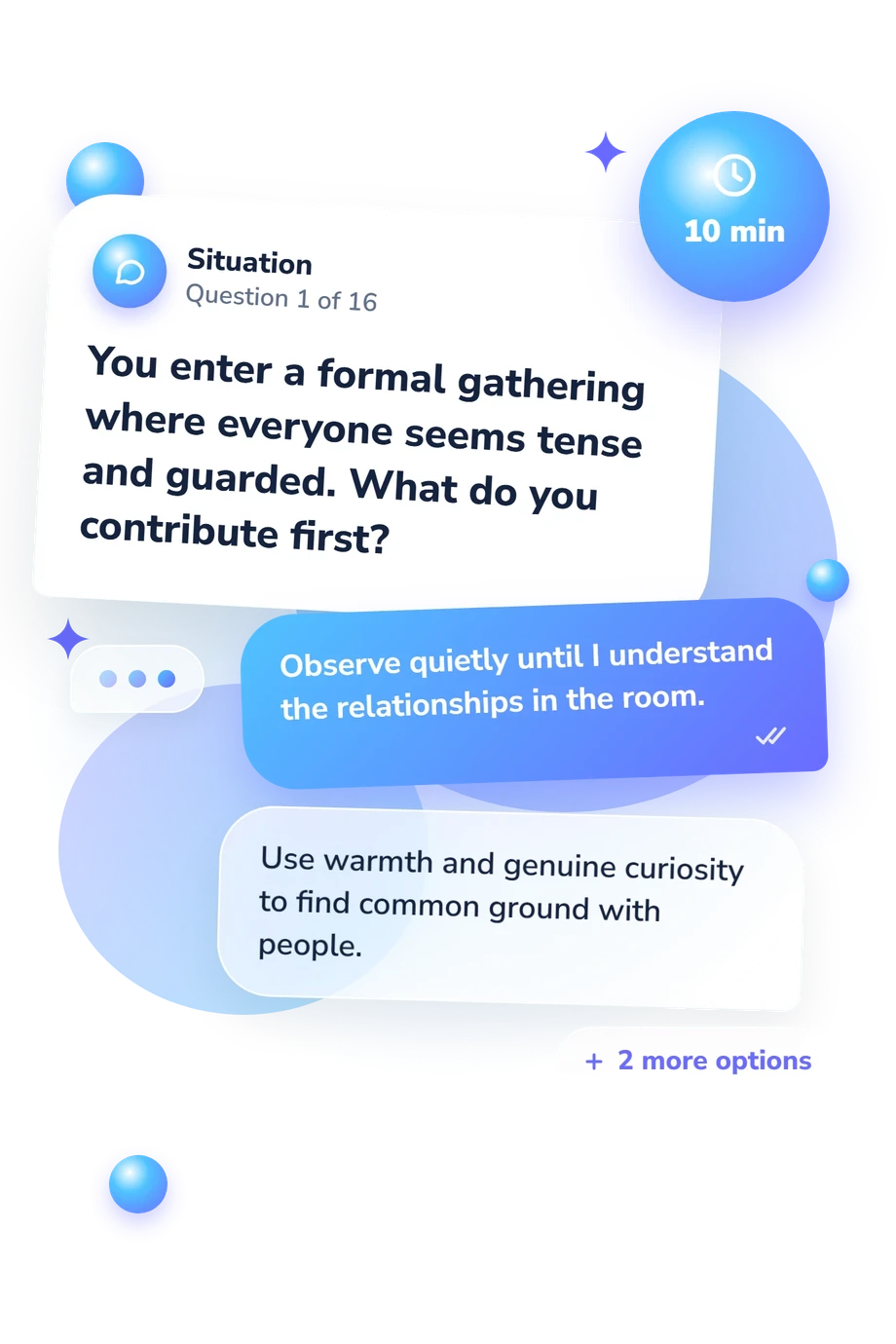
Example Questions From the Test
- Observe quietly until I understand the relationships in the room.
- Use warmth and genuine curiosity to find common ground with people.
- Demonstrate my expertise so others know why I belong there.
- Challenge the assumptions creating the tension, even if it surprises people.
- Answer with humor or confidence so the criticism does not control the room.
- Step back from the exchange and reflect on it later in private.
- Respond calmly, explain my responsibility, and consider whether the criticism has merit.
- Ask a trusted ally to help me understand how the decision was perceived.
- Pack the essentials and leave plenty of room for spontaneity.
- Make a checklist, verify details, and prepare for likely complications.
- Let the most travel-savvy person handle most of the logistics.
- Secure the key arrangements, then stay flexible about the smaller details.
Movie Character Quiz - Description and methodology of the test
People who enjoy films and want a playful way to reflect on their own choices can use this movie character quiz to compare everyday tendencies with four recognizable fictional figures. The questions ask which film character most resembles your way of handling pressure, preparation, loyalty, leadership, fairness, and change. The fictional character quiz compares those choices through recognizable roles, giving readers a concise basis for conversation or self-reflection.
What This Assessment Explores
This assessment examines responses to pressure, responsibility, relationships, fairness, and change. It is for readers, not film-knowledge testing. Scenario choices produce a movie character personality profile across four scales:
- Elle Woods (0-12) ranges from Quietly Self-Directed (0-4), protecting energy privately, through Expressive Achiever (5-8), joining warmth with ambition, to Authentically Determined (9-12), sustaining distinctive persistence.
- Hermione Granger (0-12) ranges from Improvising Spirit (0-4), favoring flexibility, through Thoughtful Problem-Solver (5-8), balancing evidence with adaptation, to Prepared Principle-Holder (9-12), defending informed principles.
- Samwise Gamgee (0-12) ranges from Self-Reliant Explorer (0-4), supporting through independence, through Dependable Companion (5-8), offering practical help, to Steadfast Supporter (9-12), sustaining loyal care.
- T’Challa (0-12) ranges from Independent Path-Maker (0-4), prioritizing personal initiative, through Considered Contributor (5-8), balancing duty and consultation, to Composed Steward (9-12), practicing accountable leadership through change.
Within one point, scores form a blended result.
Methodology and Evidence Base
Each item presents a concrete situation and four responses, so you choose what feels natural rather than a correct answer. It compares character-associated tendencies, not audience-character identification directly. Comparing preparation, duty, support, leadership, and openness to change across four figures creates a character profile quiz with a separate score for each figure; close results indicate shared tendencies rather than one identity.
Scenarios cover tension, criticism, preparation, tradition, morale, commitment, study, fairness, leadership, resources, friendship, ambition, and revising an argument. Together, they summarize patterns across everyday decisions rather than one isolated trait.
Research by Huang and colleagues links audience-character similarity with identification, while Cohen distinguishes identification from liking. Huang and Fung describe merging, perspective-taking, understanding, and emotional involvement. This research is conceptual context, not evidence that this questionnaire adapts those measures.
These studies do not establish this questionnaire’s reliability, norms, or standardization. Answers are hypothetical self-reports, so mood and social desirability can shift results; familiarity with the figures may instead affect interpretation of the labels, and the profile is not a diagnostic assessment.
- Huang, K. Y., Fung, H. H., & Sun, P. (2024). The effect of audience-character similarity on identification with narrative characters: A meta-analysis. Current Psychology, 43, 7026-7043. 10.1007/s12144-023-04842-4
- Huang, K. Y., & Fung, H. H. (2024). Measuring identification with narrative characters: The development and validation of a new scale. Current Psychology, 43, 24835-24849. 10.1007/s12144-024-06191-2
- Cohen, J. (2001). Defining identification: A theoretical look at the identification of audiences with media characters. Mass Communication & Society, 4(3), 245-264. 10.1207/S15327825MCS0403_01
Updated: