
Child Anxiety Scale Test
How the Scales are Structured
Who Usually Takes This Test?
See How You Compare
Below is a preview of how scores are typically distributed across each scale.
Example Questions From the Test
- Very unpleasant
- Slightly unpleasant
- Not frightening
- Very unpleasant
- Slightly unpleasant
- Not frightening
- Very unpleasant
- Slightly unpleasant
- Not frightening
Child Anxiety Scale Test - Description and methodology of the test
Parents, caregivers, and educators may use a child anxiety assessment to explore situations that feel threatening, demanding, or socially uncomfortable for a child. The Child Anxiety Scale Test organizes those responses into a profile that can support a calmer conversation about the child’s reported experience. It is most useful when results are considered alongside the child’s words and everyday behavior.
What This Assessment Explores
Items cover performance, criticism, unfamiliar people, exclusion, frightening thoughts, future uncertainty, and school demands.
The child anxiety questionnaire groups school-related situations within a broader profile, and its results indicate the band reached in each domain.
The four displayed dimensions are:
- Self-Evaluative: 0-30 shows anxiety about self-esteem and self-attitudes, including confidence and fear of not meeting expectations; Low 0-7, Moderate 8-19, High 20-30.
- Academic: 0-30 shows worry about school activities and fear of failure; Low 0-7, Moderate 8-19, High 20-30.
- General Anxiety Level: 0-90 summarizes overall anxiety-related experiences; Low 0-20, Average 21-59, High 60-90.
- Interpersonal Anxiety: 0-30 shows anxiety in relationships and social interactions, including fear of communication; Low 0-7, Moderate 8-19, High 20-30.
Methodology and Scientific Basis
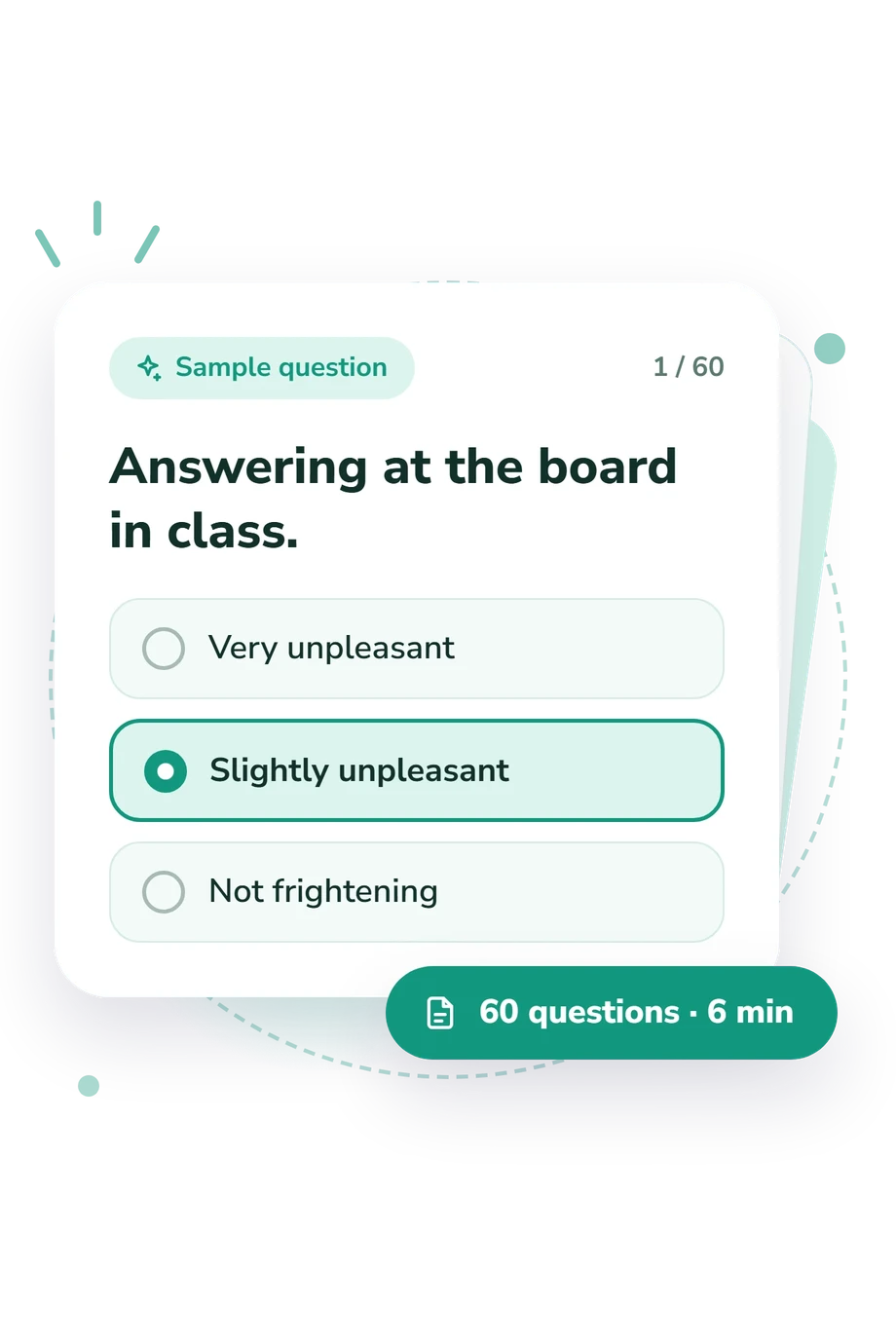
Each item describes a familiar situation and offers three reactions: "Very unpleasant," "Slightly unpleasant," or "Not frightening." This format asks for perceived emotional intensity, so the child should answer according to typical experience rather than a single exceptional moment. The item groups span school performance, self-evaluation, social contact, criticism, and frightening situations.
Responses are aggregated into the displayed dimensions and overall profile. The bands classify results within this questionnaire; they do not establish an additional cutoff or prove that every response contributes identically. Considering related situations together adds useful context to the child anxiety profile.
Conceptually, the item themes are consistent with the Prikhozhan Personal Anxiety Scale, Kondash’s fear and stage-fright scale, and Tarasova and Osnitsky’s 2015 school-anxiety research.
Context still matters: mood, recent events, honesty, and self-awareness can shift self-report, so interpretation benefits from broader observation and conversation. High scores may indicate a need for additional attention from adults, while very low scores may reflect unusually low anxiety or an atypical response pattern.
- Prikhozhan, Anna M. Anxiety in Children and Adolescents: Psychological Nature and Age Dynamics. Moscow: Moscow Psychological and Social Institute; Voronezh: MODEK, 2000. 304 pp. ISBN 5-89502-089-5.
- Kondash, Ondrej. The Scale of Classical, Social-Situational Fear and Stage Fright. Bratislava: Psychodiagnostika, 1973.
- Tarasova, Svetlana Yu., and Alexey K. Osnitsky. Psychophysiological and Behavioral Indicators of School Anxiety. Psychological Science and Education, 20(1), 2015, 59-68. 10.17759/pse.2015200107
Updated: