
MLB Stadium Quiz
How the Scales are Structured
Who Usually Takes This Test?
See How You Compare
Below is a preview of how scores are typically distributed across each scale.
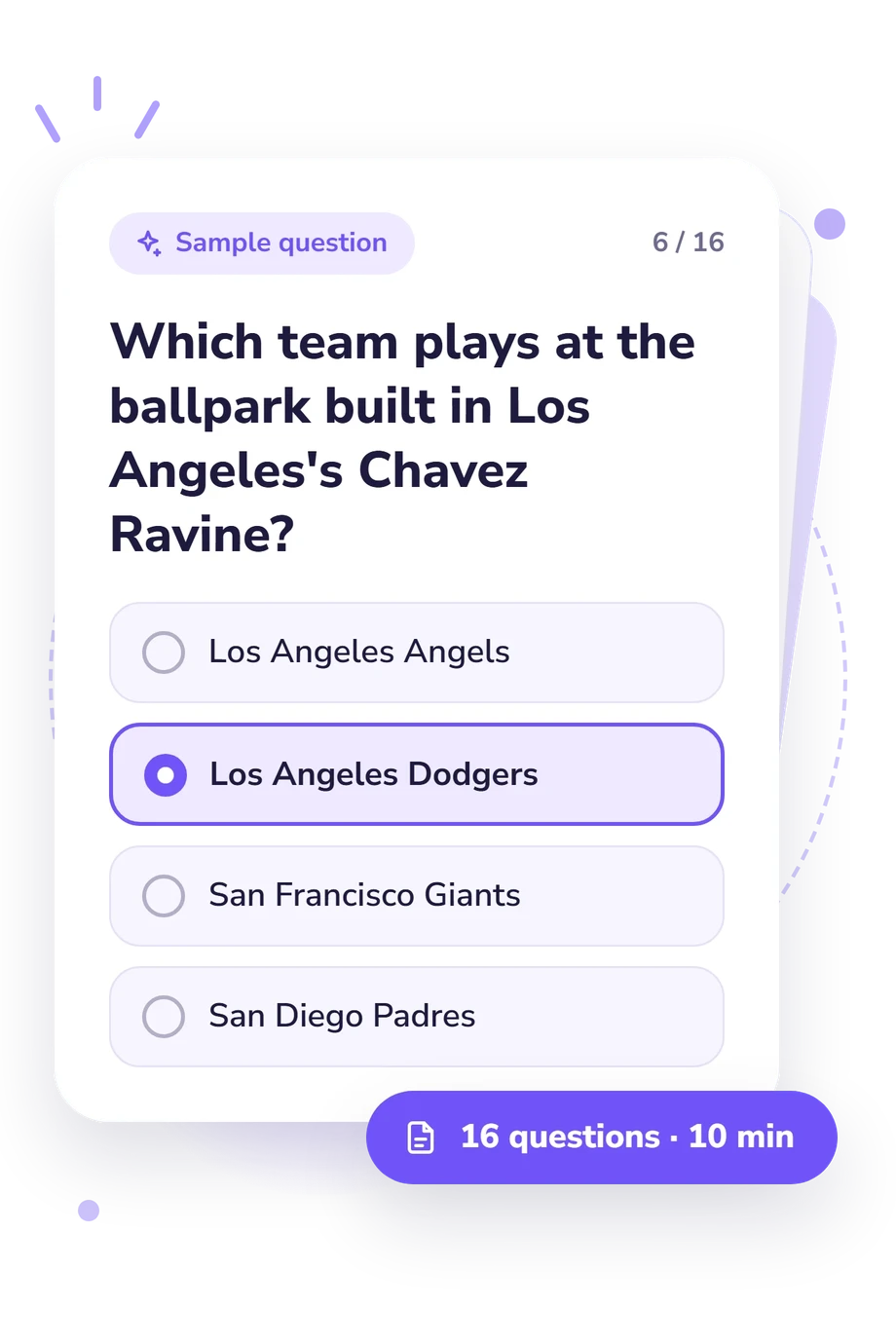
Example Questions From the Test
- Cincinnati Reds
- Washington Nationals
- Pittsburgh Pirates
- Minnesota Twins
- Dodger Stadium
- Fenway Park
- Kauffman Stadium
- Angel Stadium
- Oakland Athletics
- San Diego Padres
- San Francisco Giants
- Los Angeles Dodgers
MLB Stadium Quiz - Description and methodology of the test
For fans who enjoy connecting baseball history with the places where it is played, the MLB Stadium Quiz turns ballpark recognition into a focused knowledge check. Fans can approach it as an MLB ballpark quiz that rewards attention to unusual dimensions, city views, historic structures, and team traditions. The result shows whether your recall is developing, well established, or broad across MLB’s varied venues.
What This Assessment Explores
It measures physical, geographic, and historical clues that distinguish one major-league venue from another. Prompts connect roof designs, walls, rivers, bridges, skylines, altitude, historic buildings, and club traditions with the correct team. As a baseball stadium quiz, it tests applied recall: you identify a venue by interpreting its setting rather than naming an isolated fact.
The themes contributing to the result are:
- Design and dimensions show whether you connect roof systems, wall shapes, field geometry, and unusual structures with a park.
- Place and surroundings indicate how well you recognize rivers, bridges, downtown views, elevation, and neighboring spaces.
- History and signature features reveal recall of older venues, franchise landmarks, ivy, trains, fountains, coves, and preserved buildings.
The themes suit fans and students of the game. MLB Stadium Knowledge runs from 0-16: Building the Foundation (0-6), Informed Ballpark Fan (7-12), and Stadium Standout (13-16).
Methodology and Scientific Basis
Each item presents a clue and four possible clubs. You choose one answer, producing a right-or-wrong total rather than separate subscores. This is a criterion-referenced multiple-choice knowledge quiz: it checks recognition against the intended answer, not a psychological trait. A ballpark trivia quiz of this kind rewards memory, visual association, and familiarity with baseball places.
Conceptually, the content is consistent with Big League Ballparks (Gillette et al., 2009), which presents major-league parks as historical, architectural, and cultural objects. MLB’s park chronology supports questions about active venues and opening dates, while Paul Goldberger and Stuart Shea reinforce how parks fit their cities and preserve traditions. The questionnaire is not a direct adaptation of any one published instrument.
No normative sample or psychometric standardization is stated, so the displayed bands are descriptive rather than population-based. Team familiarity, travel, recent viewing, and guessing can affect performance. A strong result indicates accurate venue recognition, while a lower result identifies topics to explore rather than a fixed limit on knowledge. Self-administered responses also depend on honest attention to each clue.
- Gillette, Gary, Eric Enders, Stuart Shea, and Matthew Silverman. Big League Ballparks: The Complete Illustrated History. New York: Metro Books, 2009. ISBN 9781435114524.
- Major League Baseball. MLB Parks from Oldest to Newest., September 28, 2025.
- Goldberger, Paul. Ballpark: Baseball in the American City. New York: Alfred A. Knopf, 2019. ISBN 9780307701541.
- Shea, Stuart. Wrigley Field: The Long Life and Contentious Times of the Friendly Confines. Revised ed. Chicago: University of Chicago Press, 2014. 10.7208/chicago/9780226134307.001.0001.
Updated: