
Metacognitive States Questionnaire (SMI) Test
How the Scales are Structured
Who Usually Takes This Test?
See How You Compare
Below is a preview of how scores are typically distributed across each scale.
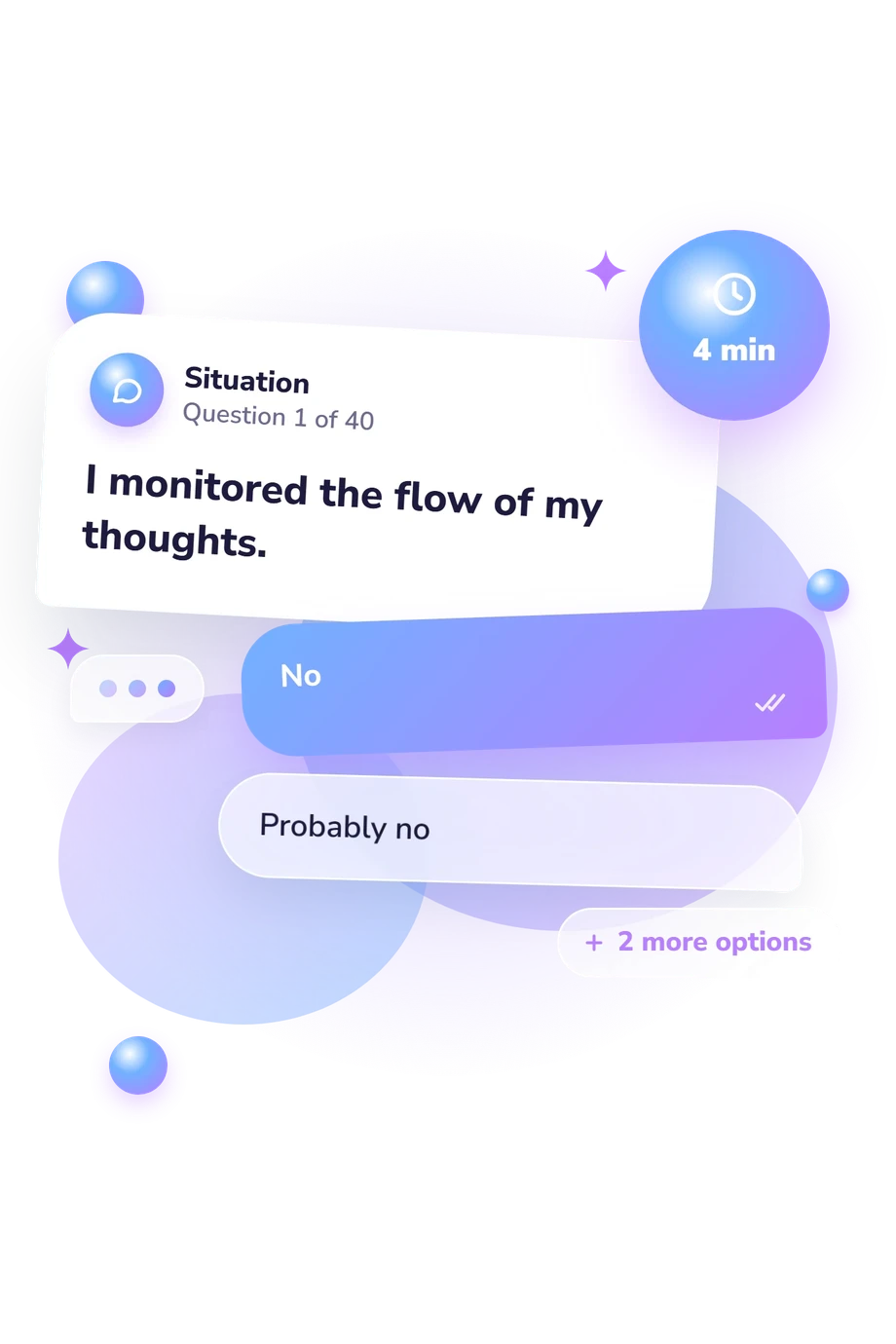
Example Questions From the Test
- No
- Probably no
- Probably yes
- Yes
- No
- Probably not
- Probably yes
- Yes
- No
- Probably no
- Probably yes
- Yes
Metacognitive States Questionnaire (SMI) Test - Description and methodology of the test
People who want to understand how they regulate thinking while working through tasks may find the Metacognitive States Questionnaire (SMI) Test useful for a snapshot of their cognitive habits. This metacognitive assessment focuses on awareness, control, and purposeful action, helping respondents notice strengths in monitoring, concentration, strategy selection, and planning. The result is best read as a profile of task-related tendencies that can guide reflection on how they approach demanding work.
What This Assessment Explores
These items examine metacognitive activity during tasks: noticing thoughts, checking understanding, organizing information, choosing methods, and anticipating demands. The questionnaire offers a practical way to examine metacognitive skills and self-regulation. Its four scales are:
- Self-Monitoring (5-20) shows how a respondent monitors and evaluates actions: Low self-check (5-9), Moderate self-check (10-15), or High self-check (16-20).
- Task Engagement (5-20) shows involvement and concentration in the activity: Low engagement (5-10), Moderate engagement (11-15), or High engagement (16-20).
- Use of Strategies (5-20) shows active use of approaches to solve tasks and reach goals: Limited strategy use (5-9), Moderate strategy use (10-15), or Strong strategy use (16-20).
- Action Planning (5-20) shows advance planning and outcome anticipation: Low planning (5-9), Moderate planning (10-14), or High planning (15-20).
Together, they indicate how actively a person monitors, engages, adapts, and plans while working.
Methodology and Scientific Basis
Each statement asks respondents to rate an experience on four ordered choices, from No to Yes, with two intermediate levels. Items cluster around monitoring, engagement, strategies, and planning; each scale addresses a distinct aspect of task-related metacognition.
Displayed ranges translate self-reports into bands; higher scores indicate more of each named tendency. This metacognitive questionnaire describes a cross-domain pattern: an uneven profile may show where attention, strategy use, or planning is easier or harder to sustain.
Its closest comparison is the State Metacognitive Inventory (O'Neil & Abedi, 1996), a comparison for state metacognitive activity; findings from that inventory do not establish this questionnaire's validity. Flavell's framework also views metacognition as monitoring and regulating cognitive processes. This relationship is conceptual: the online questionnaire is neither that inventory nor a validated adaptation.
This questionnaire has no stated normative sample or reported reliability estimate, so its bands are descriptive rather than diagnostic. Results may shift with task demands, fatigue, stress, motivation, and self-report accuracy; they are best used to examine habits and possible areas for practice.
- O'Neil, H. F., Jr., & Abedi, J. (1996). Reliability and validity of a state metacognitive inventory: Potential for alternative assessment. The Journal of Educational Research, 89(4), 234-245. 10.1080/00220671.1996.9941208
- Flavell, J. H. (1979). Metacognition and cognitive monitoring: A new area of cognitive-developmental inquiry. American Psychologist, 34(10), 906-911. 10.1037/0003-066X.34.10.906
Updated: