
LSAT Practice Quiz
How the Scales are Structured
Who Usually Takes This Test?
See How You Compare
Below is a preview of how scores are typically distributed across each scale.
Example Questions From the Test
- Only neighborhood garden proposals received community grants.
- Every neighborhood garden proposal was reviewed by the panel.
- Some neighborhood garden proposals were not submitted late.
- Some late proposals received grants without panel review.
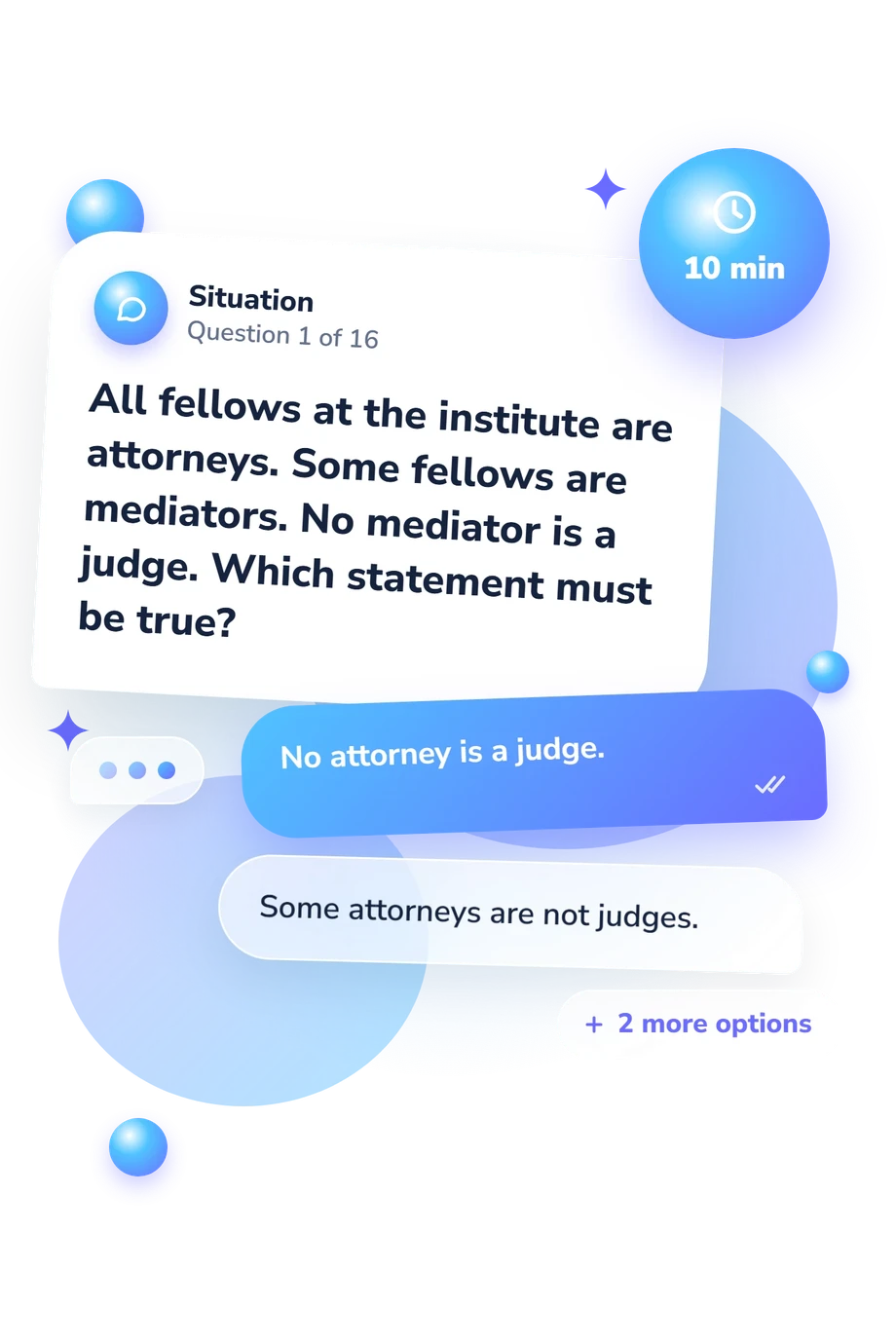
- No attorney is a judge.
- Some attorneys are not judges.
- Every attorney at the institute is a fellow.
- Some judges are neither fellows nor attorneys.
- It assumes that no unsuccessful appeal can contain a well-written argument.
- It treats a condition required for success as though that condition were sufficient to guarantee success.
- It concludes that controlling precedent is never open to interpretation.
- It confuses the timing of the appeal with the timing of the cited precedent.
LSAT Practice Quiz - Description and methodology of the test
Students who want a focused way to review performance on reasoning and reading tasks can use the LSAT Practice Quiz before planning study. It is suitable for learners exploring law-school admissions preparation as well as anyone refreshing analytical reading and argument analysis. This LSAT quiz concentrates on how you reach an answer, not on memorizing legal facts.
What This Assessment Measures
The questions sample core reasoning moves rather than legal doctrine. They ask readers to identify what must follow, recognize flawed conditional reasoning, match argument structure, evaluate assumptions, and separate evidence from conclusions. Other items address causal claims, sampling, principles, objections, and apparent discrepancies. This LSAT pop quiz samples the reasoning and reading skills described here, making it useful for checking whether analytical reading remains precise.
The result is reported on the LSAT Knowledge scale, with these bands:
- Foundational (0-6) means you are beginning to identify argument structure, logical relationships, and passage claims; focus on separating conclusions from evidence and testing what must follow.
- Developing (7-12) means you handle many common reasoning tasks, while slower diagramming and closer attention to scope may help.
- Strong (13-16) means you showed consistent command of the reasoning and reading tasks sampled here.
Methodology and Evidence Base
Each item presents a short stimulus or rule followed by four answer choices, with one option best supported by the wording. The mix samples several reasoning tasks, and the questionnaire reports a result in the displayed bands, which describe this item set and are neither an official LSAT score nor a validated predictor.
These themes are conceptually consistent with the official LSAT framework, especially its emphasis on reading comprehension and analytical reasoning. Official LSAT SuperPrep materials provide a reference for question style and practice orientation, but this questionnaire is not a reproduced official section. This LSAT prep quiz can support targeted review of how arguments use evidence and assumptions.
Research by Linn, Harnisch, and Dunbar examined how admissions-test performance relates to first-year law-school grades across settings. This LSAT mini quiz is most useful for deciding whether to revisit conditional logic, argument roles, assumptions, or evidence evaluation.
- Walzer, Mark; Dustman, Kimberly; Langer, Debra; Hegarty, Michael; Camilli, Gregory; and Gallagher, Ann. LSAC 2018 Skills Analysis Study: Content Validity of the LSAT. LSAC Research Report RR 19-01. Newtown, PA: Law School Admission Council, 2019.
- Law School Admission Council. The Official LSAT SuperPrep. Newtown, PA: Law School Admission Council, 2007. ISBN 9780979305061.
- Linn, Robert L.; Harnisch, Delwyn L.; and Dunbar, Stephen B. Validity Generalization and Situational Specificity: An Analysis of the Prediction of First-Year Grades in Law School. Applied Psychological Measurement, 5(3), 281-289, 1981. DOI 10.1177/014662168100500301
Updated: