
Logical Fallacies Quiz
How the Scales are Structured
Who Usually Takes This Test?
See How You Compare
Below is a preview of how scores are typically distributed across each scale.
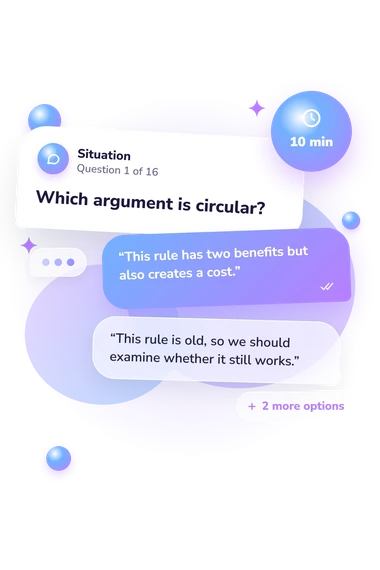
Example Questions From the Test
- The manager attacks the people who disagree
- The manager presents only two possibilities when others may exist
- The manager relies on the plan's popularity
- The manager assumes that sequence proves causation
- A flaw in reasoning that weakens an argument
- Any factual statement that turns out to be false
- A conclusion that most listeners dislike
- Any argument expressed with strong emotion
- False equivalence
- Appeal to emotion
- Appeal to ignorance
- Anecdotal fallacy
Logical Fallacies Quiz - Description and methodology of the test
People who want to examine how they evaluate claims, explanations, and disagreements can use this logical fallacies quiz as a focused check of argument analysis. It is suitable for learners, educators, and curious readers who want to distinguish weak reasoning from merely unpopular conclusions. Used as a logical fallacies practice quiz, this assessment can show which concepts deserve review, without turning performance into a judgment about intelligence.
What This Assessment Explores
The assessment examines reasoning patterns that weaken an argument, even when its conclusion is true. The scenarios cover rules, advertising, policy, schoolwork, money, and disagreements. This logical fallacies test focuses on recognizing patterns in context rather than judging whether you agree.
The items cover these dimensions:
- Relevance errors show whether a response distracts from the issue.
- Ambiguity and misrepresentation show whether wording shifts meaning or distorts a position.
- Generalization and causal errors show whether a conclusion exceeds evidence or treats sequence as proof of cause.
- Unsupported assumptions show whether an argument relies on popularity, authority, ignorance, or another weak link.
The scale is Logical Fallacies Knowledge (0-16), summarizing accuracy in recognizing and analyzing these fallacies. Foundational (0-6) indicates core concepts need review; Developing (7-12) indicates many distinctions, with subtle cases still challenging; Strong (13-16) indicates consistent, accurate application in context.
Methodology and Scientific Basis
The response format is multiple choice: each scenario presents an argument or exchange followed by four options. Choosing an answer requires matching a reasoning pattern to its context, not reacting to whether a conclusion sounds agreeable. The total score reflects performance on these questions; weighting is not stated.
This fallacy identification quiz is conceptually consistent with the Argumentation Fallacies and Structures Test (A-FaST), which examines recognition of argument structures and fallacies. It is not A-FaST or a validated adaptation. Its terminology also fits the informal-logic approach of Blair and Johnson and Walton’s classification of relevance fallacies. These sources clarify themes such as distraction, misrepresentation, irrelevant appeals, and unsupported connections, but they do not establish reliability or validity for this online questionnaire.
Interpret the result as a learning snapshot: review missed concepts, compare similar errors, and examine how premises support conclusions. Performance can vary with prior study, attention, wording, and current context. The result describes performance on these questions, so it should not be read as a population-normed estimate of reasoning ability or debate skill.
- Berkle, Yvonne, Lukas Schmitt, Antonia Tolzin, Andreas Janson, Thiemo Wambsganss, Jan Marco Leimeister, and Miriam Leuchter. “Measuring university students’ ability to recognize argument structures and fallacies.” Frontiers in Psychology 14 (2023): 1270931. 10.3389/fpsyg.2023.1270931
- Blair, J. Anthony, and Ralph H. Johnson. “Informal logic: an overview.” Informal Logic 20, no. 2 (2000): 93-107. 10.22329/il.v20i2.2262
- Walton, Douglas N. “Classification of fallacies of relevance.” Informal Logic 24, no. 1 (2004): 71-103. 10.22329/il.v24i1.2133