
License Plate Quiz
How the Scales are Structured
Who Usually Takes This Test?
See How You Compare
Below is a preview of how scores are typically distributed across each scale.
Example Questions From the Test
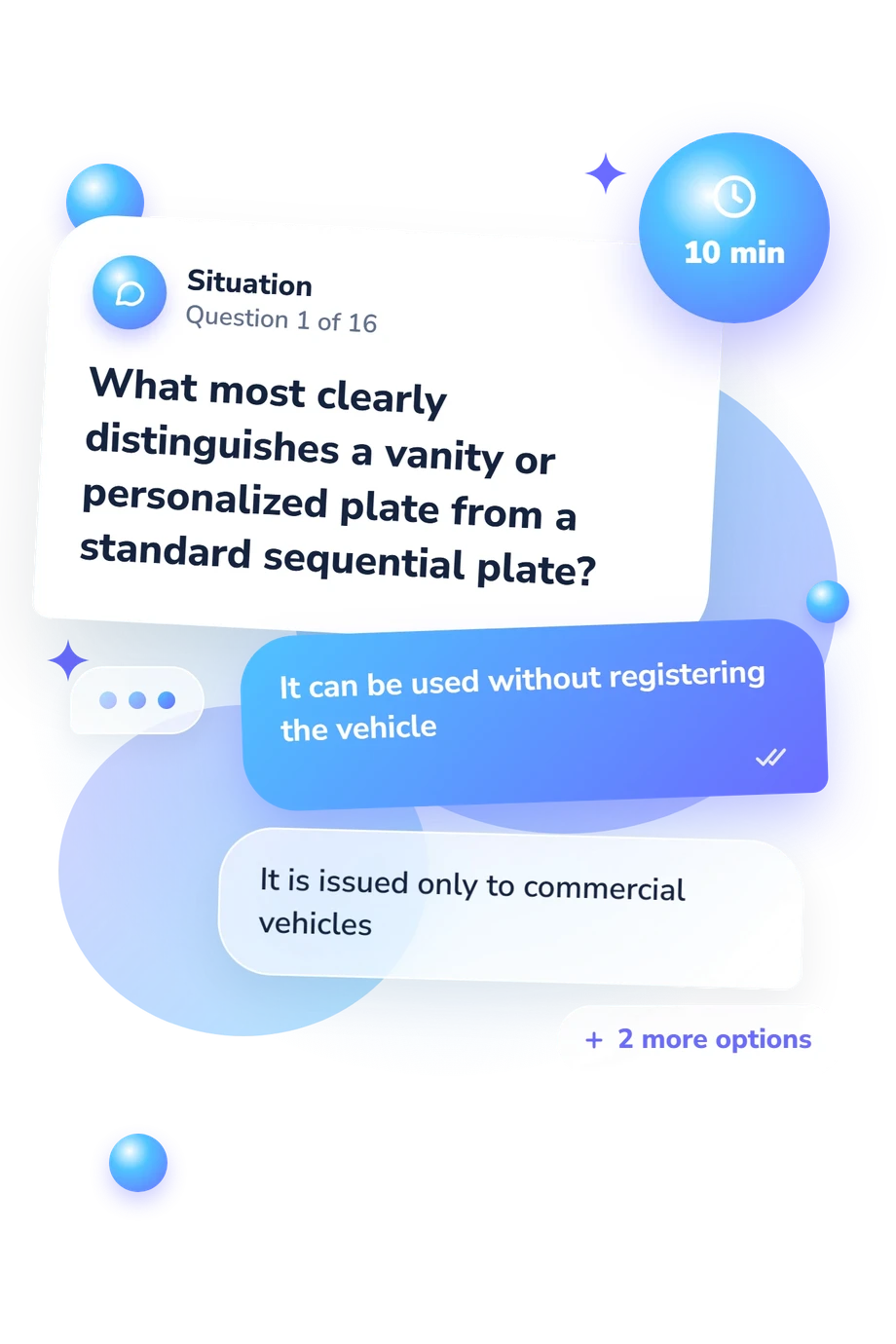
- It can be used without registering the vehicle
- It is issued only to commercial vehicles
- Its characters never include numbers
- Its available character sequence is selected by the applicant
- Mexico
- Guatemala
- United States
- Costa Rica
- Ireland
- Denmark
- The Netherlands
- Germany
License Plate Quiz - Description and methodology of the test
Travelers, drivers, geography learners, and curious readers can use this license plate quiz to build a clearer framework for reading unfamiliar vehicle markings. It suits people who want to connect plate terminology with issuing jurisdictions, country signs, and registration situations. A quiz about state license plates adds practical regional context, while the result gives a focused snapshot of current recognition knowledge.
What This Assessment Explores
The questionnaire tests whether you can recognize the systems and clues that make a vehicle plate meaningful, rather than recall isolated designs. It covers terminology, issuing jurisdictions, geographic relationships, international distinguishing signs, and common registration situations. The intended reader is anyone interested in travel, geography, driving, or vehicle identification.
The displayed License Plate Knowledge scale runs from 0-16 correct. Starting Out covers 0-6, Developing Knowledge covers 7-12, and Plate Expert covers 13-16. These bands describe how readily your answers connect plate features with the places and rules they represent.
The main question groups are:
- Plate formats show whether you distinguish standard, vanity, specialty, and temporary designs.
- Jurisdiction clues measure how accurately you connect state, province, district, or Mexican regional names with locations.
- International and registration clues show whether you interpret country signs, abbreviations, displayed numbers, and temporary tags.
International examples appear alongside a quiz covering US license plates, so the result reflects more than familiarity with one national system alone.
Methodology and Evidence Base
Each item presents four answer options in a structured multiple-choice knowledge assessment for a recognition or interpretation task. Topics include plate terminology, national and subnational jurisdictions, international distinguishing signs, abbreviations, and temporary registration. The score is based on the number of correct responses and the displayed bands describe the level associated with that total.
Parker and Weeks (2004) provide the closest reference for plate formats and jurisdiction markings. The questionnaire is conceptually consistent with that work, but it is not an adaptation of their publication. The Vienna Convention supports the treatment of international distinguishing signs, while United States Postal Service standards support the use of US two-letter abbreviations. Gurney, Rhead, and Martin (2022) provide context on layout and automated recognition, not validation of this questionnaire.
The assessment functions as a vehicle registration quiz: it is descriptive rather than a standardized, norm-referenced scale for this version. A higher band means more correct plate facts, not expertise in transport law or identification. Travel experience, memory, language familiarity, and attention to wording can affect performance, so the result is a snapshot of knowledge.
- Parker, Neil A., and John Weeks. Registration Plates of the World. 4th ed. Taunton, Somerset, UK: Europlate, 2004. ISBN 0-9502735-7-0.
- United Nations. Convention on Road Traffic, Vienna, 8 November 1968. United Nations Treaty Series, vol. 1091, 1977.
- United States Postal Service. Publication 28: Postal Addressing Standards. Appendix B: Two-Letter State and Possession Abbreviations. Washington, DC: USPS, October 2024.
- Gurney, Robert, Michael Rhead, and William E. Martin. The Effect of Number Plate Layout and Design on Automated Recognition. 2022 IEEE International Carnahan Conference on Security Technology (ICCST), IEEE, 2022, pp. 1-6. 10.1109/ICCST52959.2022.9896522.
Updated: