
Larynx Anatomy Quiz
How the Scales are Structured
Who Usually Takes This Test?
See How You Compare
Below is a preview of how scores are typically distributed across each scale.
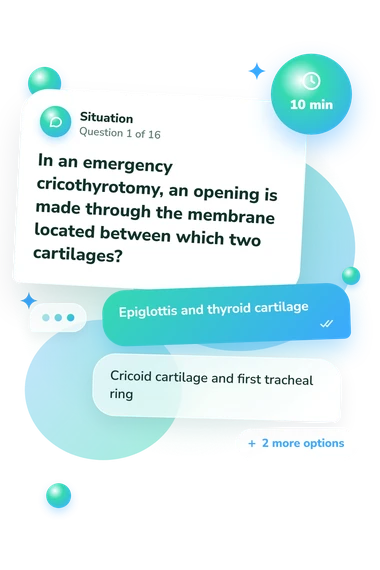
Example Questions From the Test
- Epiglottis and thyroid cartilage
- Cricoid cartilage and first tracheal ring
- Thyroid and arytenoid cartilages
- Thyroid and cricoid cartilages
- Arytenoid cartilages
- Cuneiform cartilages
- Corniculate cartilages
- Thyroid cartilages
- Lateral cricoarytenoid
- Posterior cricoarytenoid
- Transverse arytenoid
- Thyroarytenoid
Larynx Anatomy Quiz - Description and methodology of the test
Students, trainees, and curious readers who want to strengthen applied anatomy can use this larynx anatomy quiz to decide which relationships among structures, movements, and nerve pathways deserve closer review. The quiz on the anatomy of the larynx asks you to connect each structure with its function, giving focused direction for further study.
What This Assessment Explores
The assessment treats the larynx as an integrated system. It checks cartilages, fold position and lining, airway spaces, muscles, and sensory and motor nerve branches. Some items place facts in clinical-style situations involving airway access, vocal-fold movement, sensation, or pitch. This makes the anatomy of the larynx quiz useful for learners reviewing head and neck anatomy and checking whether terms connect to function.
Four areas shape the result:
- Cartilages and spaces show how well you orient the framework and openings.
- Folds and epithelium show whether you distinguish vocal structures and coverings.
- Muscles and movement show understanding of abduction, adduction, tension, and pitch.
- Nerves and applied relationships show how branches produce sensory or motor effects.
Larynx Anatomy Knowledge is scored from 0-16: Foundations to review (0-6), Developing knowledge (7-12), and Strong knowledge (13-16). These bands summarize tested performance and do not establish clinical competence.
Methodology and Evidence Base
Each of the laryngeal anatomy questions presents one problem with four answer choices. One point is awarded for each correct answer, so the total reflects answer accuracy rather than clinical importance. The items combine direct identification with functional application, asking the reader to connect structure, movement, innervation, and airway protection.
Moore's anatomy text supplies the core relationships involving cartilages, folds, spaces, muscles, and nerve pathways. A study by Sanders and colleagues examines human laryngeal innervation, while Brancatisano and colleagues provide evidence on the respiratory role of the posterior cricoarytenoid and vocal-fold behavior. The questionnaire is conceptually consistent with these sources, but it is not a reproduction or validated adaptation of any one published instrument.
The questions emphasize links among nerve territories, muscle actions, fold position, and airway spaces that learners often need to review. Results are best used as a study signal, directing review toward relationships that caused uncertainty. Performance may vary with prior coursework, recall, and interpretation of a four-choice item, and the quiz cannot measure hands-on dissection or examination technique.
- Moore, Keith L., Arthur F. Dalley II, and Anne M. R. Agur. Moore's Clinically Oriented Anatomy. 9th ed. Wolters Kluwer, 2023.
- Sanders, Ira, B. L. Wu, L. Mu, Y. Li, and H. F. Biller. "The innervation of the human larynx." Archives of Otolaryngology-Head & Neck Surgery 119, no. 9 (1993): 934-939. 10.1001/archotol.1993.01880210022003.
- Brancatisano, T. P., D. S. Dodd, and L. A. Engel. "Respiratory activity of posterior cricoarytenoid muscle and vocal cords in humans." Journal of Applied Physiology 57, no. 4 (1984): 1143-1149. 10.1152/jappl.1984.57.4.1143.
Updated: