
Jung Typology Quiz
How the Scales are Structured
Who Usually Takes This Test?
See How You Compare
Below is a preview of how scores are typically distributed across each scale.
Example Questions From the Test
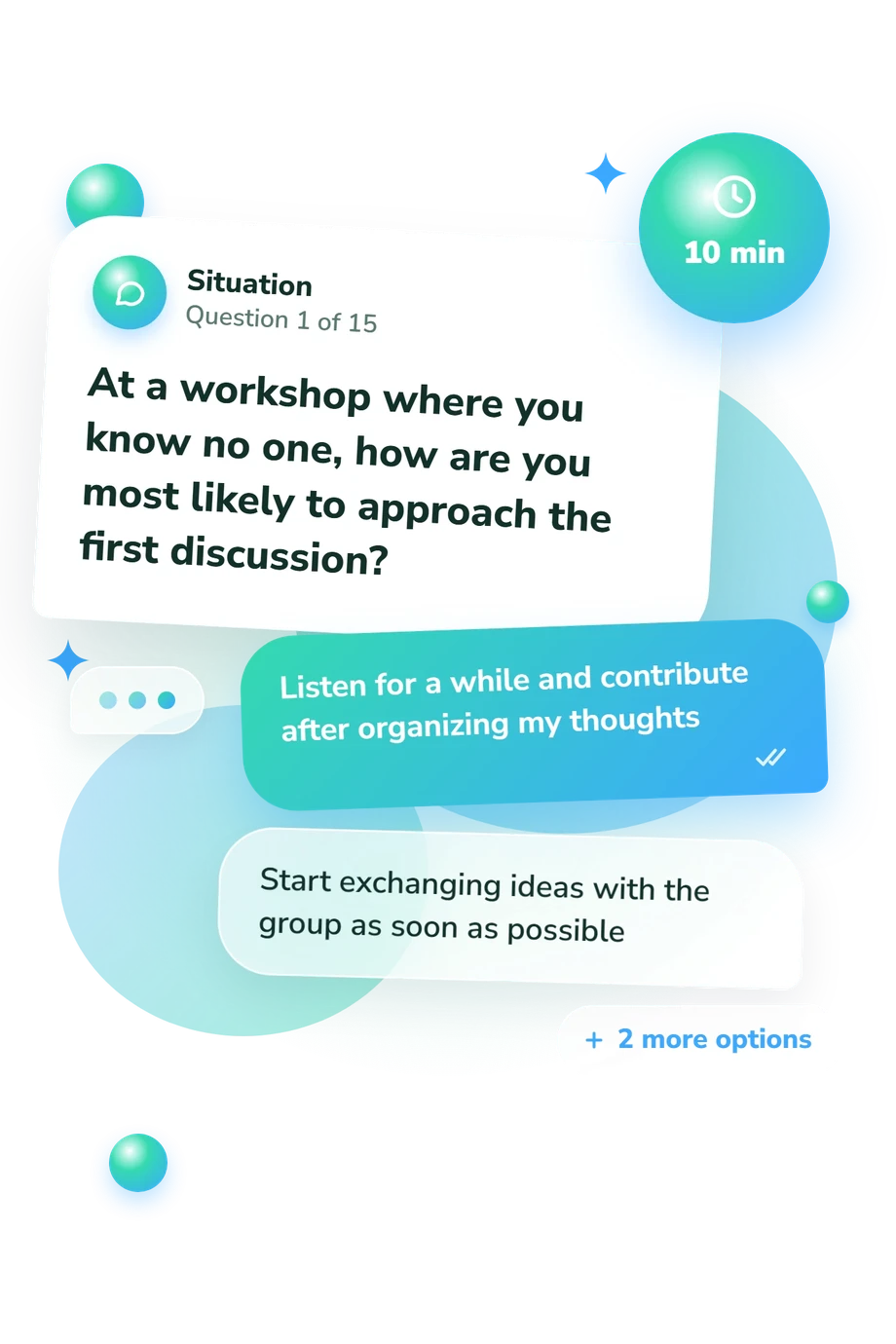
- Listen for a while and contribute after organizing my thoughts
- Start exchanging ideas with the group as soon as possible
- Formulate my view privately before deciding whether to share it
- Talk with one nearby participant before addressing the group
- Preserving their dignity and connecting the conversation to what matters to them
- Stating the performance gap directly and applying the same standard used for others
- Explaining the consequences of the gap and identifying the most efficient correction
- Addressing the gap while adapting the conversation to their circumstances
- A casual outing with one or two familiar people
- A largely solitary day with plenty of uninterrupted space
- A lively event where I can meet and interact with many people
- A quiet activity with limited, low-key social contact
Jung Typology Quiz - Description and methodology of the test
For readers seeking language for habitual preferences, the Jung Typology Quiz organizes reflection on social energy, perception, and judgment. This Jungian personality quiz is intended for everyday self-exploration when familiar choices feel easier to notice than to explain. Results connect ordinary situations with a compact three-part profile, showing how you tend to draw energy, notice information, and weigh decisions.
What This Assessment Explores
The questionnaire examines three preference contrasts associated with Jung’s model. Scenarios cover groups, information, feedback, rules, and difficult choices. This Jung typology test describes recurring emphases rather than fixed abilities.
The result is organized into three dimensions:
- Extraversion-Introversion Orientation (0-15) shows whether outward activity or inward processing usually restores energy: Outward orientation 0-5, Contextual balance 6-10, Inward orientation 11-15.
- Sensation-Intuition Perception (0-15) shows whether attention favors observable details or wider possibilities: Concrete Perception 0-5, Integrated Perception 6-10, Pattern Perception 11-15.
- Thinking-Feeling Judgment (0-15) shows whether decisions favor consistent criteria or personal values and relationships: Principle-Led 0-5, Contextual 6-10, Values-Led 11-15.
These bands describe emphasis, not intelligence, sociability, creativity, kindness, or emotional control.
Methodology and Scientific Basis
Each item presents an everyday situation with four response options. The choices contrast social contact, private reflection, concrete evidence, broader patterns, logical consistency, and personal circumstances. You select the option that best matches your usual response.
Responses produce three separate results on the displayed continua. Lower and higher positions represent contrasting emphases, while middle ranges indicate a context-dependent balance between them. The output is a profile rather than a single overall type, so this Jung personality test is best read as a lens for comparing tendencies rather than fixed identities.
The questionnaire is conceptually consistent with the Jung Psychological Types Scale (Sato, 2005), but it is not presented as an adaptation of that instrument. Woehlke and Piper (1980) examined the factorial structure of a type survey, Gray (1947) addressed consistency and meaning in questionnaire responses, and Jung (1921/1971) supplies the underlying distinctions. Together, these works provide conceptual context, not validation of this online questionnaire.
As a self-report tool, it can reflect circumstances, self-perception, and response style. The bands describe preference emphasis rather than fixed identity.
- Sato, Junichi. (2005). Construction of Jung Psychological Types Scale. The Japanese Journal of Psychology, 76(3), 203-210. 10.4992/jjpsy.76.203
- Woehlke, Paula L., and Roberta B. Piper. (1980). Factorial Validity of the Jungian Type Survey. Educational and Psychological Measurement, 40(4), 1051-1058. 10.1177/001316448004000432
- Gray, Horace. (1947). Jung's Psychological Types: Meaning and Consistency of the Questionnaire. The Journal of General Psychology, 37(2), 177-185. 10.1080/00221309.1947.9918149
- Jung, Carl Gustav. (1971). Psychological Types (H. G. Baynes, Trans., revised by R. F. C. Hull). In The Collected Works of C. G. Jung (Vol. 6). Princeton University Press. Original work published 1921.
Updated: