
Jewelry Quiz
How the Scales are Structured
Who Usually Takes This Test?
See How You Compare
Below is a preview of how scores are typically distributed across each scale.
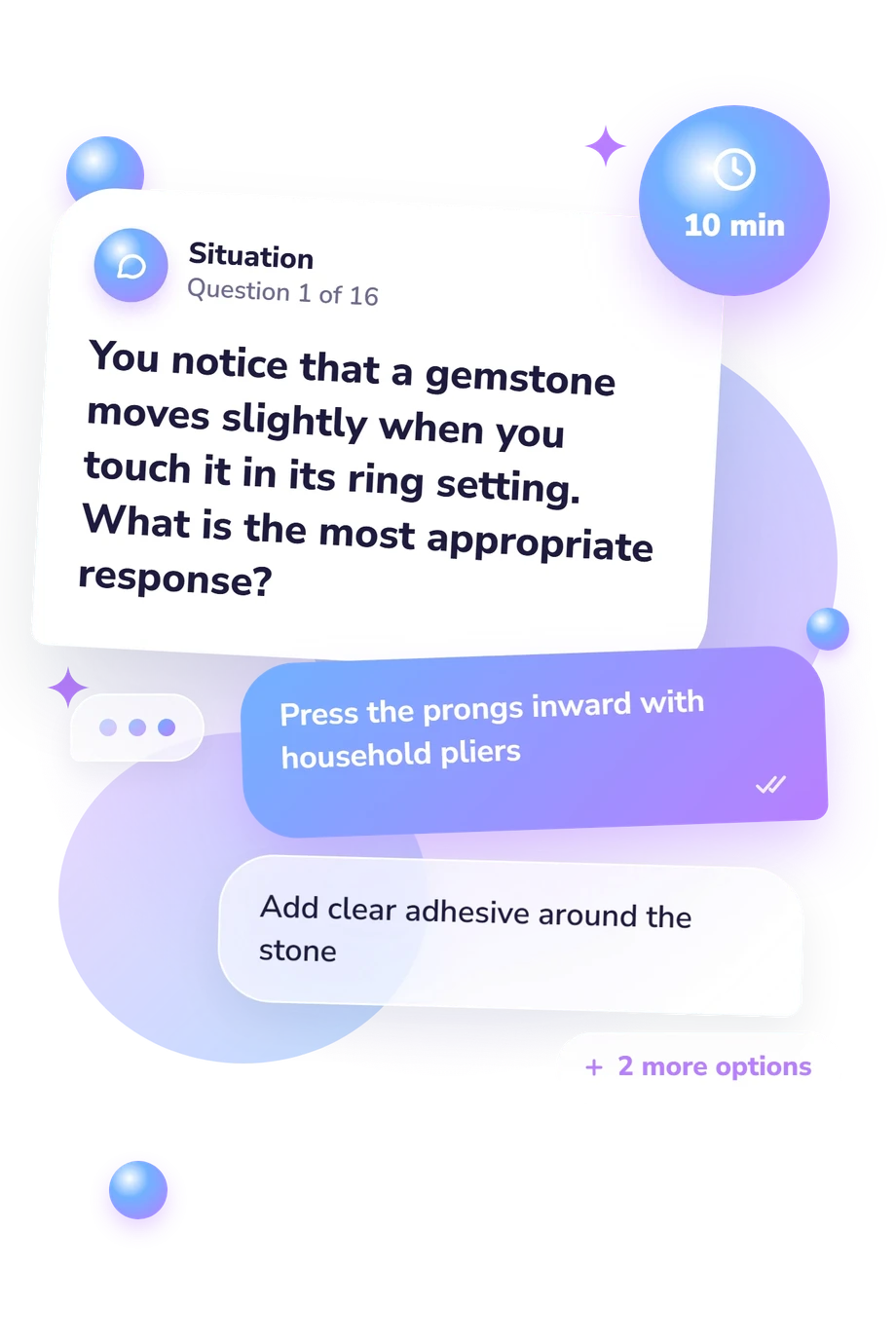
Example Questions From the Test
- Press the prongs inward with household pliers
- Add clear adhesive around the stone
- Continue wearing it but avoid getting it wet
- Stop wearing it and have the setting checked by a jeweler
- Quartz should scratch the diamond because quartz is more brittle
- Neither can scratch the other because both are gemstones
- Each should scratch the other equally
- Diamond should scratch quartz because diamond is harder
- Resistance to scratching
- Resistance to chipping from impact
- Optical transparency
- Weight relative to size
Jewelry Quiz - Description and methodology of the test
People seeking practical confidence with jewelry can use this jewelry quiz to check everyday understanding rather than personal taste. It suits shoppers, collectors, owners, and curious learners; the result gives a broad overall indication of jewelry knowledge across materials, gemstones, settings, terminology, and care. It indicates general performance on sampled topics without pinpointing a particular weakness.
What This Assessment Measures
Questions cover practical knowledge used to identify, handle, buy, or maintain jewelry. Materials, gemstones, settings, terminology, and care make it a useful check of knowledge about jewelry materials for readers preparing to buy, own, or develop a hobby.
The assessment reports one Jewelry Knowledge scale, scored from 0 to 16. It measures performance across these materials, gemstones, construction, terminology, and care. Foundations to Build (0-6) indicates recognized basics; Developing Expertise (7-12) reflects working knowledge; Jewelry-Savvy (13-16) indicates strong, broadly applicable knowledge.
These groups capture the emphasis:
- Materials and marks show how accurately you read purity standards, plating, alloys, and carat terms.
- Gemstones and hardness show how well you distinguish cuts, pearl types, and scratch resistance.
- Settings and construction show whether you recognize repair risks and safe handling.
- Care routines show how safely you approach cleaning, storage, knots, and vulnerable stones.
Methodology and Evidence Base
This applied multiple-choice assessment presents situations or definitions with four answer options and asks for the best response. Items address loose settings, tangled chains, Mohs hardness, alloy fineness, pearls, and gentle opal treatment.
One total is reported across the topics, and no separate subscores are shown. The questionnaire does not state how individual answers are weighted. Care-related items give the overall assessment a practical focus, while also covering jewelry care without creating an independent care result.
Conceptually, it aligns with the Jewelers' Manual for terminology, construction, metals, settings, and care. Read's Gemmology supports gemstone properties and pearls, while Gerberich's work on the Mohs scale is relevant to hardness. These sources support the concepts; the questionnaire is not their adaptation.
Interpret scores as a snapshot of sampled knowledge. The displayed bands describe performance on these questions and are not accompanied by population norms; individual answers, current context, and response bias can affect results, and valuable or damaged jewelry still needs a jeweler's inspection.
- Liddicoat, Richard Thomas, Jr., and Lawrence L. Copeland. (1967). The Jewelers' Manual, 2nd ed. Gemological Institute of America, Santa Monica, CA.
- Read, Peter G. (2005). Gemmology, 3rd ed. Elsevier Butterworth-Heinemann.
- Gerberich, William W., Roberto Ballarini, Eric D. Hintsala, Maneesh Mishra, Jean-Francois Molinari, and Izabela Szlufarska. (2015). Toward Demystifying the Mohs Hardness Scale. Journal of the American Ceramic Society, 98(9), 2681-2688. 10.1111/jace.13753
Updated: